
Learn and Master RealTest the Right Way
Free RealTest training that shows you how professional traders set up, script, and backtest their systems correctly.
- Clear orientation and setup so you know exactly how to start
- Practical scripting essentials explained with real examples
- Run, optimize, and interpret backtests without guesswork
- Build confidence before risking real capital

5.0 Rating

4.2Rating
Why You Need RealTest Launchpad
Most traders know they need backtesting… but few know how to do it properly. That’s where RealTest comes in. It’s one of the most powerful backtesting platforms available – but only if you know how to use it.
This free program gives you everything you need to get started with RealTest the right way, so you can:
-
Set up your data and environment quickly.
-
Write and test your first strategies with confidence.
-
Understand your backtest results without second-guessing.
-
Lay the foundation for building profitable trading systems.

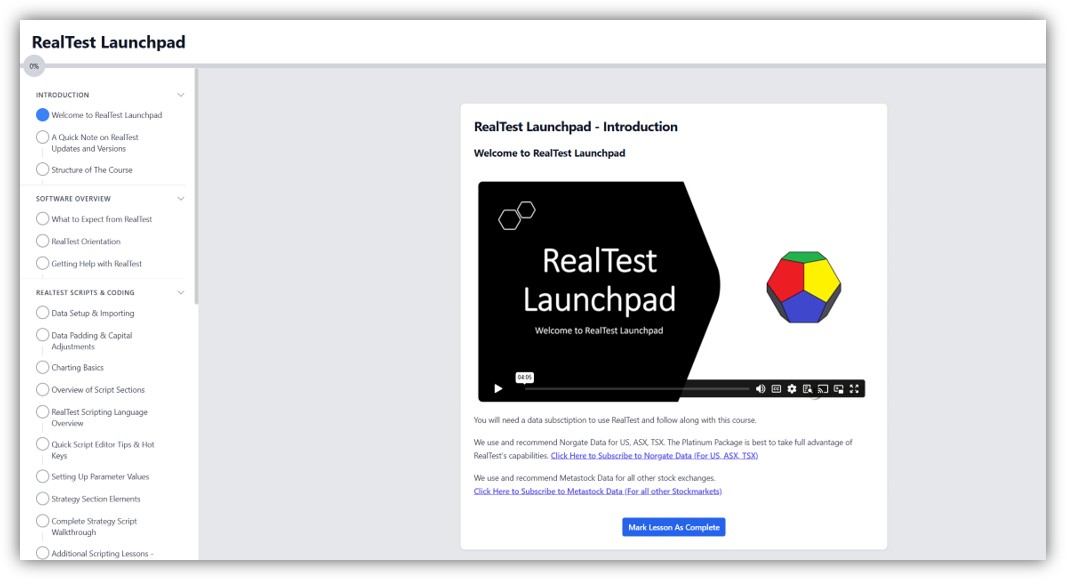
What You’ll Learn Inside
Here’s just a taste of what you’ll master in the RealTest Launchpad:
-
Orientation & Setup – Learn updates, versions, data import, and charting basics.
-
Scripting Essentials – Understand RealTest’s scripting language, hotkeys, parameter values, and strategy structure.
-
Backtesting Workflow – Run backtests, analyze results, and correctly separate in-sample vs. out-of-sample data.
-
Advanced Features – Stop/limit orders, time stops, capacity constraints, and order generation.
-
System Development – Optimize your strategy, build rotational momentum systems, and backtest multiple strategies.
-
Example Scripts – Walk through ready-to-use scripts so you can model and build from proven templates.
Everything is broken into short, focused lessons so you can progress fast without overwhelm.
Why This Matters
RealTest isn’t just another piece of software – it’s the engine behind professional systematic trading.
If you’re serious about trading with rules, you need to know how to:
-
Backtest correctly.
-
Avoid curve fitting.
-
Build confidence in your systems before risking real money.
By the time you finish this free course, you’ll have the skills to do exactly that.
Who This Is For
This program is perfect if you’re:
-
New to RealTest and want a step-by-step walkthrough.
-
Already dabbling with systematic trading but unsure if your backtests are reliable.
-
A discretionary trader ready to transition to rules-based, objective strategies.
-
Analytical, logical, and tired of wasting time figuring it out alone.
About Your Mentor
I’m Adrian Reid, Founder of Enlightened Stock Trading. I’ve been trading systematically for over 20 years, across stocks, ETFs, crypto, and global markets. I founded Enlightened Stock Trading in 2014 and since then I have mentored hundreds of traders worldwide to move from erratic, emotional trading to consistent, confident, rules-based success.
I created this course because too many traders waste time and get lost trying to set up and learn RealTest…. time that would be better spent on strategy development. You shouldn’t have to waste months figuring it out on your own, this course will get you started and confident in a mater of days!

Frequently Asked Questions about Realtest Course
What is an example of backtesting?
Alright, let’s dive into an example of backtesting. Imagine you’ve got a trading strategy that uses two moving averages to generate buy and sell signals. Here’s how you’d go about backtesting it:
- Define Your Strategy: First, clearly outline the rules of your strategy. For instance, you might decide to buy when the short-term moving average crosses above the long-term moving average and sell when it crosses below.
- Choose Your Software: Use backtesting software to input your strategy. This software will apply your rules to historical market data.
- Run the Backtest: The software will simulate all the trades your strategy would have made over a specified period, generating buy and sell signals based on your moving average rules.
- Analyze the Results: Look at the performance metrics like compound annual return, drawdown, percentage of winning trades, and average win/loss size. This helps you understand how your strategy would have performed historically.
- Refine and Validate: Check if the strategy is robust across different market conditions and parameter values. Ensure it wasn’t just a fluke by testing various combinations of moving averages.
This process helps you determine if your strategy is worth trading in real-time. If it didn’t perform well in the past, it’s unlikely to succeed in the future .
What is the difference between AmiBroker and RealTest?
AmiBroker and RealTest are both powerful tools for backtesting and trading system development, but they have some key differences:
- Ease of Use: RealTest is generally easier to program and backtests faster than AmiBroker. It allows for multi-system backtests and can generate orders across multiple systems in a single step, which is a significant advantage for traders looking to streamline their processes .
- Charting and Technical Analysis: AmiBroker offers more advanced charting and technical analysis capabilities compared to RealTest. While RealTest is designed primarily for algorithmic trading strategies, its charting functionality is more rudimentary .
- Community and Support: AmiBroker has a larger user base and more community support, which can be beneficial for new users seeking help and resources. RealTest, being relatively new, has a smaller community, which might mean less readily available support .
- Cost and Performance: Both platforms are cost-effective, but RealTest is noted for its ability to handle multi-system portfolios and optimize capital allocations between systems efficiently. AmiBroker, on the other hand, is known for its speed and affordability, making it a top choice for many traders .
Ultimately, the choice between AmiBroker and RealTest may depend on your specific needs, such as the importance of charting capabilities versus ease of programming and backtesting speed . If you’re exploring these platforms, consider what aspects are most critical for your trading strategy.
Is backtesting worth it?
Absolutely, backtesting is worth it. It’s one of the most powerful tools in your trading toolbox if you use it correctly. Backtesting allows you to apply your trading system rules to historical data, generating buy and sell signals that would have occurred in the past. This process gives you valuable performance statistics like compound annual return, drawdown, and win/loss ratios .
The real value of backtesting lies in its ability to show whether your strategy was profitable in the past. If it wasn’t, it’s unlikely to be profitable in the future. Conversely, if it was profitable, there’s a chance it might continue to be so. Backtesting helps eliminate unprofitable systems and builds confidence in your strategy by revealing how it performs across different market conditions .
Without backtesting, you’re essentially trading blind, hoping your strategy works without any evidence. It’s not just about finding the best historical performance, it’s about ensuring your strategy is robust and adaptable to future market conditions. So, yes, backtesting is definitely worth the effort .
How many trades are good for backtesting?
To get reliable results from backtesting, you generally need a substantial number of trades. Ideally, you should aim for at least 500 to 1,000 trades to start understanding a system’s performance . This amount of data helps ensure that your backtest results are statistically significant and not just a result of random chance or overfitting to past data .
If your system is complex with many rules, you’ll need even more trades to validate it properly. The more rules you have, the more data you need to avoid overfitting . Backtesting over a long period, like 30 years, across a wide universe of stocks, can provide a comprehensive evaluation of your trading systems .
Remember, the goal is to test through various market conditions bull, bear, and sideways markets to get a true sense of how your system performs .
How do I backtest my own strategy?
To backtest your own strategy effectively, follow these steps:
- Document Your Trading Rules: Clearly outline your strategy using pseudocode. This means writing your rules in logical statements, like “If this and this happens, buy” .
- Ensure Objectivity: Make sure your rules are 100% objective. Avoid subjective criteria like “trending up” without a clear definition. Use specific indicators, such as a stock being above the 200-day moving average .
- Fully Define Your Strategy: Cover all scenarios, including buy/sell signals, position sizing, stop losses, and exit conditions. This ensures there are no subjective decisions during the backtest .
- Code Your Strategy: Convert your pseudocode into the programming language of your chosen backtesting software. Ensure there are no syntax or logic errors .
- Run the Backtest: Execute the backtest and verify that the signals are generated and executed correctly. Check different trade outcomes to ensure accuracy .
- Analyze Performance: Once verified, analyze the performance metrics like return, drawdown, and win/loss ratio. This helps evaluate the strategy’s effectiveness .
By following these steps, you can ensure your strategy is robust and ready for real-time trading.
How long does backtesting take?
The time it takes to backtest a trading strategy can vary significantly based on your experience and the complexity of the strategy. Initially, it might take a fair bit of time as you familiarize yourself with the process and ensure everything is set up correctly. However, with practice, this time can be reduced substantially.
- Initial Learning Curve: When you’re just starting, it might feel like it takes ages. You could spend days or even weeks getting everything right, especially if you’re new to coding your strategy and using backtesting software .
- With Experience: Once you’re more comfortable with the process, you can streamline it significantly. For example, I’ve managed to go from concept to a fully automated system in about 2 hours, though typically, it might take a few days to ensure everything is thoroughly tested and ready for live trading .
- Efficient Backtesting: Using software like AmiBroker, once your strategy is coded, running a backtest over 30 years of data across thousands of stocks can take just a minute. The key is having the right setup and process in place .
So, while it might seem daunting at first, with the right tools and practice, backtesting can become a quick and efficient part of your trading routine.
How do I test my trading strategy?
Testing your trading strategy involves several key steps to ensure it’s robust and reliable. Here’s a concise guide to get you started:
- Document Your Rules: Begin by clearly documenting your trading rules in pseudocode. This means writing out the logic in plain language, like “If this and this happens, buy” . This step is crucial to avoid jumping straight into coding without a clear plan.
- Ensure Objectivity: Make sure your rules are 100% objective. Avoid subjective terms like “trending up” without a specific definition. For example, define “trending up” as when a stock is above the 200-day moving average .
- Fully Define Your Strategy: Cover all scenarios, including buy/sell signals, position sizing, stop losses, and exit conditions. This ensures there are no subjective decisions during the backtest .
- Code Your Strategy: Convert your pseudocode into the programming language of your chosen backtesting software. Ensure there are no syntax or logic errors .
- Run the Backtest: Execute the backtest and verify that the signals are generated and executed correctly. Check different trade outcomes to ensure accuracy .
- Analyze Performance: Once verified, analyze the performance metrics like return, drawdown, and win/loss ratio. This helps evaluate the strategy’s effectiveness .
By following these steps, you can ensure your strategy is robust and ready for real-time trading.
Ready to master RealTest and backtest your trading ideas with confidence?
👉 Click the Button below and enter your name and email to get free lifetime access right now.