Trading Books: Beating the Financial Futures Market: Combining Small Biases Into Powerful Money Making Strategies
Author: Art Collins
Publisher: Wiley
Year: 2006
Topics Covered:
- The Problem with Non-Mechanical Trading
- Why Doesn’t Spontaneous Trading Work? Why Is It So Hard for Someone to Profit by Merely Using His Head?
- Identifying Simple Biases
- Close versus Closing Averages
- The Four Rules of Prudent Optimization
- Two-Day versus Five-Day Averages
- Fifty-Day Order of Extreme Highest/Lowest Closes
- Combining the First Three Basic Indicators
- Cuing Off Relative Range Sizes
- Fifteen-Day High/Low Averages
- Combining All Five Indicators
- Other Combinations of the Five Basic Indicators
- Two More Open-to-Close Biases
- Cups and Caps
- Three-Day 20 Percent Support-Resistance Indicator
- The Eight Indicator System
- Entering on Stops and Limits
- Some General Observations about Stops
- The Pros and Cons of Price Targets
- Other Applications of the Two High/Low Exit Technique
- On Further Optimization, Market Drift, and Virgin Data
- Targeting Sectors
- Index Biases Part One—Days of the Week
- Index Biases Part Two—Days of the Month
- Index Biases Part Three—Month of the Year Indicator
- Index Biases Part Four—Combining Day of Week, Monthly, and Previous Eight Indicators
- The Dow-Spoo Spread
- Intraday Day Trading Part One: The Most Significant Price in Your Arsenal
- Intraday Part Two—The Switch
- Intraday Part Three—An Effective Index Switch
- Intraday Part Four—A Financial Switch
- Intraday Part Five—Four Combined Entry Signals in the Indexes
- What to Do after Five Closes in the Same Direction
- Some Additional Fade Ideas
- Another Look at N Day and an Alternative Stop Approach
- Taking On the Axioms Part One—The RSI Indicator
- Taking On the Axioms Part Two—The Reversal Day Indicator
- Potpourri—Systems as I Discover and/or Rediscover Them—In No Particular Order
- The Six Signal Indicator
- Combining the Non–Either-Or Indicators
- Six Signals Plus Non–Either-Or—Putting It All Together
Click the image below to buy it now on Amazon:

Trading Book Review of ‘Beating the Financial Futures Market: Combining Small Biases Into Powerful Money Making Strategies’ by Art Collins:
This book was a huge influence on my own approach to systematic trading. My copy is covered in handwritten notes, learnings and realizations from my multiple readings of the book. What I loved is how Art Collins identifies and analyzes simple (but not obvious) edges in many different markets and demonstrates how to build them into complete systems. This trading book is a must-read for any systematic trader looking for ideas and inspiration for new rules and edges in the market regardless of which markets you trade. I have read it cover to cover at least 5 times! If you have other trading books that you can recommend then please leave me a comment below and I will make a review about it!
Frequently Asked Questions about Beating the Financial Futures Market
What is the financial futures market?
The financial futures market is where futures contracts are traded. These contracts obligate the buyer and seller to transact a specific financial instrument or commodity at a predetermined future date and price. Here’s a quick rundown of some key aspects:
- Leverage: Futures are traded on margin, allowing traders to control large positions with a relatively small amount of capital. This can amplify both gains and losses.
- Contract Rollover: Futures contracts have expiration dates, so traders need to manage the transition from one contract to the next, known as rolling over. This is crucial in backtesting and live trading to account for any associated costs and impacts on results .
- Volatility and Liquidity: Futures can be more volatile than stocks, especially commodities futures, which are influenced by factors like weather and geopolitical events. Liquidity can vary, affecting the ease of entering and exiting positions .
- Short Selling: Unlike stocks, short selling in futures is straightforward and unrestricted, allowing traders to profit from declining markets as easily as rising ones .
- Market Diversification: Futures offer opportunities for diversification beyond traditional stocks, which can be beneficial for reducing portfolio risk .
If you’re considering trading futures, it’s essential to understand these dynamics and how they fit into your overall trading strategy.
What is the most successful futures trading strategy?
When it comes to futures trading, there’s no one-size-fits-all strategy that’s universally the “most successful.” Success in trading often depends on aligning strategies with your personal risk tolerance, trading style, and market conditions. However, I can share some insights into strategies that are commonly used and have proven effective for many traders:
- Trend Following: This strategy involves identifying and riding market trends. Traders use tools like moving averages and technical indicators to spot trends and enter trades at low-risk points. It’s about patience and discipline, riding the trend until it shows signs of reversal .
- Mean Reversion: This strategy assumes that prices will revert to their mean or average over time. Traders look for overbought or oversold conditions and trade against the prevailing trend, expecting a reversal .
- Diversification: Combining different strategies, such as trend following, mean reversion, and rotational momentum, can enhance returns and reduce drawdowns. A diversified portfolio of strategies is more likely to meet long-term objectives than relying on a single strategy .
Ultimately, the key is to backtest any strategy thoroughly to ensure it has worked historically and aligns with your trading goals.
How do you make money from futures?
Making money from futures involves leveraging the unique characteristics of futures contracts to capitalize on market movements. Here’s a quick rundown of how you can potentially profit:
- Trend Following: This is a popular strategy where you identify and ride market trends. Futures markets can offer great diversification and returns through trend following, though you need to manage contract rollovers due to expiration .
- Leverage: Futures allow you to control large positions with a relatively small amount of capital, amplifying potential gains. However, this also increases risk, so careful risk management is crucial .
- Short Selling: Futures make it straightforward to profit from declining markets, as short selling is unrestricted, unlike in stocks. This flexibility allows you to take advantage of both rising and falling markets .
- Diversification: Futures offer opportunities to diversify beyond traditional stocks, which can help reduce portfolio risk and enhance returns .
- Backtesting: Before diving in, backtesting your strategies is essential to ensure they have worked historically and align with your trading goals. This helps in refining your approach and managing risks effectively .
If you’re exploring futures trading, it’s important to align strategies with your risk tolerance and trading style.
Can you make a living trading futures?
Absolutely, you can make a living trading futures, but it requires a solid foundation and careful planning. Here are some key considerations:
- Risk Capital: Only trade with money you can afford to lose. It’s crucial to start with risk capital that won’t impact your financial stability if lost .
- Trading System: Develop a robust trading system that aligns with your risk tolerance and objectives. Backtesting is essential to ensure your strategy has worked historically .
- Diversification: Consider diversifying your strategies and markets to reduce risk and enhance returns. Futures offer opportunities for diversification beyond traditional stocks .
- Risk Management: Implement disciplined risk management to protect your capital. This includes setting stop losses and managing position sizes .
- Learning and Adaptation: Continuously learn and adapt your strategies based on market conditions and personal experiences. Trading is an ongoing journey that requires commitment and adaptability .
If you’re considering trading futures for a living, it’s important to align your approach with your financial goals and lifestyle.
How to succeed at futures trading?
Succeeding at futures trading requires a disciplined approach and a solid foundation. Here’s a roadmap to help you on your journey:
- Objective Rules: Develop clear, objective trading rules. This removes discretion and emotional decision-making from your trading process. You should know exactly when to buy and sell without second-guessing .
- Backtesting: Test your trading rules over extensive market history using backtesting software like Amibroker. This builds confidence in your strategy by showing how it would have performed in the past .
- Risk Management: Protect your capital by managing risk effectively. This includes setting stop losses and controlling position sizes to prevent significant losses .
- Diversification: Use a diversified portfolio of strategies and markets to smooth out your equity curve and reduce risk. This helps in achieving more consistent results over time .
- Continuous Learning: Stay informed and adapt your strategies as market conditions change. Trading is an ongoing learning process, and staying flexible is key to long-term success .
By focusing on these areas, you can build a robust trading approach that aligns with your financial goals and risk tolerance.
How to make profit in futures trading?
To make a profit in futures trading, it’s crucial to have a structured approach. Here’s how you can set yourself up for success:
- Develop a Trading System: Create a systematic approach with clear, objective rules for entering and exiting trades. This removes emotional decision-making and helps you stay consistent .
- Backtesting: Test your trading system over historical data to ensure it has a positive edge. This builds confidence and helps you understand how your strategy performs under different market conditions .
- Risk Management: Implement strict risk management rules. This includes setting stop losses and managing position sizes to protect your capital from significant losses .
- Diversification: Use a diversified portfolio of strategies and markets to reduce risk and enhance returns. This helps smooth out your equity curve and achieve more consistent results over time .
- Continuous Learning: Stay informed and adapt your strategies as market conditions change. Trading is an ongoing learning process, and staying flexible is key to long-term success .
By focusing on these areas, you can build a robust trading approach that aligns with your financial goals and risk tolerance.
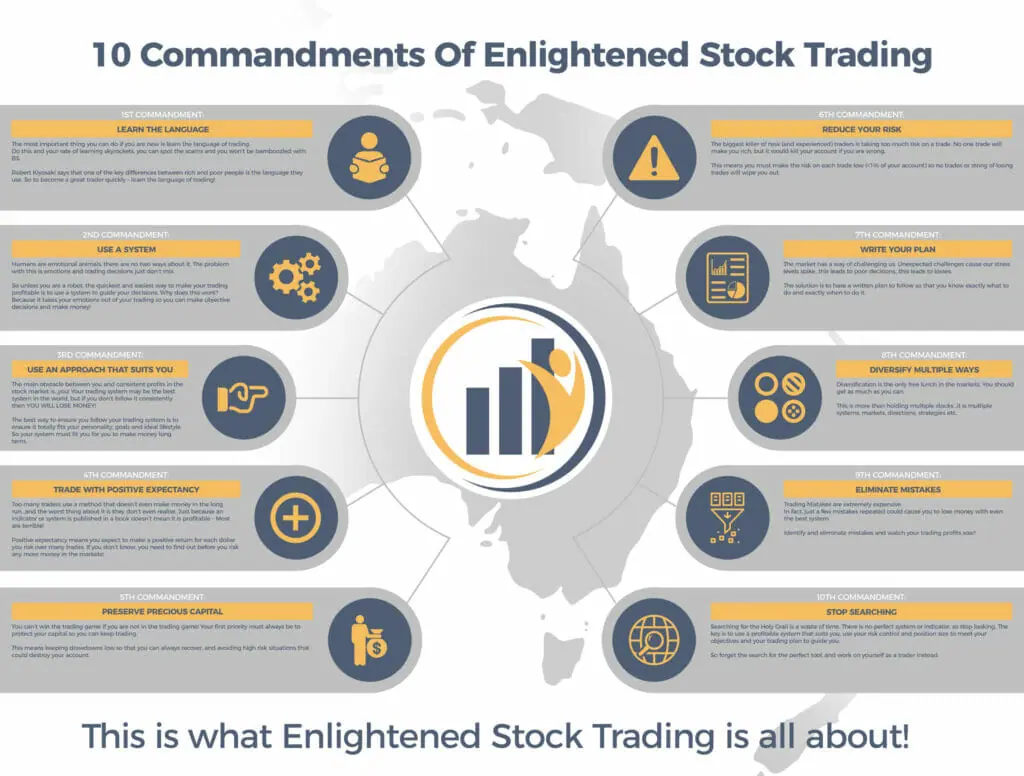
Learn The 10 Commandments For Profitable Trading
Discover the 10 most important lessons from 18 years of profitable trading & reading over 150 trading books.
Get your FREE Report & 10 Training Videos NOW!