This is one of the trading questions that I have received from one of my readers who is on the path to learn stock trading profitably… “When I use end of day data can I trade all time frames with it?”
End of day data (EOD for short) is data that you download after the markets have closed for the day, or after some pre specified time if you are looking at 24 hour markets like forex.
Typically when we talk about EOD data we are referring to daily price data where you get the open, high, low, close, volume and open interest for the day. When you view daily EOD data on a price chart one bar represents a single day’s trading activity.

Daily EOD price data allows you to trade daily, weekly and monthly timeframes.
Want To Learn Stock Trading Quickly…
If you want to learn stock trading and have someone guide you every step of the way so that you can stay in control and learn how to profit quickly then check out my unique new program by clicking the image on the right.
I would love to help you learn stock trading quickly and address your trading questions for you!
Click on the image to find out more about this unique new program which allows you to learn stock trading quickly with the support you need.

Once you have this end of day price data your charging package can automatically plot daily, weekly, monthly, quarterly and yearly price bars. This is perfect if you are using a low touch daily or weekly trading system where you make trading decisions once a day or less frequently.
What you can’t do with daily EOD price data is trade using timeframes shorter than one Trading day. For example if you are a day trader and you would want to make trading decisions based on charts which have price bars representing from say 1 minute to 4 hours. You can’t do this with daily end of day price data.
Daily end of day price data is my preferred data feed because I use medium to long term trading systems and I only make trading decisions once each day.
Data for day trading is more expensive, more difficult to handle and typically has less price history than end of day price data.
One note of caution that I would give is that you really need to use data that is right for your purpose. If you want to make intra day decisions (i.e. daytrading) then you really need data that is more frequent than just daily price bars.
Do not try to design a day trading system using only end of day data because IT WILL NOT WORK!
You may be tempted (as I have been at some point in the past) to try to design a system that enters and exits during the trading day using just daily price data. The problem with this is, while you know the open / high / low / close of the day, you do not know what order the high and low occur in, nor do you know what happened in-between. These four examples below illustrate the problem of trying to use daily price data to design shorter term trading approaches. You just don’t know what happens in what order.

Illustration of why daily price bars can’t be used for intra day trading systems
I use and recommend stock market data from Metastock. Because I have an arrangement with Metastock, I would like to make you a special offer if you subscribe to their stock market data for your trading system backtesting or charting.
- Subscribe to Metastock stock market data through this link and get 1 month free
OR - Subscribe to stock market data and the Metastock trading software through this link and get 3 months for the price of 1 (Both are affiliate links, so I get a small commission at no cost to you)

In each of the four charts above the price movement throughout the day (the squiggly line) is totally different, but the daily price bar that is generated is exactly the same. This is why you can’t use daily price data to make decisions on lower timeframes of data.
But I still believe EOD trading systems are the best option for most people and EOD price data is all you need to design great EOD trading signals. The warning is just that you must know what data you are using and what you can and can’t use it for.
I do not encourage new traders (or experienced ones for that matter) to use timeframes shorter than a day. It is difficult, commissions are high relative to profits, average profit per trade is very low and it takes a lot of time.
I like end of day trading signals and trading systems much better than day trading signals because you can get a much higher return for your effort and you don’t have to stare at the markets all day to make money.
Want To Learn Stock Trading Quickly…
If you want to learn stock trading and have someone guide you every step of the way so that you can stay in control and learn how to profit quickly then check out my unique new program by clicking the image on the right.
I would love to help you learn stock trading quickly and address your trading questions for you!
Click the image discover how you can become a confident, systematic trader in just a few weeks!
Frequently Asked Questions About EOD Data
How much is MetaStock EOD?
MetaStock End-of-Day (EOD) data costs $39.95 per month. For that price, you get access to end of day price history for every stock market globally. That is tens of thousands of stocks and decades of history for one low subscription price. It’s a fantastic value because the data is reliable, back-adjusted for stock splits, and cleaned up to avoid errors like bad ticks. This makes it ideal for backtesting and running trading systems with confidence.
If you’re comparing data sources, keep in mind that free data often lacks this level of quality and accuracy, which can lead to unreliable backtest results. For $39.95 a month, MetaStock EOD data is hard to beat for its breadth and value.
What is the EOD trading strategy?
An End-of-Day (EOD) trading strategy involves making trading decisions based on daily price data after the market closes. This approach is particularly suited for traders who have other commitments during the day, as it allows them to analyze the market and place trades outside of trading hours. Here’s how it works and why it’s effective:
- Daily Price Data: EOD strategies rely on daily charts, where each bar represents a full day’s trading activity (open, high, low, close). This reduces the noise and randomness often seen in shorter timeframes, making signals more reliable.
- Flexibility: You can design your system to fit your lifestyle. For instance, you can place trades at the open, close, or use stop/limit orders to automate entries and exits. This is great for those with limited time during the day.
- Higher Profit Per Trade: EOD strategies often result in longer trades, which can generate higher average profits per trade. This reduces the impact of commissions and slippage, making it easier to remain profitable over time.
- Stress Reduction: Since decisions are made after the market closes, there’s no need to monitor trades constantly. This can significantly lower stress levels compared to intraday trading.
EOD trading is a fantastic starting point for new traders and a solid option for experienced ones who value simplicity and flexibility.
What is the end of day trading in stocks?
End-of-day (EOD) trading in stocks means making trading decisions after the market has closed, based on the daily price data. This approach is ideal for traders who can’t monitor the markets during the day or prefer a less time-intensive trading style. Here’s how it works:
- Daily Price Data: EOD trading uses daily charts, where each bar represents a full day’s trading activity (open, high, low, close). This reduces the noise and randomness seen in shorter timeframes, making signals more reliable.
- Decision Timing: You analyze the market and place trades after the market closes, giving you time to think clearly without the pressure of live market movements.
- Flexibility: EOD trading allows you to fit trading around your lifestyle. For example, you can place trades at the open, close, or use stop/limit orders to automate entries and exits.
- Higher Profit Per Trade: EOD strategies often result in longer trades, which can generate higher average profits per trade. This reduces the impact of commissions and slippage, making it easier to remain profitable.
EOD trading is a fantastic option for traders who value simplicity, flexibility, and a more relaxed approach to the markets.
What is end of day data?
End-of-day (EOD) data refers to stock market data that is collected and made available after the market closes for the day. It typically includes the following key details for each trading day:
- Open, High, Low, Close (OHLC): These are the price levels for the day – where the stock opened, the highest and lowest prices reached, and where it closed.
- Volume: The total number of shares traded during the day.
- Open Interest: For futures and options, this shows the number of outstanding contracts.
Each bar on a daily chart represents one full day of trading activity, making EOD data ideal for analyzing trends and making trading decisions based on daily price movements.
EOD data is particularly useful for traders using medium- to long-term strategies, as it eliminates the noise and randomness of intraday price movements. It’s also cost-effective and easier to manage compared to intraday data, which is more expensive and requires more frequent updates.
If you’re looking to trade using EOD data, it’s essential to choose a reliable data provider to ensure accuracy. Bad data – like missing adjustments for splits or incorrect prices – can ruin your backtests and trading decisions. Always test the data before committing to a provider.
Is MetaStock worth it?
MetaStock data is worth it if you’re looking for reliable end-of-day (EOD) data for backtesting and trading system development. I use Metastock historical data combined with RealTest or Amibroker for backtesting on stockmarkets other than ASX, US and TSX – For these markets I use and recommend Norgate Data.
Here’s why I use Metastock data:
- Data Quality: MetaStock data is cleaned, adjusted for stock splits and corporate actions, and checked for errors like bad ticks. This ensures your backtests are accurate and trustworthy, which is critical for building profitable trading systems.
- Cost-Effectiveness: At around $39.95 per month, you get access to EOD data for thousands of stocks acros the globe (All markets are included in the one global subscription). This is exceptional value for the breadth of data provided.
- Ease of Use: The MetaStock downloader automates the process of retrieving and updating data, saving you time and effort and daily downloads can be easily automated.
- Broad Market Coverage: You can access data for a wide range of global markets, making it ideal if you’re trading or testing strategies across different regions.
While there are free data sources available, they often lack the accuracy and adjustments MetaStock provides. Bad data can lead to flawed backtests, costing you far more in the long run than the subscription fee. If you’re serious about systematic trading, MetaStock is a solid investment.
What time is EOD in stock market?
End-of-day (EOD) in the stock market refers to the time when the market officially closes for the day. The exact time depends on the specific stock exchange you’re trading on. Here are some examples of major stock market closing times:
- NASDAQ and NYSE (U.S.): 4:00 PM EST
- London Stock Exchange: 4:30 PM GMT
- ASX (Australia): 4:00 PM AEST
- Tokyo Stock Exchange: 3:00 PM JST
- NSE (India): 3:30 PM IST
EOD data is typically available shortly after the market closes, and it includes the open, high, low, close prices, and volume for the day. This data is crucial for traders using EOD strategies, as it allows them to analyze the market and make decisions outside of trading hours.
If you’re trading globally, it’s important to know the closing times for the exchanges you’re interested in, as they vary by region and time zone.
What is an end of day chart?
An end-of-day (EOD) chart is a type of stock market chart that displays daily price data for a specific stock, index, or other financial instrument. Each bar or candlestick on the chart represents one full trading day, summarizing the following key data points:
- Open: The price at which the stock started trading for the day.
- High: The highest price reached during the trading session.
- Low: The lowest price reached during the trading session.
- Close: The price at which the stock finished trading for the day.
- Volume: The total number of shares traded during the day.
EOD charts are particularly useful for traders who focus on medium- to long-term strategies, as they filter out the noise and randomness of intraday price movements. By analyzing these charts, traders can identify trends, patterns, and signals that are more reliable than those found on shorter timeframes like 1-minute or 5-minute charts.
For example, if you’re using an EOD trading strategy, you’d rely on these charts to make decisions after the market closes, giving you time to analyze the data and place trades without the stress of live market fluctuations.
How risky is MetaStock?
MetaStock itself isn’t inherently risky – it’s a tool for charting, technical analysis, and backtesting. However, the risks come from how you use it and the decisions you make based on the data and analysis it provides. Here are some key considerations:
- Data Accuracy: MetaStock provides global, adjusted data (e.g., for stock splits), which reduces the risk of errors in your backtesting and analysis. However, like any tool, if you rely on incorrect settings or fail to validate your strategies properly, the results could mislead you.
- Overfitting: If you use MetaStock to backtest strategies and over-optimize them to fit historical data, you risk creating a system that performs well in backtests but poorly in live trading. This is a common pitfall with any backtesting software.
- Single Instrument Focus: MetaStock is excellent for single-instrument backtesting but isn’t designed for portfolio-level testing. If your strategy requires portfolio diversification, you might need additional tools like AmiBroker or RealTest to complement MetaStock.
- User Error: The software is only as good as the trader using it. Misinterpreting charts, ignoring risk management, or failing to test strategies thoroughly can lead to poor trading outcomes.
Ultimately, MetaStock is a reliable tool for charting and discretionary technical analysis, but for systematic trading and backtesting RealTest and Amibroker are more powerful.
What is MetaStock used for?
MetaStock is primarily used for technical analysis, charting, and backtesting single-instrument trading systems. It’s a powerful charting tool for discretionary technical analysis. Here’s what it’s commonly used for:
- Charting: MetaStock provides excellent charting tools, allowing traders to visualize price movements, trends, and patterns over time. You can customize charts to suit your analysis style and trading needs.
- Technical Indicators: It includes a wide range of built-in technical indicators like moving averages, RSI, and stochastic oscillators. These help traders identify potential trade opportunities and confirm trends.
- Backtesting: MetaStock allows you to test single-instrument trading strategies on historical data. This helps you evaluate how well a strategy would have performed in the past, giving you confidence before trading it live.
- Signal Generation: The software can generate buy and sell signals based on your chosen indicators and criteria, making it easier to spot trading opportunities.
- Data Integration: It works seamlessly with high-quality EOD data from its own data service, ensuring accuracy and reliability in your analysis.
MetaStock is ideal for discretionary traders and those focused on single-instrument strategies. If you’re looking for portfolio-level backtesting, though, you might need to complement it with other tools like AmiBroker or RealTest.
Is MetaStock a broker?
No, MetaStock is not a broker. It’s a technical analysis and charting software designed to help traders analyze markets, backtest strategies, and generate trading signals. While it provides tools for market analysis and decision-making, it doesn’t handle the execution of trades. For that, you’d need to connect with a broker separately.
MetaStock does integrate with data providers to supply historical and real-time market data, which is essential for its analysis and backtesting capabilities. However, it’s not involved in the actual buying or selling of stocks or other financial instruments. If you’re looking for a broker, you’d need to choose one that aligns with your trading needs and then use MetaStock as your analysis tool alongside it.
How do you use End-of-Day (EOD)?
End-of-day (EOD) trading is all about making trading decisions after the market closes, using daily price data. Here’s how you can use it effectively:
- Analyze Daily Charts: EOD trading relies on daily price bars, which summarize the open, high, low, close, and volume for the trading day. These charts help you identify trends, patterns, and signals without the noise of intraday fluctuations.
- Generate Trading Signals: Use EOD data to create trading signals based on your strategy. For example, you might look for moving average crossovers, breakouts, or other technical indicators that align with your system.
- Backtest Your Strategy: Test your trading system on historical EOD data to evaluate its performance. This ensures your strategy is robust and gives you confidence before trading live.
- Place Trades After Market Hours: Since EOD trading decisions are made after the market closes, you have time to analyze the data and place trades without the stress of live market action. This is particularly helpful for traders with other commitments during the day.
- Focus on Longer-Term Trades: EOD trading typically results in longer trade durations, which can lead to higher average profits per trade and reduce the impact of commissions and slippage.
EOD trading is ideal for traders who want flexibility and less stress while still building effective systems.
Learn The 10 Commandments For Profitable Trading
Discover the 10 most important lessons from 18 years of profitable trading & reading over 150 trading books.
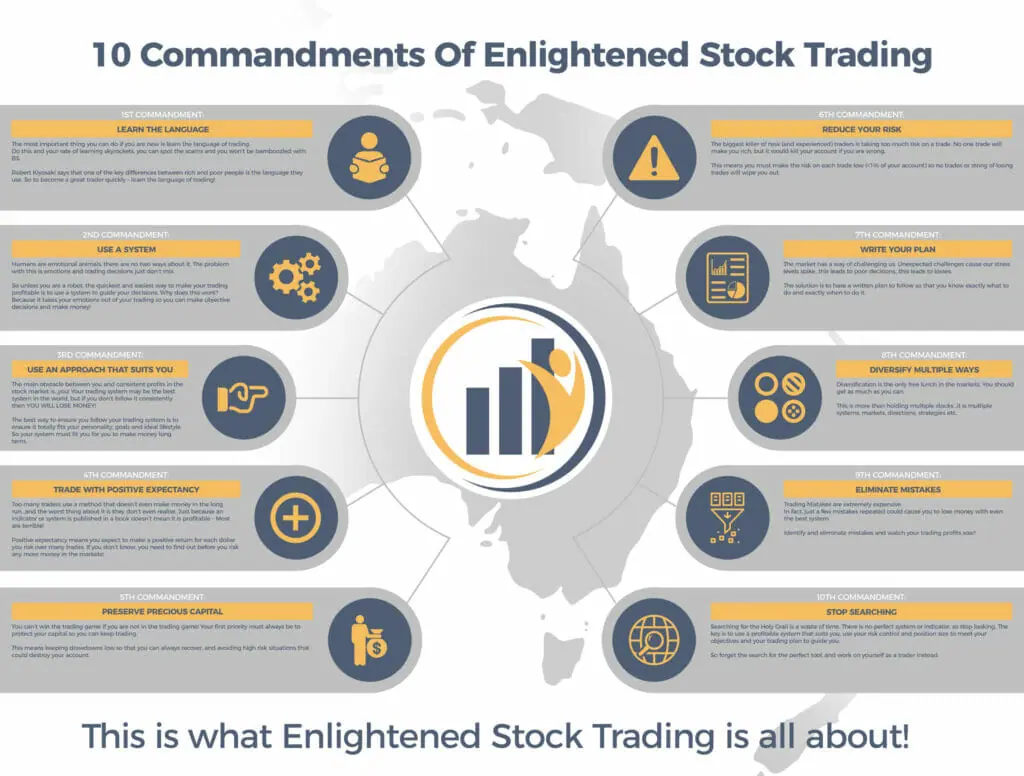
Get your FREE Report & 10 Training Videos NOW!