Everyone is talking about using AI for stock trading right now. Trading forums are full of it. Social media is packed with claims like “this AI bot turned my account around” and “I just ask ChatGPT which stocks to buy.”
Most of those people are going to lose money.
Not because AI is useless. It is genuinely one of the most powerful tools available to a systematic trader right now. But the way most retail traders are using it is completely backwards – and that gap between how AI should be used and how it actually gets used is costing people real money.
I have been a systematic trader for over 20 years. I now use AI tools every single day in my trading research, system development, and backtesting process. My view on this is grounded in real experience. Here is what actually works – and what does not.
What Does AI Actually Do in Stock Trading?
AI analyses large volumes of data and identifies patterns within that data. It can process text, numbers, price histories, news feeds, earnings reports, and more – faster than any human ever could. It can screen thousands of stocks against defined criteria, generate code from plain English descriptions, summarise complex information, and execute predefined rules automatically.
What AI does not do is generate a proven edge in the market. It can find patterns. Whether those patterns are real and persistent is a completely different question.
AI Trading vs. Algorithmic Trading – What Is the Difference?
Algorithmic trading is rules-based trading: you define exact entry and exit conditions and a computer executes them without emotion. This has been around since the 1980s.
AI trading adds machine learning or large language model capability on top – the AI can identify patterns it was not explicitly programmed to find, or it can process unstructured data like news articles and social media feeds.
Both can be powerful. Both can also be dangerously fragile if the underlying rules have not been validated through rigorous backtesting.
5 Ways Systematic Traders Can Use AI for Stock Trading
Here is where AI genuinely earns its place in a systematic trader’s toolkit. These are specific, practical applications grounded in rules-based trading – not black-box signal generation.
1. Use AI to Screen and Filter Stocks
One of AI’s clearest strengths is processing large amounts of data quickly. If you are trading the US market, you have thousands of stocks to consider. Manually filtering those by liquidity, volatility, trend conditions, and sector is time-consuming work.
AI tools can apply screening criteria across an entire market in seconds. The key principle: your screening criteria must come from your backtested system rules, not from the AI’s general suggestions. You define the rules. AI executes the filter.
This is a meaningful productivity tool. It is not a signal generator.
2. Use AI to Help Build and Code Your Trading System
This is where AI has had the most profound impact on my own trading research.
I use custom AI skills – built specifically for my workflow – to generate trading system code in both AmiBroker (AFL) and RealTest, based on nothing more than a plain English description of the rules I want to test. What used to take me hours to code manually now takes minutes (or even seconds). That time goes directly back into testing more ideas, building more systems, and compounding my research faster.
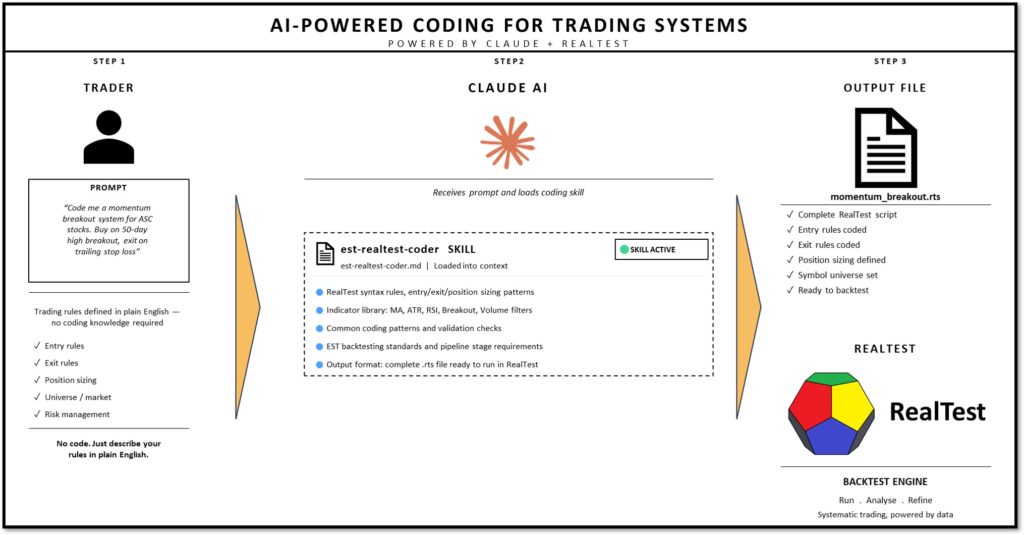
The important caveat: out of the box, an AI model like ChatGPT or Claude will get your trading code about 70-80% right. The nuances of backtesting software – correct data handling, timing of signals, how to avoid future leaks, the right parameter structure for optimisation – are not reliably in any AI’s training data.
With purpose-built skill files that teach the AI how to code the way a systematic trader needs it coded – proper documentation, parameter labelling, optimisation ranges, and clean data handling rules – accuracy goes to 99–100%. That investment in building the right skill files pays for itself many times over. If you want to learn more about skill files for AI, this article from Anthropic is a great place to start.
I also use Norgate Data as my historical data source for these backtests. Quality data is non-negotiable. Garbage in means garbage out, regardless of how good your AI coding is.
3. Use AI to Research Market Ideas and Hypotheses
AI is a useful thinking partner when you are developing new system ideas. You can describe a market behaviour you have observed and ask AI to help articulate the hypothesis, identify potential weaknesses in your logic, or suggest what conditions might invalidate the edge.
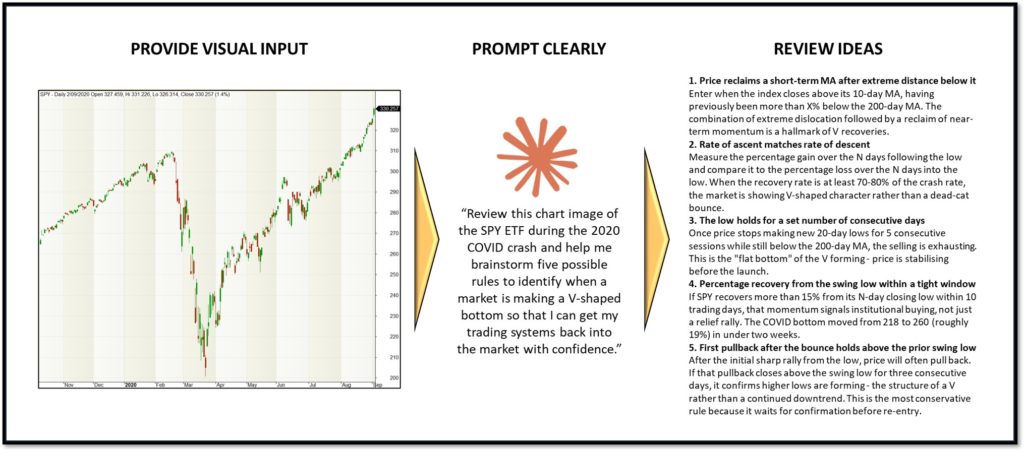
This is very different from asking AI to tell you what trades to take.
In the early days of my AI experimentation, I asked AI models to generate trading system ideas directly. Some sounded plausible. Almost none held up to rigorous backtesting. Ideas generated without proper guardrails tend to be superficial – they reflect what is commonly discussed on the internet rather than what has been tested and validated.
Now I use AI to stress-test my own hypotheses: “Here are the rules I am planning to test. What holes can you find in this logic? What market conditions would break this?” That is a productive use of AI as a thinking tool.
4. Use AI to Analyse Sentiment and News at Scale
Processing news, earnings announcements, and market commentary at scale is something AI does genuinely well. Reading 200 earnings reports in an evening is not realistic for a human. For an AI model, it is a trivial task.
The application for systematic traders is specific: you can use AI to process news feeds and classify sentiment as part of a filter in your trading system. The discipline is the same as always – any sentiment signal you plan to trade must be backtested with historical data before it goes near your live account. I want to be clear here though, this is a massively data intensive exercise and is extremely difficult to backtest. I do not do this in my own trading because I prefer a simpler approach.
AI can read the news. Whether a news-based trading rule has a real edge is something only backtesting can determine… to backtest you need historical data, and historical sentiment data is difficult to build. So, while this is possible, it is not something that I would recommend for retail traders.
5. Use AI to Review and Improve Your Trading Systems
Once you have a working trading system, AI can serve as a useful review tool. Submit your system rules and ask for a structured critique: “Are there any conditions in these rules that could cause future leaks? Is there a missing filter that would improve consistency? Are there market regimes where these rules would break down?”
This kind of review – with AI acting as an experienced second opinion – can surface issues that are easy to miss when you are deep in your own work.
I have taken this further by running my entire Expert’s Guide to Backtesting process end-to-end through Claude Code. Claude interfaces directly with RealTest and runs every stage of the process – hypothesis generation, coding, backtesting, optimisation, validation – and presents the full analysis. I can even run this in autonomous mode, where the AI develops and optimises a complete trading system using my exact processes, without manual input at each stage.
This is only possible because the underlying process is rigorously defined. Decades of refining my backtesting methodology into a precise, step-by-step framework is what makes the automation work. The AI is executing the process. It is not inventing it.
What AI Cannot Do for Your Trading (This Part Matters More)
Every article about AI in trading focuses on what AI can do. This section is about what it cannot do – because this is where most traders get into real trouble.
AI cannot generate a backtested edge from nothing.
If you ask an AI model to give you a profitable trading strategy, it will give you one. It will sound plausible. It may reference real indicators and common trading logic. But it has no way to verify that the rules it generates have a genuine edge in the market. It is pattern-matching from training data, not testing against real historical price data.
AI cannot replace your position sizing and risk management rules.
No AI signal tells you how much to risk on a trade. That is determined by your position sizing framework – the rules that protect your account when trades go against you. Outsourcing the signal without controlling the risk is a fast way to blow up an account. This is only possible to determine if you backtest your trading system and vary the position size to see how your system responds to different position size levels and models.
AI cannot tell you whether a pattern will hold in the future.
AI identifies patterns in historical data. Every backtesting tool does this. The hard question, the one that actually determines whether you make money, is whether the pattern reflects a real, persistent market behaviour or a statistical coincidence in a specific period of data. That judgement requires deep understanding of trading system development and validation, not just AI output.
AI cannot tell you when to trust a system through a drawdown.
When your system enters a drawdown – and every system does – you need to know whether to keep trading or stop. That decision requires understanding your system’s historical behaviour, its maximum expected drawdown, and your own risk thresholds. No AI subscription service can make that call for you.
The limit of AI in trading is not the technology. It is the trader behind it. If you do not understand the fundamentals of systematic trading, you are not in a position to evaluate what the AI is generating, let alone act on it safely.
Should You Use AI Trading Bots?
The short answer: only if you can validate the rules behind them.
The AI trading bot market has grown rapidly. Many platforms now offer automated stock trading signals, AI-powered stock pickers, and subscription-based bots that claim to beat the market. Before you commit capital to any of them, ask one question: “Can you show me exactly what rules trigger every buy and sell signal?”
If the answer is no – if the logic is a black box – walk away.
This is not a new problem. In the 1990s and early 2000s, you could buy black-box trading systems for thousands of dollars. They produced buy and sell signals with no explanation of the underlying rules. Almost all of them were highly overfit to historical data, and most broke down quickly when market conditions changed. The patterns they had identified were not real edges – they were statistical artefacts dressed up as systems.
A lot of AI trading bots are the same product in a different package. The technology is newer. The outcome for uninformed traders is the same.
The traders doing well with AI-assisted trading are not the ones subscribing to a $29-a-month bot and hoping for the best. They are traders who understand systematic trading deeply, and who use AI tools to accelerate their research, test more ideas, and build better systems faster.
AI is most powerful in the hands of traders who already know what they are doing.
The Hidden Risk: Outsourcing Your Understanding
There is one risk that sits underneath all of this, and it is the one most traders never see coming. It is not that AI writes bad code or builds a weak strategy. That can happen, but you can test for it. The bigger danger is subtler: you slowly stop understanding your own trading process.
When something breaks – and in trading, something always eventually breaks – you need to know what is going on. If your data feed stops updating, where do you look first? If your backtest results suddenly change, is it the code, the data, the database, the position sizing, or the market filter? If your broker connection fails, is it your API key, permissions, account settings, order type, or trade size? If your honest answer is “I don’t know, the AI built it,” then you are not running a systematic trading business. You are placing blind trust in a black box.
Here is a simple test. If your trading computer died today, how quickly could you rebuild your entire setup on a new machine? Could you reinstall your software, reconnect your data, rebuild your AmiBroker or Norgate database, find your strategy files, confirm the data is updating correctly, re-run your backtests and get the same results, and reconnect your broker with confidence? If that thought makes you want to hide under a blanket, that is useful information. It means there are parts of your process you do not yet understand well enough – and that is exactly where your next learning step is.
This is the difference between running a bot and operating a trading business. When you understand your data, your code, your signals, your risk controls, and your daily workflow, your confidence does not depend on hoping a black box behaves itself. It comes from knowing what your system is doing, why it is doing it, and what to check when something looks wrong.
So use AI as an assistant, not a crutch. Let it document your data setup, explain sections of code, build checklists, summarise error messages, and speed up repetitive tasks. But make sure you can still explain your system in plain English – where the data comes from, how signals are created, how orders are sized and placed, and what could go wrong. Because no one cares more about your trading account than you do.
How to Get Started Using AI for Stock Trading
If you are serious about using AI to improve your trading, here is a practical framework for starting correctly.
Step 1: Learn systematic trading first.
Before AI can accelerate your results, you need a process worth accelerating. That means learning how to build a trading hypothesis, how to backtest correctly, how to validate an edge without overfitting, and how to manage risk with proper position sizing. Programs like the Trader Success System are built to teach exactly this – the foundational skills that AI will then multiply. Without those skills in place, AI is just noise.
Step 2: Define your system rules in plain English.
Before you write any code or run any AI tool, write out your trading rules clearly. Entry conditions, exit conditions, stop loss rules, position sizing logic, market filter. If you cannot explain your system in plain English, you are not ready to build it in code – with or without AI assistance.
Step 3: Use AI to help code and test your rules.
Once you have a clear hypothesis, use an AI model to help translate those rules into backtesting code. AmiBroker and RealTest both work well for systematic equity trading. Describe your rules, let the AI generate the code, review it carefully for errors, and run the backtest. Use the trading expectancy calculator to assess whether the results show a genuine edge before going further.
Step 4: Validate your results rigorously.
A good backtest result is not enough. Check for survivorship bias, future leaks, and curve fitting. Test the system across different market regimes. If the rules hold up under scrutiny, you have something worth considering for live trading.
Step 5: Execute end-of-day, on a schedule.
If you are trading a systematic, end-of-day strategy like trend following, execution takes 5–10 minutes at the close of each trading day. You have built a set of rules, tested them thoroughly, and you execute them mechanically. AI is not monitoring the market in real time on your behalf. You are running a process – and the process is what creates consistency.
The Right Mindset for Using AI in Your Trading
Here is a principle that runs directly counter to most of the hype you will read about AI in trading.
The more deeply you understand systematic trading – how to develop an edge, how to test it properly, how to manage risk – the more powerful AI becomes as a tool. The less you understand those fundamentals, the more dangerous AI becomes.
This is counterintuitive. Most people assume AI is most useful as a shortcut for people who do not know what they are doing. In practice, it is the opposite.
AI without guardrails produces superficial ideas, poorly structured code, and trading rules that have not been validated. AI with the guardrails that come from deep systematic knowledge, well-defined processes, clear criteria and rigorous testing is genuinely exceptional. The same AI model, pointed at the same problem, produces dramatically different results depending on whether the person using it understands what good output looks like.
Think of AI as a highly capable assistant. An assistant can implement a great process very efficiently. Without a great process to implement, the same assistant just makes mistakes faster.
The process is what you need to learn first. AI is what you use to execute it faster, test more ideas, and compound your results over time.
Ready to Build the Foundation That Makes AI Work?
If you want to use AI effectively in your trading, you need the systematic trading skills that AI will multiply.
The Trader Acceleration Bundle gives you three of my most powerful free resources – including the foundational frameworks that underpin everything covered in this article. This is where the process starts.
Download the Trader Acceleration Bundle – it is free.
Frequently Asked Questions
Can AI pick winning stocks?
AI can screen and filter stocks based on defined criteria, and it can identify patterns in historical price data. What it cannot do is guarantee that any pattern represents a genuine, persistent edge. Every signal generated by AI should be validated through rigorous backtesting before being traded with real capital.
Is AI stock trading legal?
Yes. Using AI tools for stock trading research, screening, and system development is legal for retail traders. Automated execution via a brokerage API is also legal in most jurisdictions. Always check the specific rules of your broker and your regulatory environment.
What is the best AI tool for stock trading?
There is no single best tool. For systematic traders, the most useful combination is an AI model like Claude or ChatGPT (for system coding and hypothesis development), combined with a dedicated backtesting platform like RealTest or AmiBroker and quality historical data. The tools matter far less than the process you use them within.
Do AI trading bots actually work?
Some do and some do not. Without transparency into the underlying rules, there is no reliable way to tell before you risk capital. Bots that work are generally built on validated, rules-based strategies. Black-box bots that cannot explain their logic are high-risk for retail traders, regardless of claimed performance.
How long does it take to learn AI-assisted systematic trading?
Learning systematic trading is the main time investment. With structured guidance covering system development, backtesting, risk management, and position sizing, you can have a working, tested system within months. Adding AI tools to that foundation then significantly accelerates your research from there. The Trader Success System can help you accelerate this journey and get you there in a matter of months rather than struggling for years on your own.
What is the difference between AI trading and systematic trading?
Systematic trading is rules-based trading: every entry, exit, and risk management decision follows pre-defined, backtested rules. AI is a set of tools that can assist with coding those rules, screening stocks, and analysing data at scale. The best approach combines both – systematic rules developed and tested with the help of AI tools.