“Always use a stop loss.” It is the first rule most traders learn, and it is only half right.
A stop loss matters. But how you set it, where you execute it and whether your system needs one at all are decisions you can test. When I tested three ways of handling the same stop on the same system, the traditional approach, a stop order sitting with your broker, came last.
This guide covers what a stop loss is for a systematic trader, when you need one, how to set it, where to execute it and how to test it before you trust it. It is part of my guide to risk management for traders.
What Is a Stop Loss in Trading?
A stop loss is the price at which your trading system says a trade has failed, so you exit to limit the loss. For a long trade it sits below your entry. For a short trade it sits above.
Two different things share the name. The stop loss rule is part of your system: it defines where the exit is. The stop loss order is one way to execute that rule: an instruction to your broker to sell automatically if price reaches the level. You can follow the rule without placing the order, and as you will see below, that choice can change your results pretty dramatically.
For a systematic trader the stop is decided before the trade is entered. It is objective, and it is backtested along with every other rule. “I’ll get out if it starts to look bad” is not a stop loss, it is something that discretionary traders say, hoping they will have the discipline to follow through. More often than not, they won’t!
Do You Always Need a Stop Loss?
No. Every system needs a way to limit losses, but not every system needs a traditional stop loss, and some work better without a tight one.
Think of it this way. A long side system with no stop has a 100% wide stop (the most you can lose is the stock going to zero). A short side system with no stop effectively has an infinitely wide stop (this is bad!). As you tighten the stop from its widest point towards zero, you change how the system behaves. The right width is the one that gives the best overall result when you backtest it, and that depends on what the system is trying to do.
- Trend following: you want a stop. Win rates are low, often 30% to 50%, so the system makes its money from a few big winners and has to keep the losers small. Use an initial stop at entry and a wider trailing stop to stay in the trend.
- Mean reversion: a tight stop usually hurts. You are buying weakness, and prices often fall further before they bounce, so a tight stop takes you out just before the recovery and destroys the high win rate the system depends on. If you use a stop at all, make it wide, and let a time stop do the real work: if the trade has not reverted within a set number of days, exit. Keep position sizes small.
Either way, the decision comes from the backtest, not from a rule someone told you. You can read more about how mean reversion and trend following systems are built.
How Do You Set a Stop Loss?
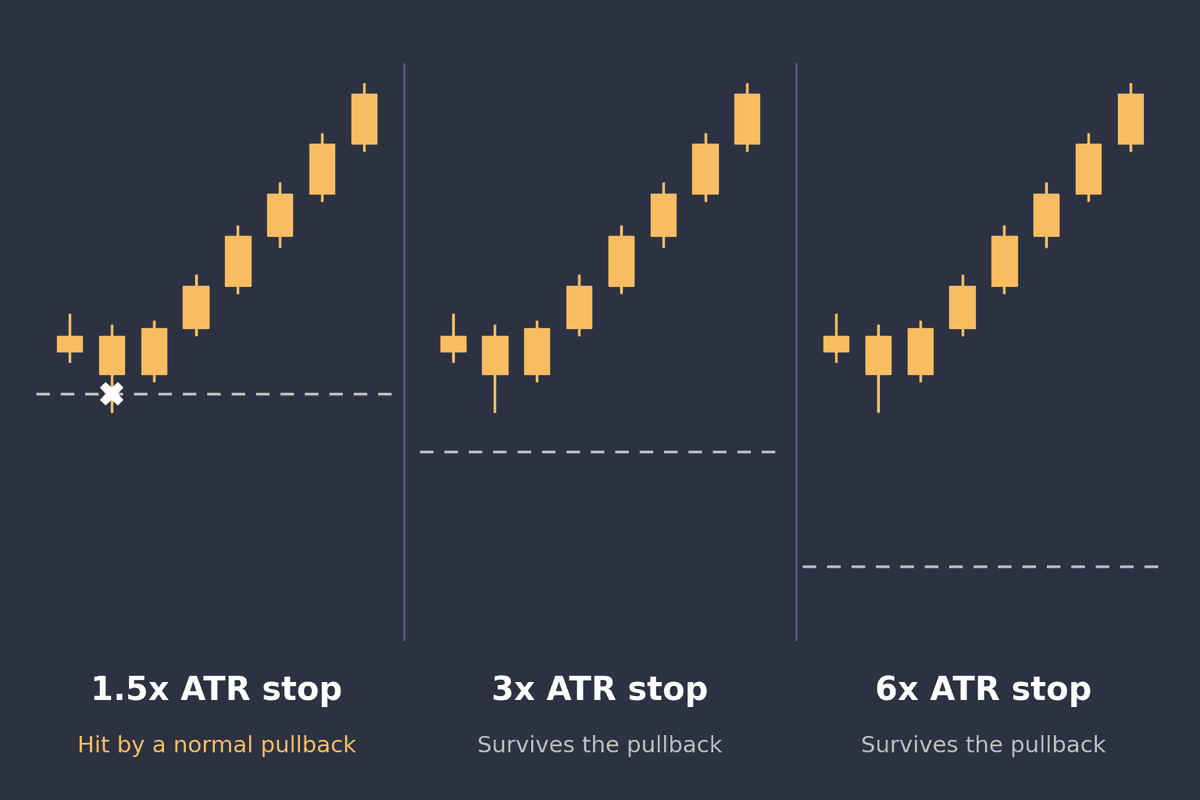
One of the best ways to set your stop is as a multiple of the stock’s Average True Range (ATR), then size the position so that hitting the stop costs a fixed percentage of your account.
Why ATR Stops Usually Beat Percentage Stops
A percentage stop treats every stock the same. A 10% stop on a sleepy utility may never be touched by a normal pullback, while a 10% stop on a volatile small cap gets hit by ordinary noise. ATR measures how far a stock actually moves, so an ATR stop adapts to each stock: wider for volatile stocks, tighter for quiet ones. It works the same way on the ASX, US stocks or crypto, and it is easy to backtest. Here is how to use the Average True Range.
As a rough guide from my own testing:
| ATR multiple | What to expect |
|---|---|
| 1.5 to 2 x ATR | Tight. Many small losses, often around 80% losing trades, large R multiples on the winners |
| 3 to 4 x ATR | Medium. A reasonable win rate and a sensible starting point for most systems |
| 5 to 6 x ATR | Wide. A higher win rate, with smaller gains per winner relative to the risk |
For an end-of-day trend following system, 3 x ATR is a solid place to start testing. Remember that you need to backtest every aspect of your system, including the type of stop loss. I have several systems where an ATR based stop loss works best, but I also have some systems where a percentage based stop loss works better. Test everything and don’t rely on blanket rules of thumb and trading folklore to determine your profits.
Why a Tight Stop Is Not Lower Risk
Early in my trading I developed a trend following system that used a 1.25 x ATR stop (very tight) because I wanted to keep each loss small. The system backtested profitably, but the real life result was much harder to take. The system generated 82% losing trades and I had a real life streak of 27 losses in a row which was psychologically extremely difficult to take. Each loss was small. The system was miserable to trade.
A tight stop lowers the risk on each trade but raises the number of trades that fail. At the portfolio level that can be more dangerous, not less.
Size the Position From the Stop
The stop sets your position size, not the other way round:
- Dollar risk per trade = account size x risk per trade (for example 1%)
- Shares to buy = dollar risk / (entry price – stop price)
With a $100,000 account, 1% risk, an entry at $20 and a stop at $18, you risk $1,000 and buy 500 shares. Hit the stop and you lose 1%, whatever the stock and wherever the stop sits. That is position sizing, and the position size calculator does the arithmetic for you.
Should You Place Your Stop in the Market or Exit at the Next Open?
Test both in-market stops and next bar on open stops. In my testing on daily-bar systems, exiting at the next day’s open after the stop level is breached has beaten a stop order left with the broker. The in-market order still has a job: it protects you when you cannot watch your trades, but this convenience comes at a cost because in-market stops usually have lower expectancy than next bar on open stops.
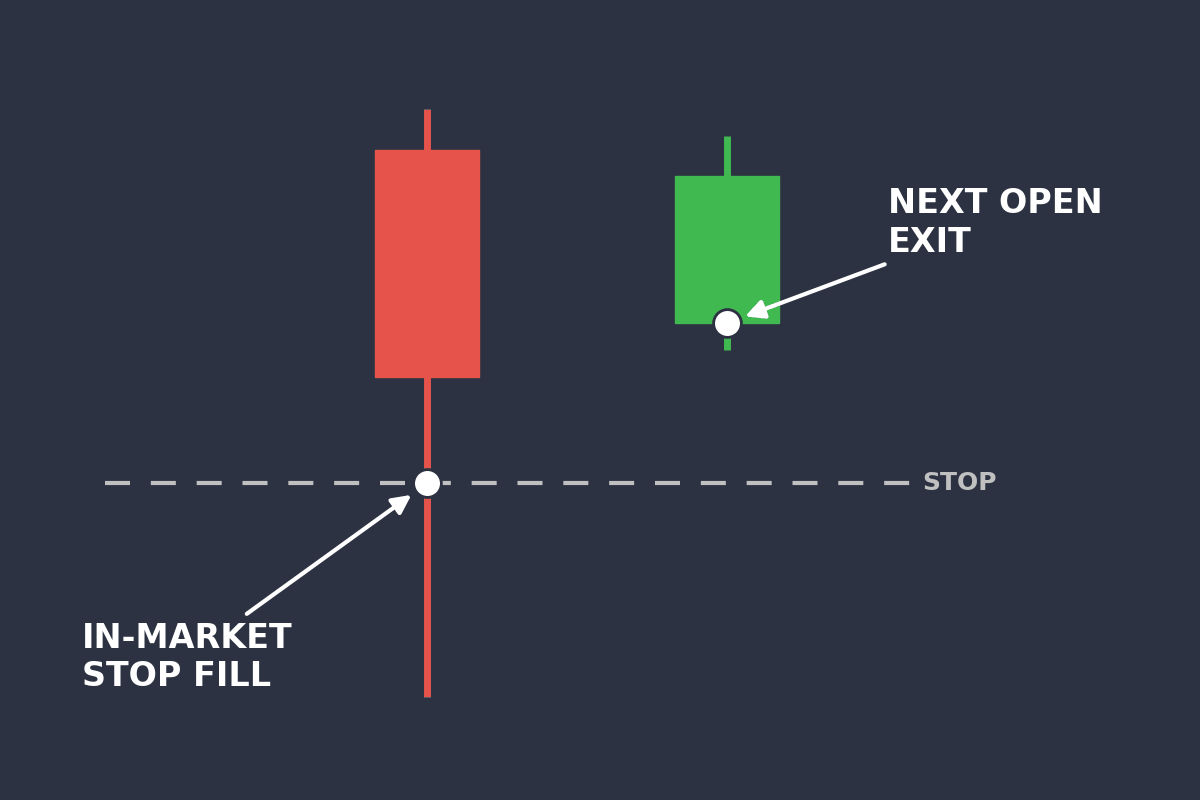
There are three ways to act on the same stop level:
- In-market stop: a stop loss order with your broker. If price touches the level during the day, you are out at the next available price.
- Next bar on open stop: you track the stop level yourself. If the day’s price breaches it, you exit at the next day’s open.
- No stop: you exit only when the system’s normal exit rule triggers.
What My Backtest Showed
I tested all three on a simple trend following system across all ASX stocks, from 1990 to early 2021, in AmiBroker.
- Entry: buy at the next day’s open when a stock makes its highest close in 200 days, with a liquidity filter, a volatility filter and the All Ordinaries above its 200-day EMA.
- Size: 5% of equity per trade.
- Exit: sell when the close crosses below the 200-day moving average.
- The stop under test: 4 x ATR below the entry price.
| In-market stops | Next bar on open stops | No stops | |
|---|---|---|---|
| Compound annual return | 11.92% | 13.22% | 15.27% |
| Maximum drawdown | 33.04% | 22.38% | 33.75% |
| Return / max drawdown (CAR/MDD) | 0.36 | 0.59 | 0.45 |
For this system the traditional in-market stop was the worst of the three. The next bar on open stop gave the best risk-adjusted return, and no stop gave the highest return. Slippage was not modelled, and in-market stops usually suffer more of it, so the real gap is probably wider.
It is not a one-off. One of my momentum systems in Hong Kong has a 30% higher expectancy with next bar on open stops than with in-market stops, and my crypto systems all work dramatically better with them.
Why In-Market Stops Underperform
An in-market stop gets you out at the point of maximum fear. Price drops hard during the day, your stop triggers and becomes a market order, and you are filled near the low. Then the stock recovers by the close. In-market stops also suffer from the most slippage.
It has happened to me. A stock I held in Hong Kong sold off as much as 44% during one day, straight through my stop levels, and then closed back above them. An in-market stop would have sold near the low. Because I was tracking the stop myself, I was still in the position at the close.
Exiting at the next open gives the fear a night to settle. Prices often recover part of the move, intraday noise does not trigger the exit, and a manual order at the open usually suffers less slippage.
Stop hunting, where price seems to dip just far enough to take out everyone’s stops, is real. It is nowhere near as big a factor as some people make out. The bigger cost is executing every stop at the worst moment of the day.
When an In-Market Stop Is the Right Choice
The next bar on open stop only works if you act on it, every time. Use an in-market stop when:
- you cannot reliably check your trades every day
- you are travelling or sick, or your data or broker access fails
- you do not trust yourself to exit when the stop is hit
The last point matters most. If a stop is triggered and you think “I’ll give it another day”, the next bar on open approach will eventually hurt you badly. An in-market stop takes that decision away from you. If your trading is automated, you get the benefits of next bar on open stops without the discipline risk.
Should You Use a Trailing Stop?
For trend following, yes. The initial stop limits the loss if the trade fails early. A trailing stop then follows price up and locks in more of the gain as the trend runs. For end-of-day trend systems, a trailing stop of around 15% to 25%, or a volatility-based trailing stop such as the chandelier exit, keeps you in the trend without getting shaken out by normal pullbacks.
Do not add a profit target to a trend following system. The big winners pay for everything else, and a target caps them.
How Do You Test Your Stop Loss?
Backtest it like any other rule:
- Test the three execution methods: in-market, next bar on open, and no stop.
- Test a range of widths, for example 2 to 6 x ATR, and look for a broad area where results are good, not a single best number. A lone peak is usually curve fitting.
- Judge on the right numbers: CAR/MDD, expectancy and drawdown, not the win rate. A wider stop will usually raise the win rate, and that does not make it better. Here is why win rate is not important.
- Include slippage, especially for in-market stops.
Then choose the approach you will actually follow when the stop is hit.
What Are the Most Common Stop Loss Mistakes?
- Stops that are too tight. Lots of small losses, long losing streaks and a system you will abandon.
- Moving the stop further away once a trade goes against you. The stop exists for the moment you least want to take it.
- Choosing the stop by feel instead of by backtest.
- Using next bar on open stops without the discipline to act on them.
- Sizing positions without reference to the stop, so every loss is a different size. Uneven losses that compound push you towards risk of ruin.
Frequently Asked Questions
What is the 7% rule for stop losses?
The 7% rule says to sell any stock that falls 7% to 8% below your purchase price. It comes from William O’Neil’s CAN SLIM approach. It is simple, but as a fixed percentage it ignores how much each stock normally moves. A systematic trader would test a volatility-based stop against it and keep whichever performs better in the backtest.
Is a 20% stop loss good?
For a long-term trend following system on daily charts, a 20% trailing stop can be reasonable, because it gives a trend room to breathe. For a short-term system it is usually far too wide. Whether it is good for your system is a question your backtest should answer.
What is the golden rule for stop losses?
Decide the stop before you enter, and never move it further away once the trade is open. Everything else, including the width, the type and how you execute it, should come from testing.
Where should I place my stop loss?
Place it where your system’s backtest says the trade has failed, usually a multiple of ATR below your entry for a long trade. Then decide whether to execute it in the market or at the next open, based on your testing and on whether you can reliably monitor your trades.
Should a mean reversion system use a stop loss?
Usually only a wide one, or none, with a time stop doing the real work. Tight stops take mean reversion trades out just before the bounce the system is waiting for.
Build Your Stops Into a Complete Trading System
A stop loss is one rule. On its own it cannot make you consistent. Inside a tested system, alongside entry, exit and position sizing rules, it is what keeps you in the game long enough for your edge to show.
That is what the Trader Success System teaches: how to build, backtest and trade complete systematic strategies, stops included, that fit your personality and lifestyle.
Remember – you are only one trading system away!