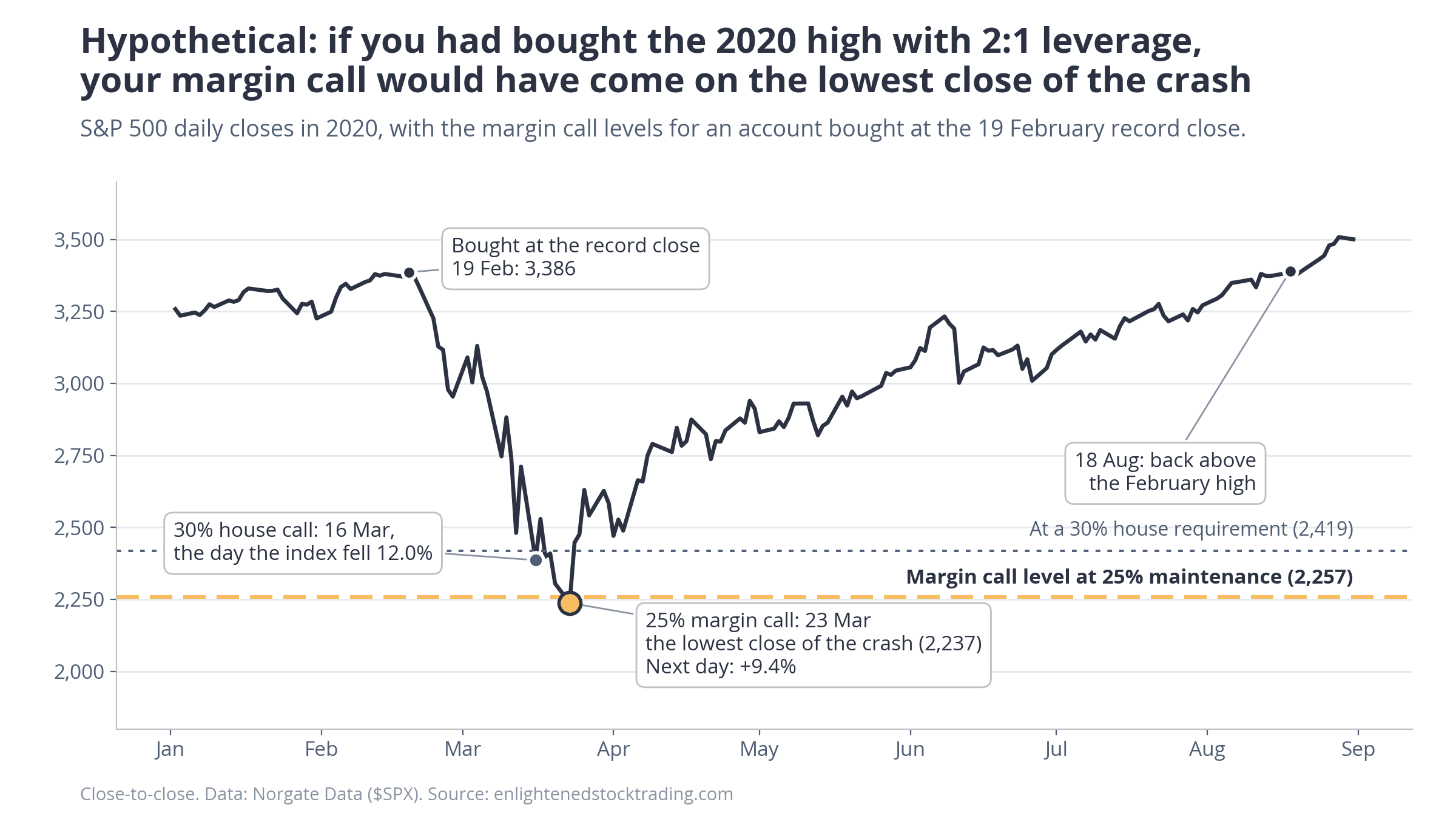
On 19 February 2020 the S&P 500 closed at a record high. A trader who bought the index that day with 2:1 leverage, $10,000 of their own money and $10,000 borrowed from their broker, would have been hit with a margin call 23 trading days later, when the index closed 33.9% lower on 23 March.
That was the lowest close of the entire crash. The next day the S&P 500 rose 9.4%, and by 18 August it had closed above its February high. The margin call came on the worst possible day because a margin call is triggered by the loss itself. It fires when your equity is at its lowest, and in a falling market that is usually close to the bottom.
I have been trading systematically for over 25 years, across the ASX, US, Canadian and Hong Kong markets. In that time I have had a handful of margin calls, most of them minor, because I never run my leverage anywhere near my broker’s limit. This guide explains what a margin call is, the difference between initial and maintenance margin, how to calculate the price that triggers one, how brokers liquidate your positions, and how a fast market can leave you owing more than you deposited. Then it shows how a systematic trader avoids margin calls by capping maximum exposure.
Margin calls are one part of a bigger subject. My guide to risk management for traders covers the full set of controls that keep a trading account alive, and my guide to leverage in trading explains how borrowed money multiplies every move you make. A margin call is the moment the borrowed money comes due.
What Is a Margin Call?
A margin call is your broker’s demand that you add cash or securities to your account, or sell positions, because your equity has fallen below the minimum the broker requires you to hold against borrowed money. That minimum is called the maintenance margin. In plain English, the margin call meaning is simple: your losses have eaten into the collateral behind your loan, and the broker wants it topped up.
Your equity is what would be left if you sold everything and repaid the loan. The broker holds that equity as collateral. When prices fall, the loan stays the same while your equity shrinks, and once your equity drops below the maintenance margin, you get the call.
You can meet a margin call in three ways:
- Deposit cash.
- Deposit more securities that the broker will lend against.
- Sell positions to reduce the loan.
If you do none of these in time, the broker sells for you. Many brokers don’t wait for you to choose. Some liquidate automatically the moment your account falls short.
Margin calls happen wherever you trade with borrowed money: US stock margin accounts, Australian margin loans, futures accounts, CFD and forex accounts, and the prime broker accounts hedge funds use. The trigger and the time you get to respond vary, but the mechanism is the same.
If you were searching for the 2011 film Margin Call, it is on my list of the best trading movies. This guide is about the margin call that happens to your own account.
What Is the Difference Between Initial Margin and Maintenance Margin?
Initial margin is the deposit you need to open a leveraged position. Maintenance margin is the minimum equity you must keep while the position stays open. The gap between the two decides how far your position can fall before the margin call.
In a US stock margin account:
- Initial margin is 50% under the Federal Reserve’s Regulation T. You can borrow at most half the purchase price, which caps you at 2:1 leverage on a new position.
- Maintenance margin is at least 25% of the market value of your positions under FINRA rules, and many brokers set their own “house” requirement of 30% to 40%. Brokers set higher requirements on volatile, concentrated or low-priced stocks, and on short positions.
Brokers can raise their house requirements at any time without notice, so a margin call can arrive even when the price hasn’t fallen any further. In my own Interactive Brokers account I have seen a single small-cap short position carry a margin requirement of 200% to 300% of its value.
Here is how the main account types compare:
| Account | Initial margin | When the margin call comes | Time to respond |
|---|---|---|---|
| US stock margin account | 50% (Regulation T) | Equity below 25% of the position’s value (FINRA minimum), often 30% to 40% at the broker | Often a few days, but the broker can sell straight away without contacting you |
| Australian margin loan | Set by the lender for each stock, as a maximum loan-to-value ratio (LVR) | LVR above the maximum plus a buffer, often 5 percentage points | Often around 24 hours |
| Futures account | Set by the exchange for each contract | Equity below the maintenance level, checked at least daily | Usually by the next trading day, and you must top up to the full initial margin |
| Retail CFD account (Australia and Europe) | 3.33% to 50%, depending on the asset | The provider must close positions once equity falls below 50% of the initial margin | No call: positions are closed automatically |
One detail in futures catches traders out. Once you are called, you have to bring the account back up to the initial margin, not just to the maintenance level. If a contract’s initial margin is $10,000 and its maintenance margin is $9,000 (illustrative numbers), a $1,500 loss leaves $8,500 in the account and the call is for $1,500, not $500.
How Is a Margin Call Calculated?
For a long position, the price that triggers a margin call is:
Margin call price = Purchase price × (1 – Initial margin) / (1 – Maintenance margin)
Buy a stock at $100 with 50% initial margin and 25% maintenance margin, and the margin call price is $100 × 0.5 / 0.75 = $66.67. A 33.3% fall triggers the call.
A 2:1 Margin Call Worked Example
This is the same example I use in my guide to leverage:
- You deposit $10,000 and borrow $10,000, buying $20,000 of shares. That is 2:1 leverage.
- The maintenance margin is 25%, the FINRA minimum.
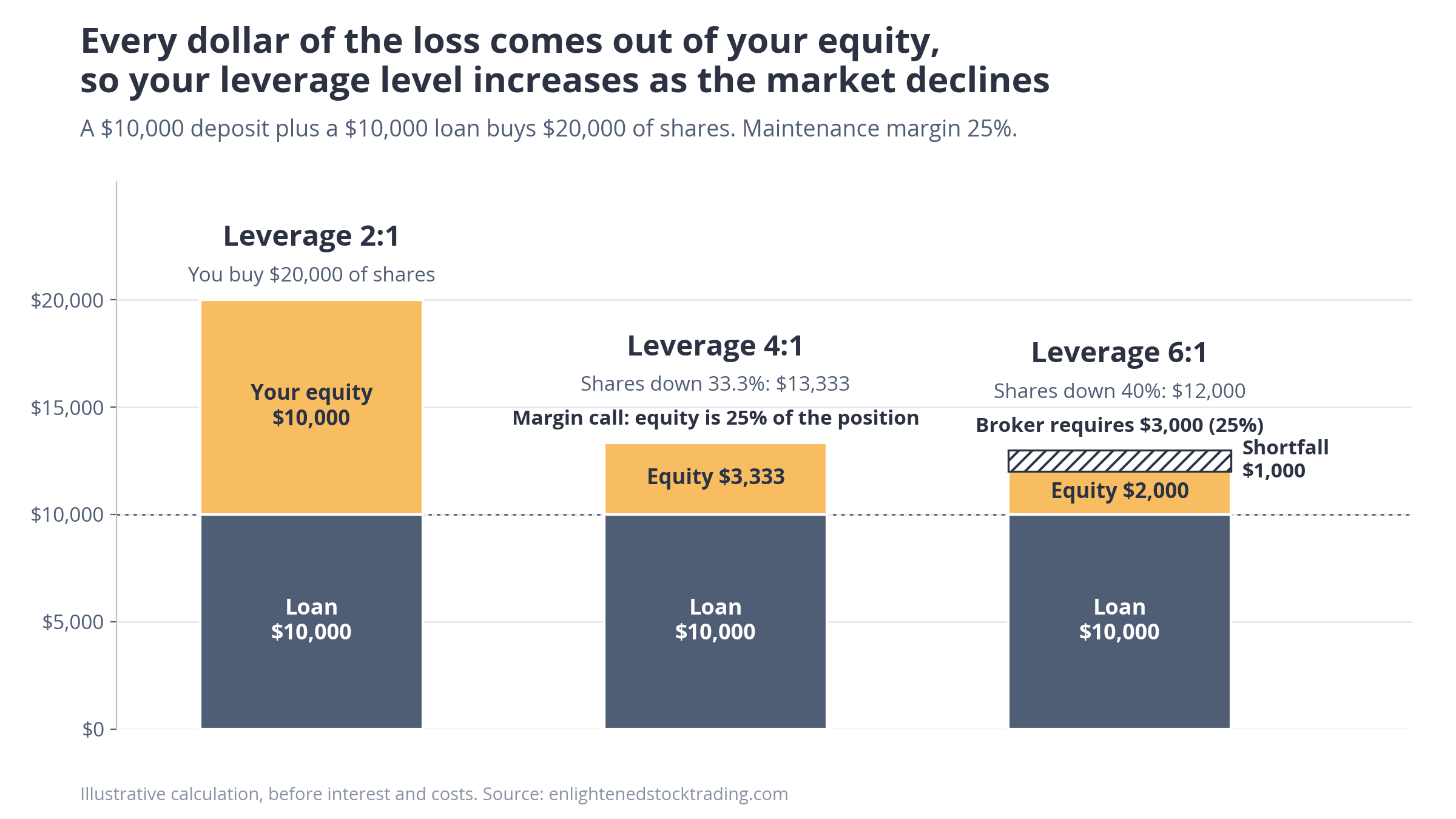
- The call arrives when your equity is only 25% of the position’s value. With a $10,000 loan, that happens when the shares are worth $13,333, a fall of 33.3%.
- At that point your equity is $3,333. You have lost two-thirds of your account on a one-third fall in the shares.
Two more numbers from that example explain why margin calls do so much damage.
Your leverage is 4:1 at the moment of the call. $13,333 of shares on $3,333 of equity is 4:1, double what you started with. With a 25% maintenance margin, every margin call arrives at 4:1 leverage, whatever leverage you opened at, because the broker calls you at the exact point where your equity is a quarter of your position.
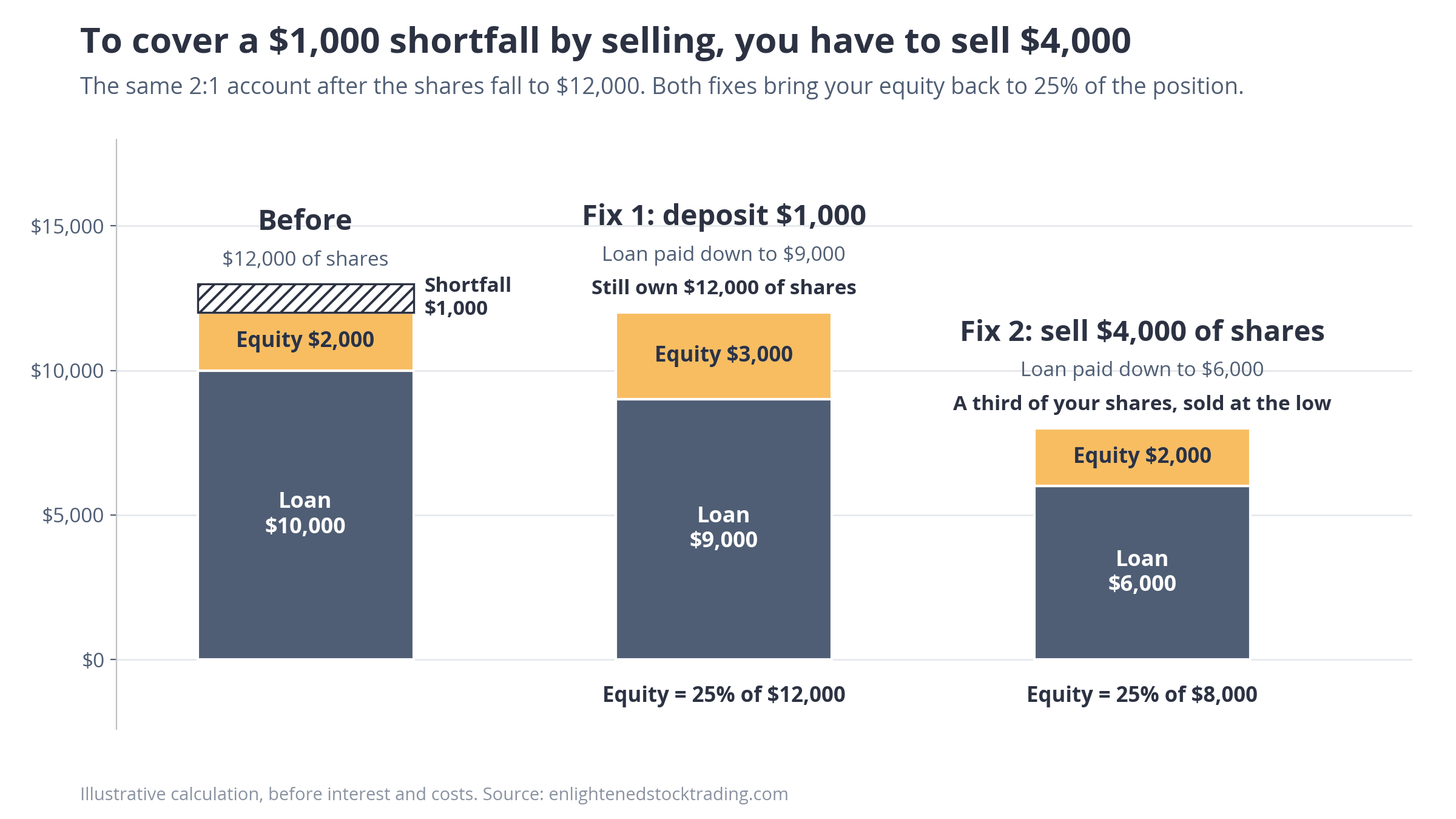
Selling to meet a call takes four times the shortfall. Say the shares keep falling to $12,000 before you act. Your equity is $2,000 and the broker requires $3,000 (25% of $12,000), so you are $1,000 short. Depositing $1,000 fixes it. Selling doesn’t work dollar for dollar: every $1 of shares you sell cuts the loan by $1 but leaves your equity unchanged, so the requirement only falls by 25 cents. To cover a $1,000 shortfall by selling, you have to sell $4,000 of shares, a third of what you hold, at the lowest price so far.
At a 30% house maintenance margin, the same 2:1 position is called after a 28.6% fall, and covering the call by selling takes 3.3 times the shortfall.
How Far Can the Market Fall Before a Margin Call?
The fall that triggers a call depends on two numbers: your leverage and your broker’s maintenance margin. Here is what that means at three levels of maximum exposure, alongside how often the US market has actually fallen that far:
| Leverage | Fall that triggers a call (25% maintenance) | Fall that triggers a call (30% maintenance) | S&P 500 declines that deep since 1950 | Nasdaq Composite declines that deep since 1971 |
|---|---|---|---|---|
| 1.3:1 (130% exposure) | 69.2% | 67.0% | 0 | 1 |
| 1.5:1 (150% exposure) | 55.6% | 52.4% | 1 | 2 |
| 2:1 (200% exposure) | 33.3% | 28.6% | 6 | 4 (9 at 30% maintenance) |
Declines measured close to close from a record close, using Norgate Data. The counts assume your portfolio moves exactly like the index.
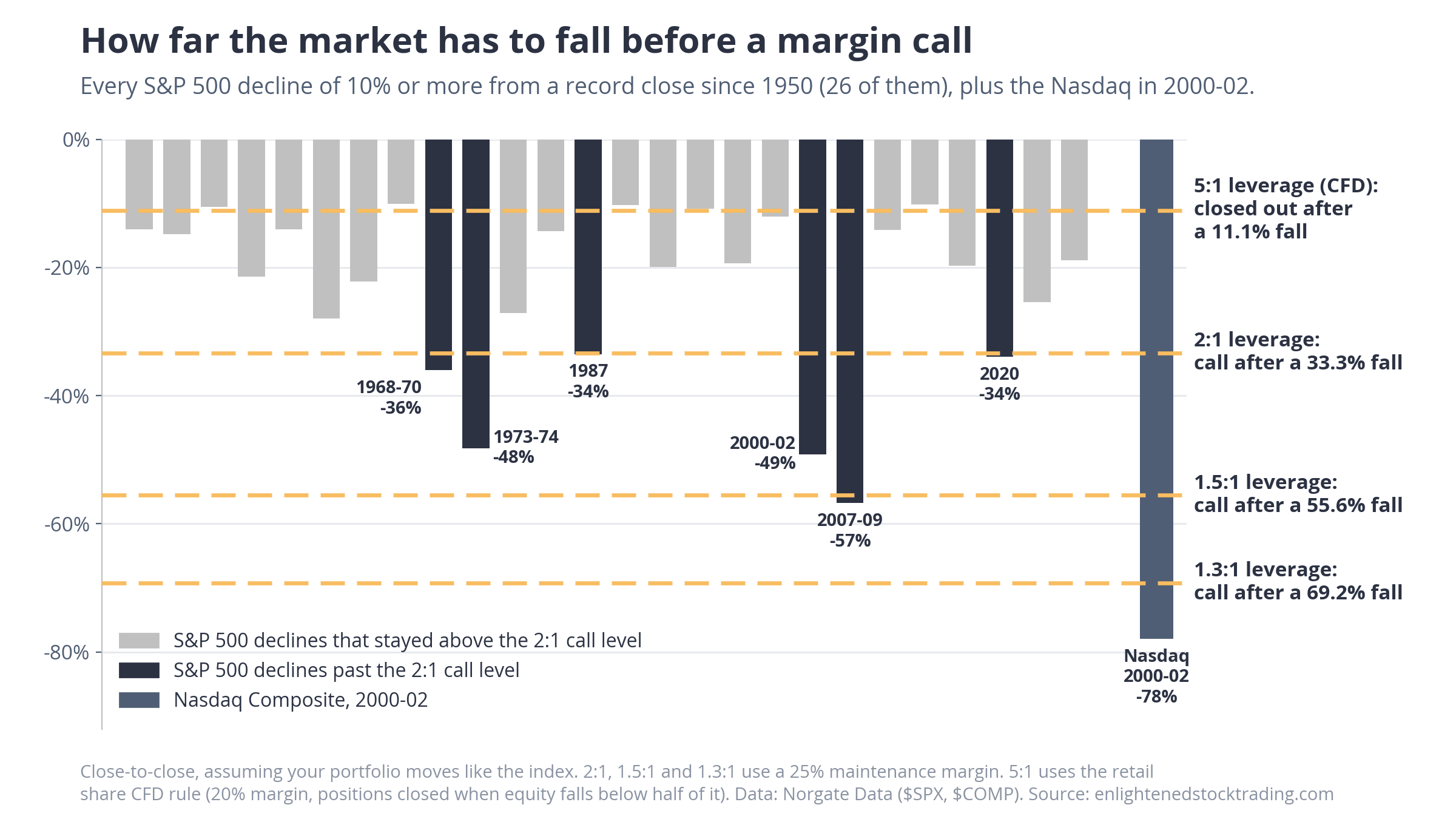
At 2:1, the S&P 500 has fallen far enough to trigger a margin call six times since 1950: 1968 to 1970, 1973 to 1974, 1987, 2000 to 2002, 2007 to 2009 and 2020. At 1.5:1 it has happened once, from October 2007 to March 2009, when the index fell 56.8%. At 1.3:1 it hasn’t happened on the S&P 500 at all, but the Nasdaq Composite fell 77.9% from March 2000 to October 2002, past even that level.
Your portfolio is not the index. A portfolio of a few concentrated, high-beta stocks falls further than the S&P 500, and a single stock can fall 50% overnight. Treat the index numbers as the best case.
Why Does a Margin Call Arrive After the Loss?
A margin call arrives after the loss because the loss is what triggers it. The broker measures your equity, and your equity only falls below the maintenance margin once the market has already moved against you. By the time you get the call, the money is gone. The call is a demand to fund a loss that has already happened, so that the broker is protected from the next one.
That timing has three consequences.
The call comes near the bottom. Your equity is at its lowest when prices are at their lowest, so a margin call tends to fire at or close to the worst point of a fall. In 2020, the 2:1 account from the opening example was called on the close of 23 March, the lowest close of the crash. A broker with a 30% house requirement would have called it a week earlier, on 16 March, the day the S&P 500 fell 12.0%, its worst day since 1987.
Selling at the call locks in the loss just before the rebound. The S&P 500 rose 9.4% the day after its 2020 low, and by 9 April it was 24.7% above that low. If the broker had closed the whole 2:1 position at the 23 March close, $10,000 would have become $3,215. A trader who bought the same index with no leverage at the February high was back to $10,000 by 18 August. The leveraged trader would need a 211% gain just to get back to where they started.
Your leverage rises all the way down. A 2:1 account is at 4:1 by the time the call arrives, so every further 1% fall now costs 4% of your remaining equity, not the 2% it cost when you opened the position.
The Margin Call Spiral
When lots of positions are margin-called at once, the forced selling pushes prices lower, which triggers more margin calls. Peloton Partners’ ABS fund is the textbook case. In February 2008 it was levered about nine times, long AAA-rated mortgage securities and short subprime, after returning 87% the year before. When lenders cut how much they would lend against those securities, the margin calls forced Peloton to sell into a market with no buyers. The sales pushed prices lower, that triggered more margin calls, and the fund was wiped out within days.
Peloton’s managers were former Goldman Sachs partners with excellent records. They chose to run nine times leverage on securities their lenders could reprice overnight, and they should have known better. If a fund run by people with that pedigree can be margin-called out of existence in a matter of days, a private trader running high leverage has no protection the fund didn’t have.
How Do Brokers Liquidate Your Positions?
Brokers liquidate by selling your positions at market prices until your account is back above the maintenance margin, and in most accounts they can do it without asking you first. Every US broker has to give you a margin disclosure statement under FINRA Rule 2264 when you open a margin account. In summary, it tells you that:
- You can lose more money than you deposit.
- The broker can sell your securities without contacting you.
- You don’t get to choose which securities are sold.
- The broker can raise its house maintenance requirements at any time, without advance written notice.
- You have no right to an extension of time on a margin call.
Interactive Brokers, which I use, calculates margin in real time and often doesn’t make a margin call at all. When an account falls short, its system starts liquidating positions automatically. You might get an email warning as you get close, but if you don’t act fast enough, the selling starts without you.
Here is what that means in a falling market:
- You don’t choose what is sold. The broker picks the positions, and the price is whatever the market offers at that moment.
- The selling happens when spreads are widest. Liquidation happens in the same panic that triggered the call, so you pay more in slippage than on a normal day.
- The broker decides how much to sell. Your margin agreement lets it sell whatever it needs to protect the loan, not just the minimum you would have chosen.
When Every Lender Calls at Once
Archegos Capital Management shows what happens when the leverage is spread across several lenders who can’t see each other’s exposure. In March 2021, Bill Hwang’s family office held roughly $20 billion in under a dozen stocks through total return swaps at several prime brokers, at about five times leverage. Each bank believed it was one of a few lenders rather than one of many financing the same book. When ViacomCBS announced a share sale and the stocks fell, margin calls arrived from every bank at once, and the banks raced each other to sell the same positions. Around $20 billion was gone in two days, and the banks lost more than $10 billion.
No single bank could see the whole book, and the man running it had every reason to know what the total added up to. Archegos is one of 62 funds in my hedge fund graveyard, and leverage was part of the story in 31 of them.
Can You Lose More Than You Deposit in a Margin Call?
Yes. In a margin account or a futures account, a fall that happens faster than the broker can sell leaves you owing the broker money. The margin call only protects the broker if there is time to sell before your equity goes below zero, and in a fast market there often isn’t.
Here is how I explain it to beginners. You have $20,000 of your own money and you borrow another $20,000, so you buy $40,000 of shares. The shares fall to $15,000. You still owe the broker $20,000. Sell everything and repay the loan, and you are at minus $5,000. You started with $20,000 of your own money, and now you owe money.
Fast markets can do this in a single session:
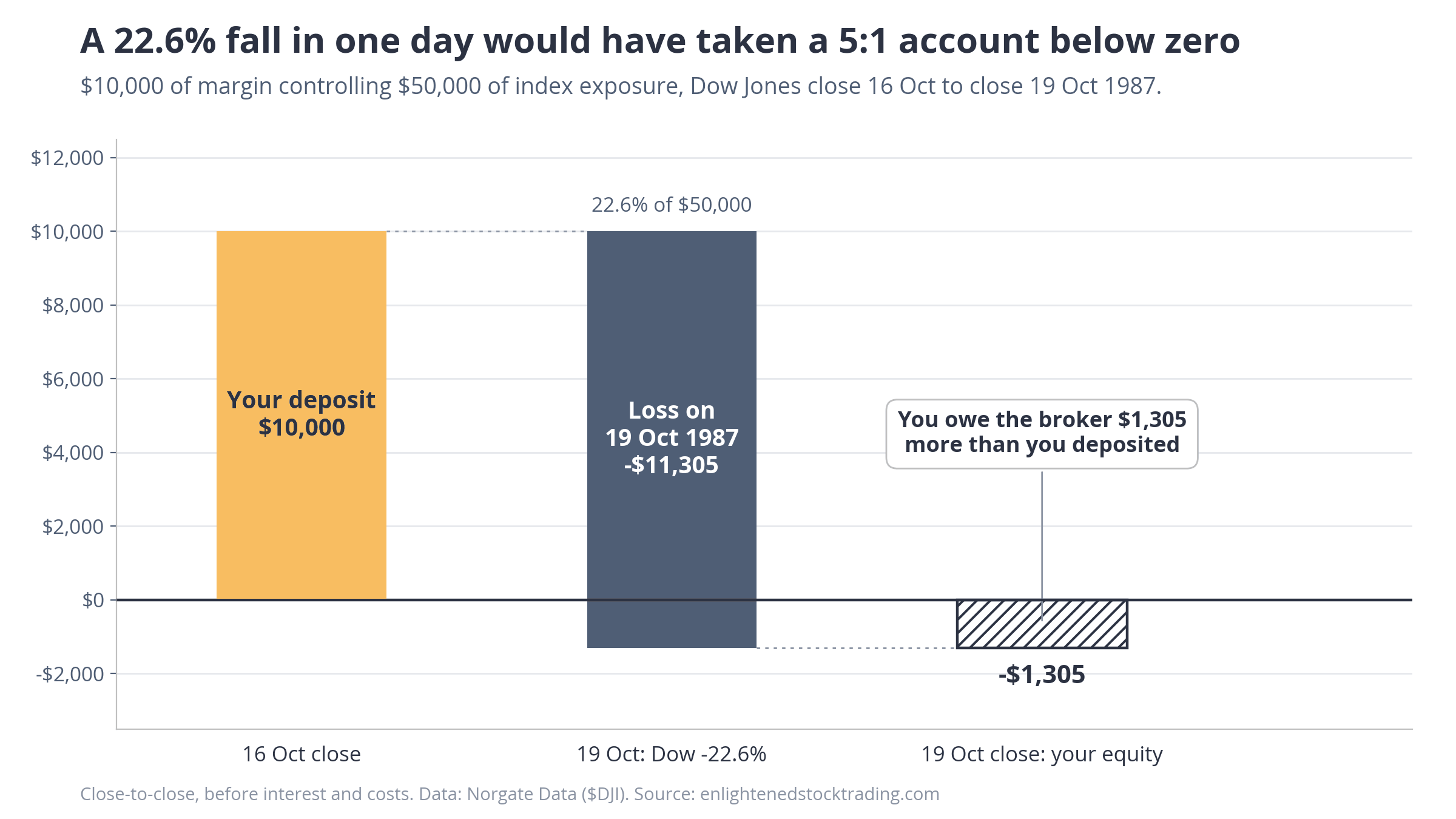
- 19 October 1987: the Dow Jones fell 22.6% in one day. Hold $50,000 of index exposure on $10,000 of margin (5:1, normal for futures and CFDs) and that one day cost $11,305, $1,305 more than your entire deposit.
- 16 March 2020: the S&P 500 fell 12.0% in one day. At 10:1, $10,000 controlling $100,000 lost $11,980 in a single session.
Single stocks are worse. A stock can open 50% lower on bad news, and there would be no chance to get out because it was an overnight gap and the market was closed. A stop loss doesn’t help either, because a triggered stop becomes an order at the next available price, which can be far below your stop. I have had a strategy whose worst backtested trade was -30% deliver a live trade worse than -50%, which is why I say your greatest loss is always in the future.
Two Traders Who Ended Up Below Zero
I had a friend who made $6 million trading stocks. Three weeks later he was at minus $300,000. He owed his broker and had to mortgage his house to pay it back. The reason this happened is that he was heavily leveraged using CFDs (this was before the days of negative balance protection in Australian CFD accounts).
Trading shares with your own money unleveraged, the absolute worst you can do is go to zero. Getting from $6 million to minus $300,000 takes borrowed money, and enough of it that the market moved further than his equity could absorb.
I also met a trader who was making $40,000 a month selling out-of-the-money put options on individual stocks, with leverage. He was living off his trading and driving a Ferrari he had bought with a loan secured against his trading income. The strategy won almost every month, and every winning month made more leverage feel safe. Then a stock gapped down through his strike price, and one trade wiped out the account. The Ferrari and other things were repossessed, and he gave up trading.
A gap is a move from one price to another with zero trading activity in between the two prices. When this happens there is no point in between where a broker could close a position for you. There is nothing you can do but take the loss.
Accounts Where You Can’t Go Below Zero
Retail CFD accounts in Australia and Europe carry negative balance protection, so your loss is capped at the money in the account. The provider must also start closing your positions once your equity falls below 50% of the initial margin. That protection stops you owing money. It does nothing to stop you losing everything in the account.
Margin Calls on Short Positions
A short position gets margin-called when the stock rises, and there is no ceiling on how far a stock can rise. In a US account you put up 150% of the short’s value when you open it (the sale proceeds plus 50% of your own money), and FINRA sets the maintenance margin on most short positions at 30%.
In a short squeeze, short sellers being margin-called have to buy back their shares, and that buying pushes the price higher still, triggering more calls. My guide to shorting a stock covers the risks on the short side and the rules I use to manage them.
How Do Systematic Traders Avoid Margin Calls?
A systematic trader avoids margin calls by capping maximum exposure so far below the broker’s limit that the market would have to fall further than anything in the backtest history to trigger one, and by checking that cap on every day of the backtest, not on average.
This is the process I use:
- Backtest every system with no leverage. I test each system as if the broker required 100% margin, using cash only. That shows the true capital each system needs before any borrowing.
- Cap total maximum exposure across every account. I keep my stock systems below 1.5:1, or 150% exposure, and run about 130% maximum long exposure. I consider 2:1 very aggressive for a portfolio of stock trading systems.
- Work out the fall that would trigger a call at your cap. Use the formula above. At 1.3:1 and 25% maintenance, the market has to fall 69.2% from the day you are fully invested. At 1.5:1 it takes 55.6%. At 2:1 it takes 33.3%, which the S&P 500 has done six times since 1950.
- Check the maximum exposure on every day of the backtest, not the average. Systems that rarely use all their capital at once can still be heavily invested on the same day… and that day is typically when the margin call comes and gets you into trouble.
- Watch your excess buying power every day. If it is heading toward zero, run your broker’s margin report position by position before the broker acts. There is often one outlier, typically a short position in a small-cap stock, using far more margin than anything else. Trimming or closing that one position usually fixes the problem without selling anything else.
- Stress-test the worst case, not the median. Run a Monte Carlo simulation of the portfolio and ask whether the worst outcome would still leave you trading the next morning.
Your exposure comes straight out of your position sizing. Every increase in risk per trade, or in the number of positions you allow open at once, raises your leverage and moves your margin call closer. My guide to position sizing covers the three sizing models I test and how to choose between them.
Margin calls also feed straight into risk of ruin. A forced sale at the bottom turns a drawdown you could have recovered from into a permanent loss. Most risk of ruin calculations assume your trades are independent, and a margin call is the moment that assumption fails, because your positions are sold together. You can test your own numbers in the free risk of ruin calculator, which accounts for how many positions you hold at once and how correlated they are.
What Should You Do If You Get a Margin Call?
Act before your broker does, and follow the rule your trading plan already has for this situation.
- Find out the exact shortfall and how long you have. With some brokers the answer is no time at all.
- Run the margin report and find the position using the most margin. Deal with that one first instead of selling at random.
- Decide between depositing cash and cutting positions using your exposure cap, not your hopes for a rebound. Depositing cash to keep a leveraged position open means adding new money to a position that is already losing. If your plan caps exposure at 130%, cut back to 130%.
- Lower your cap before you trade again. A margin call means your leverage was higher than your account could handle in the market you actually got.
Review your maximum possible exposure before you ever get a margin call, and reduce it to ensure that you never get a margin call in the future.
Frequently Asked Questions About Margin Calls
What Does Margin Call Mean?
A margin call means your broker is demanding more money because your account equity has fallen below the maintenance margin, the minimum you must hold against borrowed funds. You meet it by depositing cash or securities or by selling positions. If you don’t, the broker sells for you.
What Triggers a Margin Call?
A margin call is triggered when your equity falls below the maintenance margin, usually because your positions have fallen in value. In a US margin account at 2:1 leverage with the 25% FINRA minimum, a 33.3% fall triggers it. A broker raising its margin requirement can also trigger a call with no further fall in price.
How Long Do You Have to Meet a Margin Call?
It depends on the broker and the account. Some US brokers give a few days, Australian margin lenders often give around 24 hours, and futures accounts usually expect payment by the next trading day. Many brokers, including Interactive Brokers, can liquidate immediately without contacting you, so plan as if you have no time at all.
What Happens If You Don’t Meet a Margin Call?
Your broker sells your positions at market prices until the account is back above the maintenance margin. You don’t get to choose what is sold or when. If the sale doesn’t cover the loan, you owe the broker the difference.
Can You Lose More Than You Invest on Margin?
Yes. In a margin account or a futures account, a fast fall can take your equity below zero before the broker can sell, and you owe the shortfall. The Dow fell 22.6% on 19 October 1987, enough to wipe out a 5:1 account in one day and leave it owing money. Retail CFD accounts in Australia and Europe have negative balance protection, which caps the loss at your deposit.
How Do You Avoid a Margin Call?
Cap your maximum exposure well below your broker’s limit and check it on every day of your backtest. At 1.5:1 leverage and 25% maintenance, the market has to fall 55.6% before a margin call, which the S&P 500 has done once since 1950. At 2:1 it takes a 33.3% fall, which has happened six times.
Set Your Exposure Before Your Broker Does
Every margin call starts with a decision about leverage that was made weeks or months earlier. The traders who last make that decision in advance: they test every system without leverage, set their maximum exposure from the worst case in the data, and leave enough room below the broker’s limit that a margin call would need a crash bigger than anything in their backtest.
One trader told us when they joined: “I blew up a sizeable account some years back and took ‘some time off’ as a result. Now I want to approach the topic with a more data-based approach.”
That is what the Trader Success System teaches. You learn to build and backtest end-of-day trading systems, combine them into a portfolio, set position sizing and capital allocation from the evidence, and cap your exposure before you risk a dollar. Five to ten minutes a day, end of day, with your exposure set by rules you tested in advance, so your broker never has to make the decision for you.
Remember – you are only one trading system away!