Automated trading systems changed my life for the better. A few years ago, my wife Stephanie booked a surprise weekend away. Beautiful spot. Lovely accommodation. One problem – no internet, no mobile reception, and I had not yet placed my trades for the Friday session before we left on Thursday night.
I spent the first morning of our weekend driving to the nearest town that had a phone signal so I could open positions, set exits, and follow my plan. That was the moment I knew something had to change. My trading had quietly become a constraint on the life I was trying to build with it.
I had been trading manually for years. The routine worked. But as I diversified into more systems and more markets – ASX, US, Canada, Hong Kong, then crypto – the time required to execute every system, every market, every day, was eating into evenings, weekends, holidays, and family time. Manual was no longer scaling with the life I wanted.
That weekend was the trigger. The path from there was automation, a cloud VPS, and a setup that lets me run a seven-figure portfolio of systems in around half an hour a day. This article walks through everything I learned getting there – what automated trading systems actually are, how they work, where most traders get stuck, what they cost, what they can and cannot do, and the honest truth about whether AI trading bots are the shortcut they claim to be.
What are Automated Trading Systems?
An automated trading system is software that executes a predefined set of trading rules without manual intervention at the point of order entry. The trader defines the rules. The software watches the data, generates signals, and sends orders directly to the broker.
Three things have to be in place before a system qualifies as automated:
- Rules – precise entry, exit, position sizing, and risk management logic with no judgement required to apply them.
- Data – a clean, reliable feed of historical and current prices the system can read on schedule.
- Execution – a connection between your system and your broker that places orders automatically once signals are generated.
If any of those three is missing, you are running a semi-automated workflow at best. Most retail “automated trading” articles blur this line. They lump together signal alerts, charting indicators, and broker bots as if they were the same thing. They are not.
For the systematic end-of-day trader, automated trading means a daily process where your end-of-day system runs after the close, calculates the next session’s orders, and submits them at the open without you touching a keyboard. The trades are decided by rules you built and validated. The software is the messenger, not the strategist.
How Do Automated Trading Systems Work?
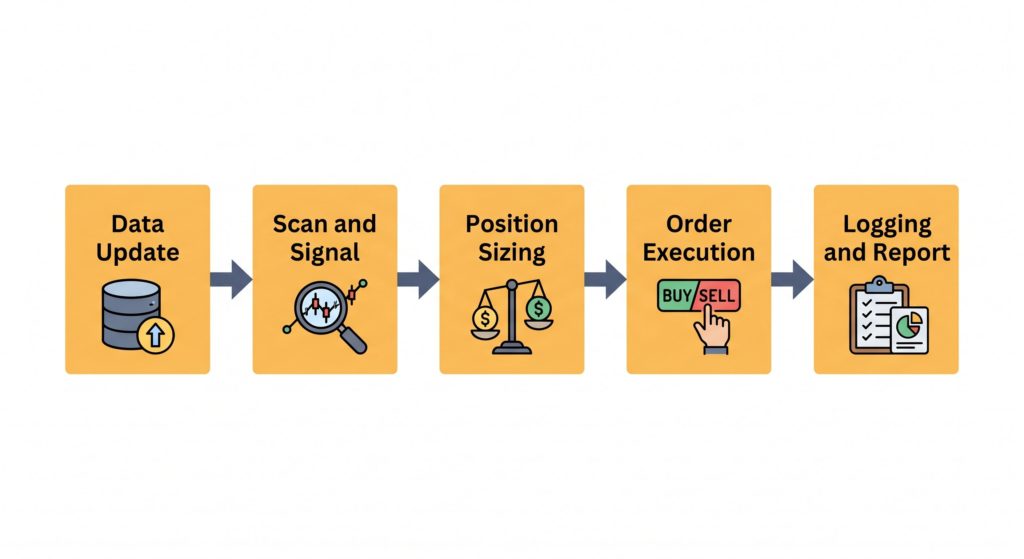
An automated trading system works by running the same five-step cycle every trading day, end-of-day, on schedule, without you in the loop.
Here is the daily cycle for a typical systematic end-of-day setup:
1. Data update. After the market close, the system pulls fresh end-of-day prices, dividends, splits, and index constituent changes from your data provider.
2. Scan and signal generation. The system runs each of your strategies against the updated data. For each strategy, it produces a list of buy candidates, sell signals, and exit orders for existing positions.
3. Position sizing and risk calculation. The system calculates how many shares to buy or sell for each signal based on your account size, your risk per trade, and the volatility of the instrument.
4. Order generation and execution. The system sends the orders to your broker through an API connection. For most end-of-day systems, this means market-on-open, market-on-close, or limit orders queued for the following session. Your order type choice depends on your strategy and the slippage you can tolerate.
5. Logging and reporting. Every signal, every order, every fill, and every position update is logged. A summary report lands in your inbox each day so you can verify the system ran cleanly.
This whole cycle takes a few minutes of computer time. Your job is to review the report and confirm nothing broke – data feed issues, missed fills, broker connectivity failures. That review is the part that cannot be automated, and it is the difference between automated trading and abandoned trading.
Automated Trading vs Algorithmic Trading vs Manual Trading: What Is the Difference?
These three terms get used interchangeably online, which causes confusion. They are not the same.
| Type | Decision making | Execution | Typical timeframe |
|---|---|---|---|
| Manual trading | Discretionary judgement | Manual order entry | Any |
| Systematic manual trading | Rules-based | Manual order entry | End-of-day, swing, position |
| Automated trading | Rules-based | Software places orders | Any |
| Algorithmic trading | Often rules-based, can be complex models | Software, often optimised for speed | Often intraday, HFT |
Manual trading in the broad sense is what most retail traders start with – looking at charts, making judgement calls, placing orders by hand. This is the discretionary trap most struggling traders are caught in.
Systematic manual trading is what I did for years before automating. The decisions are rules-based and backtested, but I placed every order by hand. This is a fine place to be for a long time, and arguably where every trader should spend their early systematic years.
Automated trading is systematic trading where the execution layer is also software-driven. The same rules, applied without human friction.
Algorithmic trading is a broader term that often gets applied to institutional or high-frequency strategies running on millisecond infrastructure. Almost none of this is relevant to the private systematic trader running daily-chart systems on a personal account.
For the end-of-day systematic trader, the sweet spot is systematic manual first, then automated trading once you have proven the system works and you understand exactly what it does.
The 3 Layers of Trading Automation (and Where Most Traders Get Stuck)
Most articles on automated trading skip the layer that matters most. They jump straight to execution software without acknowledging that automation is only the final layer of a three-layer stack.
Every working automated trading setup needs all three layers, in order:
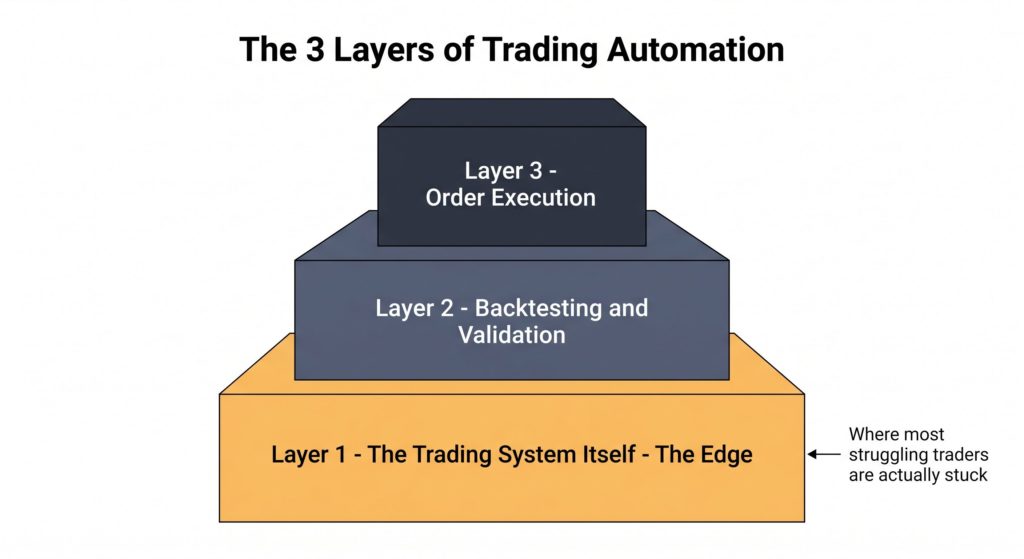
Layer 1 – The Trading System Itself
This is the actual edge – your entry rules, exit rules, position sizing, and risk management. Without a real edge here, nothing further matters. Automation does not create profitability. It only executes what you give it.
A system needs to define, with zero ambiguity:
- Which instruments it will trade
- Under what conditions a position is opened
- Under what conditions a position is closed
- How big each position will be
- How much total risk the system is willing to carry
If any of these is undefined, you do not have a system. You have a sketch. And you cannot automate a sketch.
This is where most struggling traders refuse to look. They want the dashboard, the green lights, the daily fill report. But the dashboard is downstream of the edge, and there is no edge yet. Read the trading systems pillar guide for the full anatomy of what a complete system looks like.
Layer 2 – Backtesting and Validation
Once you have rules, you have to prove they have an edge. This is what backtesting is for.
Backtesting is also where most retail traders create the lies they go on to trade with real money. Overfit parameters, in-sample-only results, ignored slippage, survivorship-biased data, and selective reporting are the four horsemen of fake edges. If your backtest looks too clean, it probably is.
A system that has passed proper backtesting – in-sample and out-of-sample, walk-forward validated, stress-tested through different market regimes – has earned the right to consider Layer 3.
Layer 3 – Order Execution
This is what most people mean when they say “automated trading,” and it is the smallest layer of the three. Execution software receives the orders generated by Layer 1 and Layer 2 and sends them to your broker.
Here is the truth I see inside the Trader Success System community every week: most struggling traders think they are stuck on Layer 3. They are not. They are stuck on Layer 1.
Your job, once you have a system you are confident in, is to replicate the backtest in the real world. Every execution question comes back to one thing – “What would my backtest do?” When traders miss trades, especially in trend-following systems where a handful of big trends drive most of the annual returns, missing even a couple destroys the year. That is not a system problem. That is an execution problem. And the fix is rarely more software – the fix is usually deeper trust in Layer 1.
Are Automated Trading Systems Profitable?
Automated trading systems are profitable when, and only when, the underlying trading system has a genuine, backtested edge. Automation does not produce profit. It produces consistent execution of whatever rules you feed it.
Feed it a profitable system, and you will get consistent profitable execution. Feed it a losing system, and you will get consistent losing execution. Faster than you can manually, with fewer emotional brakes to slow the bleeding.
This is the single most misunderstood point in the entire automated trading conversation. Almost every broker promotional article and AI trading bot pitch implies that automation itself is the edge. It is not. The edge is in the system. Automation is a delivery mechanism.
To know whether your system is profitable enough to automate, you need to understand its expectancy – the average profit or loss you can expect per trade after costs. A system with positive expectancy across a large sample of trades is one worth automating. A system with negative or unproven expectancy is one to fix before you touch automation software.
The honest answer to “are automated trading systems profitable?” is therefore: yes, when built on a real edge – and no, when built on hope.
What Are the Benefits of Automated Trading Systems?
The benefits of automated trading become obvious the moment you stop thinking about them as software benefits and start thinking about them as life benefits.
Time. This is the biggest one. A fully automated systematic setup takes minutes a day to monitor once it is built. That is the gap between trading consuming your life and trading enabling your life.
Elimination of execution errors. Manual execution introduces mistakes – missed signals, fat-finger orders, skipped trades that “looked wrong on the chart.” Automation removes that entire category of error. The system does what the rules say, every time, without negotiation.
Emotional disconnection from the moment-by-moment. When the system places the trades, your ego is not on the line with every fill. The pressure of needing to be right on each trade evaporates. The system makes the call, not you. The psychological relief from this is bigger than most traders expect until they experience it.
Scale across multiple markets and strategies. Manual trading scales linearly with time. The more systems and markets you run, the more hours you have to spend. Automation breaks that scaling. Once one system is automated, the marginal cost of adding another is small.
Consistency through life events. Holidays, sick kids, power outages, surprise weekends without internet. Manual systematic trading falls over the moment life gets in the way. Automation keeps running.
Better long-term results in trend systems. Trend-following systems make most of their annual return from a handful of big trades. Missing one because you were out of the office can destroy a year of returns. Automation does not miss.
One community member told me that without automation they would have been spending three or four hours every night manually processing their systems – and they might have walked away from trading entirely under that load. Automation saved their trading career.
What Are the Risks and Drawbacks of Automated Trading?
There is one truth I want to put in bold capitals at the top of this section: automated trading is not unattended trading.
The single most common, most expensive mistake I see when traders move to automation is assuming the system runs itself. It does not. It runs the rules itself. Everything around the rules – the data feed, the broker connection, the position sizing math, the system’s continued edge – still needs you watching.
Here are the real risks and where they bite.
Technical failures. Data feeds drop. Broker APIs go down. Orders get partial fills. Limit orders don’t execute on a touch fill. Server reboots interrupt a run. Without daily monitoring, you find out about the failure when it has already cost you money.
The psychology does not actually go away. A trader I worked with ran a fully automated strategy. The computer did everything. But the distribution of results – big losses mixed with winners – created daily stress that bled into his personal life. He stopped trading the strategy. Not because it was unprofitable. Because the emotional shape of the equity curve did not fit him. Automation removed his execution friction. It did not remove his psychology.
System decay. Markets change. A system that worked for ten years can stop working. Automated systems decay silently if you are not regularly comparing live results to backtested expectations. A robustness review every quarter is the minimum.
Drawdown intervention. Automation only works if you trust the system through inevitable losing streaks. If you cannot watch a 15% drawdown without flipping the off switch, you will destroy the edge you built. The system needs room to breathe.
Hidden manual effort beginners do not expect. Exclude lists need maintenance (especially in crypto where token availability changes by country). Capital reallocation across systems needs rules set in advance. Curve-fitting risk needs periodic review. Broker statements need reconciling. None of this is automated. None of it goes away.
The goal of automation is to remove manual execution errors and free up your time. It is not to remove your responsibility as the trader in charge. My systems run on a cloud VPS. I still review daily reports, monitor system health, and stay connected to what is happening. You should too.
How Do You Build an Automated Trading System? Step-by-Step
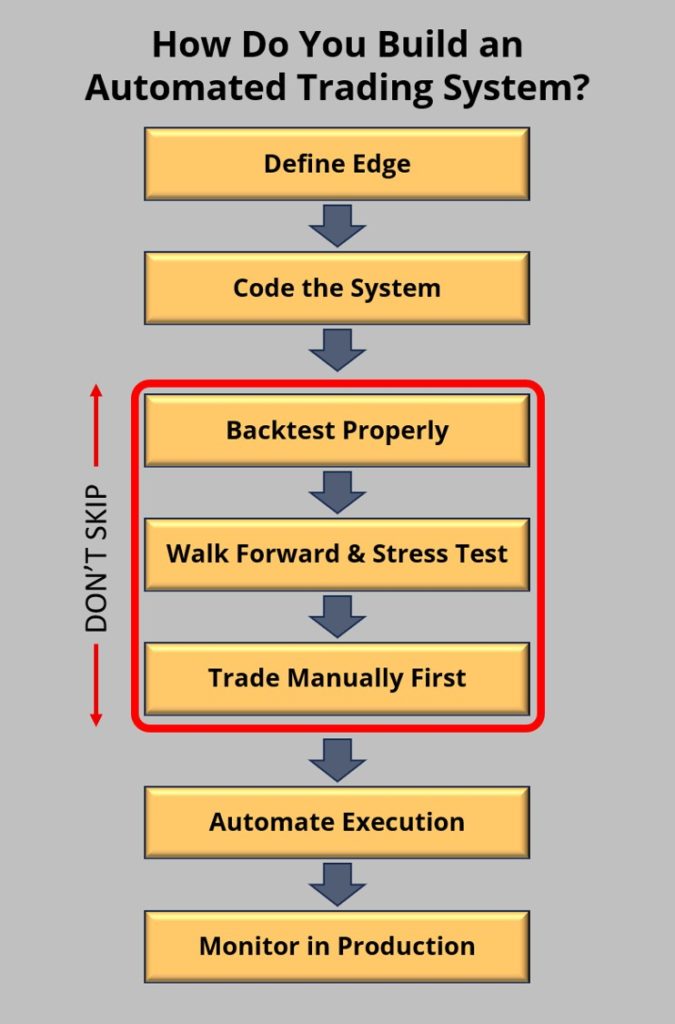
Building an automated trading system is a seven-step process, in this order. Skipping a step or doing them out of order is the single biggest reason traders end up automating losses.
Step 1 – Define your edge
Start with the trading strategy, not the software. Decide what you are trying to capture – a trend, mean reversion, a breakout, a volatility expansion. Pick markets and a timeframe. Write down, on paper, the rules in English before you write a line of code. If you cannot explain the rules to a friend in two minutes, they are not ready.
Step 2 – Code the system in a backtesting platform
Translate the English rules into code your backtesting platform can run. The two platforms I use and recommend are RealTest and AmiBroker. Both handle portfolio-level systematic testing. If you don’t have backtesting software yet, choose RealTest as it is more powerful and easier to learn. Both produce the statistical output you need to evaluate a system properly.
Step 3 – Backtest properly
This is the step where most traders cheat themselves. Use clean data with no survivorship bias. Test on the full available history. Include realistic slippage and commission. Report in-sample results separately from out-of-sample. If a test takes seconds, you are probably not testing carefully enough. We teach this entire process in depth in The Trader Success System.
Step 4 – Walk forward and stress test
Run walk-forward analysis or out of sample testing to confirm the system holds up on data it has never seen. Stress test it through bear markets, bull markets, high volatility, low volatility. A system that only works in one regime is a system that can really hurt you when the regime changes.
Step 5 – Trade it manually first
This is the step most beginners want to skip. Don’t. Trade the system manually for a few months. Get a feel for how it behaves in live markets. Watch the slippage, the fills, the psychology of holding through drawdowns. This builds the trust you will need when the automation has a bad week. My view is that you should never automate something that you have not done manually because otherwise it will be impossible to debug.
Step 6 – Automate execution
Once you trust the system and have manually traded it without intervention, automate. Start with signal generation only. Then add automated order placement. Run one system fully automated, monitor it carefully, and only then add a second.
Step 7 – Monitor in production
Every day, review the report. Reconcile the broker statement weekly. Run a system-health check monthly. Compare live performance to backtest expectations quarterly. If something drifts, investigate before assuming the system has broken; but don’t put it off because if the system is broken you want to know that before it costs you too much money!
This is the path. Skipping ahead never works. I have watched too many traders try to start at Step 6.
What Software Do You Need for Automated Trading?

A complete automated trading stack for an end-of-day systematic trader has four components. None of them is exotic. All of them can be assembled by a private trader without a quant background.
Backtesting and system development software. RealTest ($389 USD) or AmiBroker (Professional $339). These are the two platforms I trust for portfolio-level systematic backtesting. Most other charting platforms cannot do proper multi-position, multi-system (AmiBroker only backtests one system at a time, RealTest can backtest a portfolio of systems), portfolio-level testing.
Data. A clean, survivorship-bias-free, end-of-day data feed for the markets you trade. Budget around $50 per month. I use Norgate Data for ASX, US, and Canadian markets, and MetaStock for Hong Kong data and any other stock markets. Do not use free Yahoo data. The cost of bad signals from dirty data is many multiples of the data subscription.
Broker. Choose a broker that is regulated in a trustworthy first-world country, holds client funds separately from operating funds, and is financially stable. Interactive Brokers is my preferred broker for most markets. The collapse of MF Global is the cautionary tale here – traders who ignored warning signs got caught unable to exit positions.
Execution automation. This is the piece that connects your signals to your broker. I built my own automation in partnership with Alan Clement, and it is available as a productised solution called Quant Console at quantconsole.com. Quant Console connects the RealTest / AmiBroker backtesting engine to Interactive Brokers and handles the order generation, position sizing math, and trade reporting end-to-end.
Hardware. A standard laptop or desktop you likely already own will work, however it does not save you from power failures, loss of internet connectivity, damage or theft. For this reason I recommend automating your trading using a VPS. For end-of-day trading you do not need an expensive VPS because you are not developing and optimizing your trading system on the VPS, you are just generating and placing the orders. I use a Contabo VPS 20 with Windows. You do not need nine monitors, a Bloomberg terminal, or a real-time news feed. That is the institutional world. That is not your world.
A fully operational private systematic trader can get set up for well under $1,000 in software costs plus around $50 per month in data. The actual cost of running automated trading at retail scale is small. The actual cost of building a system worth automating is much larger – and that cost is mostly your time (unless you are a member of The Trader Success System where you get a complete portfolio of 20+ systems and clear step-by-step processes to get you up and running with confidence fast).
Common Mistakes Traders Make With Automated Trading Systems
After 20-plus years of trading and over a decade of mentoring other systematic traders, the same automated trading mistakes show up repeatedly. Avoid all of these.
Automating a system that does not have a proven edge. This is the biggest one. If you do not have a backtested, validated system with positive expectancy, automation just makes the losses arrive faster. Garbage in, garbage faster out.
Automating before trading the system manually. Manual trading builds the relationship with the system that you need when it goes through a drawdown. Skipping this step means you have no felt sense of how the system behaves, so you panic at the first losing streak.
Treating automation as unattended trading. The system runs the rules. You still run the system. Walk-away automation is broken automation.
Over-optimising parameters. A system tuned perfectly to historical data is almost guaranteed to underperform on future data. Choose stable parameter regions, not performance peaks.
Ignoring slippage and costs. A backtest that ignores realistic slippage is a backtest that is lying to you. Live results will be materially worse than a slippage-free backtest. Budget for it before you automate.
Trusting black-box systems you do not understand. If you cannot explain what your system does on a single page, you have no business running it with real money. Vendor-supplied trading bots and black boxes are particularly dangerous – you have no way to evaluate the edge, no way to know when it breaks.
Failing to monitor and reconcile. Daily reports go unread. Broker statements go unreconciled. Six weeks later, a position-sizing bug or a missed exit is discovered after it has cost real money. This is 100% preventable.
Adding too many systems too fast. Automate one, monitor it for a number of weeks, then add another. Running ten systems on day one means ten places where something can break and you will not catch it. I have seen too many traders rush to automate all of their systems in one go. That is like watching a train-wreck, it just gets worse and worse and you can’t stop it! Automate slowly, one system at a time and only add the next one when you get the first running smoothly.
Most of these mistakes share a root cause – traders want the outcome of automation (time freedom, consistency, scale) without doing the work that makes automation safe.
Are AI Trading Bots a Shortcut to Automated Trading?
The short answer is no. AI trading bots are not a shortcut. They are usually a faster path to the same losses you would have manually, with the added bonus of zero understanding of what went wrong.
This deserves some attention, because the AI trading bot category is dominating the 2026 retail trading conversation and the promise is genuinely seductive.
The first question to ask any bot vendor is what are their incentives? In most cases, the vendor makes money whether you win or lose. They make money from subscription fees, broker rebates, or commission shares. That is an incentive misalignment that should make you walk away before you read the rest of the sales page.
Most commercially available AI trading bots also share these structural problems:
- They trade intraday or at very high frequency, which is one of the toughest games in trading to actually win
- Short-term strategies tend to be fragile with short shelf lives
- The bot’s “edge” is usually overfit to historical data and breaks down when market conditions change
- You cannot inspect the rules to evaluate whether the edge is real or a statistical artefact
When the first wave of algorithmic trading systems became accessible to retail traders, vendors were selling the same promise in different packaging. Almost all of those systems were highly overfit and most broke down within a month or two of going live. The patterns they identified were not real edges, they were just overfit backtests that were marketed extremely well.
The danger most traders never see coming is more subtle than just a bad system. It is this: you slowly stop understanding your own trading process. When something breaks – and in trading, something always eventually breaks – you have no foundation to stand on. You cannot diagnose, you cannot adapt, you cannot rebuild. You have outsourced your trader’s brain to a black box.
I use AI in my own development process. It helps with idea generation, rule inspiration, and accelerating research. But I do not outsource my trading decisions to it. Not yet. It is too soon.
The traders succeeding with AI tools right now are not the ones subscribing to cheap bots and hoping for the best. They are systematic traders who already understand trading deeply and use AI to test more ideas faster. AI is a tool for traders. It is not a trader.
If a vendor cannot show you a rigorous backtest with fully disclosed rules, stable performance across multiple market regimes, and parameters that survive sensitivity analysis, what they are selling is hope, not edge. Hope is the most expensive purchase in trading.
How Much Time Does Automated Trading Actually Save?
A fully automated end-of-day systematic trading setup takes around 15 to 30 minutes a day to monitor and verify, once the systems are built and running cleanly.
That is the realistic number. Not five minutes – reality has slippage. Not three hours – that is what manual trading takes. The daily routine is deliberately short and repeatable. The rules do the heavy lifting. The trader does the oversight.
For comparison, I can manage a seven-figure account with more than 15 systems across multiple markets in that 15-to-30-minute window. That includes reviewing the previous day’s fills, checking that all systems ran cleanly overnight, verifying the data feed updated correctly, and confirming the orders queued for the next session match what the systems specified.
The time saving compounds in two ways. First, you get hours back every day immediately. Second, you can scale to more systems and more markets without scaling your time commitment. The marginal time cost of adding a second automated system is small. The marginal time cost of adding a second manual system is large.
This is the actual point of automation. Not lying on a beach while your bot prints money. The point is the freedom to live a normal life while running a serious portfolio.
Frequently Asked Questions About Automated Trading Systems
Are automated trading systems legal?
Yes. Automated trading is legal in every major retail market – the US, Australia, Canada (although for some reason Canadians are not allowed to place automated trades on the TSX, even though foreigners can – go figure?!?!), the UK, Hong Kong, and the EU. You are simply using software to place orders on rules you have defined. Brokers explicitly support automated trading via their APIs, and most retail brokers including Interactive Brokers offer documented programmatic access. There are no special licences required for a private trader running automation on their own account.
How much money do you need to start automated trading?
The software costs are small – under $1,000 in setup plus around $50 per month for data. The trading capital needed is a separate question. For automated trading to be worth the setup effort, your account should be large enough that the time saved and the execution errors avoided are economically meaningful. Below around $50,000 in trading capital, manual systematic trading is often the smarter starting point. Focus first on building and validating your system, then trade it manually and grow the account, then automate once the scale justifies it.
Do you need to know how to code for automated trading?
You need to know enough to write trading rules in your backtesting platform’s language (AmiBroker AFL or RealTest’s scripting language, for example). You do not need to be a full software developer. AI can help you with this – I rarely write my own system code any more. I am not a hardcore coder myself. Productised automation tools like Quant Console handle the heavy execution code so you do not have to build it from scratch.
Can you fully automate stock trading?
You can automate the execution layer fully. You cannot automate the responsibility layer. Data feed monitoring, broker reconciliation, system health checks, and periodic robustness reviews all remain your job. Automated trading is automated execution of rules. It is not unattended trading.
What is the best software for automated trading?
There is no single best software. The right stack depends on what you trade and how you trade. For end-of-day systematic stock and ETF trading on Interactive Brokers, my preferred stack is RealTest or AmiBroker for backtesting, Norgate Data for prices, Interactive Brokers as the broker, and Quant Console as the execution bridge.
What is the difference between automated trading and algorithmic trading?
The terms overlap heavily and are often used interchangeably. In practice, “automated trading” typically refers to retail or private-trader software that executes rules-based systems, often on daily or longer timeframes. “Algorithmic trading” more often refers to institutional or high-frequency systems running on optimised infrastructure at much shorter timeframes. For the private systematic trader running end-of-day systems, automated trading is the more accurate term.
Conclusion – The Missing Layer Is Usually Layer 1
If you take only one thing from this guide, take this: automation is the final layer of a three-layer stack, and most struggling traders are stuck on Layer 1.
The dream of automated trading is real. The time freedom is real. The consistency is real. The lifestyle that lets you take a surprise weekend away without driving to town for cell signal is real. I live that life now because the systems I built decades ago have grown into an automated portfolio that runs without me at the wheel for execution.
But none of it works without a system that has a real edge. Layer 1 is where the work is. Layer 2 proves the work. Layer 3 only delivers the work to the market. If you skip Layer 1, no amount of automation software fixes the problem – it just makes the losses faster and the confusion deeper.
The fastest path I know for a serious trader who wants to get to a working automated setup is to short-cut through the Layer 1 and Layer 2 mistakes by learning from someone who has already made them. That is exactly what the Trader Success System is built for – a structured five-stage journey from erratic discretionary trading to a fully systematic, validated, and ready-to-automate portfolio of systems. Quant Console is included for twelve months as part of the program, so when you are ready for Layer 3, the bridge is already built.
If you already have your trading systems dialed in and you are ready to automate them, then Quant Console is what you need. There is a stock version and a cryptocurrency version of Quant Console that both work with RealTest and AmiBroker.
If you are sick of trading restricting the life you are trying to build with it, automated systematic trading is the path out. Just make sure you walk it in the right order!