In February 2008, Peloton Partners was the best hedge fund in the world. Its ABS fund had returned 87% the previous year. It had just been named fund of the year. Fourteen months after that peak, investors had nothing at all.
In July 2026, Situational Awareness LP, run by Leopold Aschenbrenner, ran the same play with a different theme: up 439% in the first half of the year and holding a reported $20 billion to $45 billion (reports differ on the measure), it was down to roughly $10 billion within days once it sold most or all of its public stock portfolio in a single block to meet margin calls. I would say ‘Situational Awareness’ is a somewhat ironic name given what Leopold was doing. He clearly failed to see the AI stocks were in a bubble and a single correction could wipe out his fund. In fact, ‘Situational Blindness’ might have been a more apt name.
Peloton did not commit fraud. The managers were former Goldman Sachs partners with excellent records. They made one structural decision, to run about nine times leverage, and the market took the rest. Nor did the former OpenAI researcher behind Situational Awareness, still in his mid-twenties, whose read on the AI build-out may still turn out to be right. He ran up to four times leverage, which handed the timing of his exit to his lenders instead of keeping it for himself.
Eighteen years apart, same shape. I went looking for how often that story repeats. The answer is 62 times in the last 20 years, and the pattern is far more consistent than I expected.
This is the complete list. Every fund, when it died, what it was actually doing, and why it stopped existing. Then the part that matters for you and me: what a private trader with a five, six or seven figure account should take from a $9 billion failure.
The full classified dataset is free to download as a CSV, with no email address required, and every chart can be embedded with a credit link. Get the data.
The short version is that these funds died of things a rules-based process is specifically built to prevent. Not exotic things. Position size, leverage, correlation and liquidity. The same four items on your own checklist.
How many hedge funds have blown up in the last 20 years?
This list documents 62 hedge fund failures between 2005 and 2026. That is not every fund that closed, because hundreds shut quietly every year without making news. These are the ones where investors lost most or all of their money, or the firm was forced out of existence.
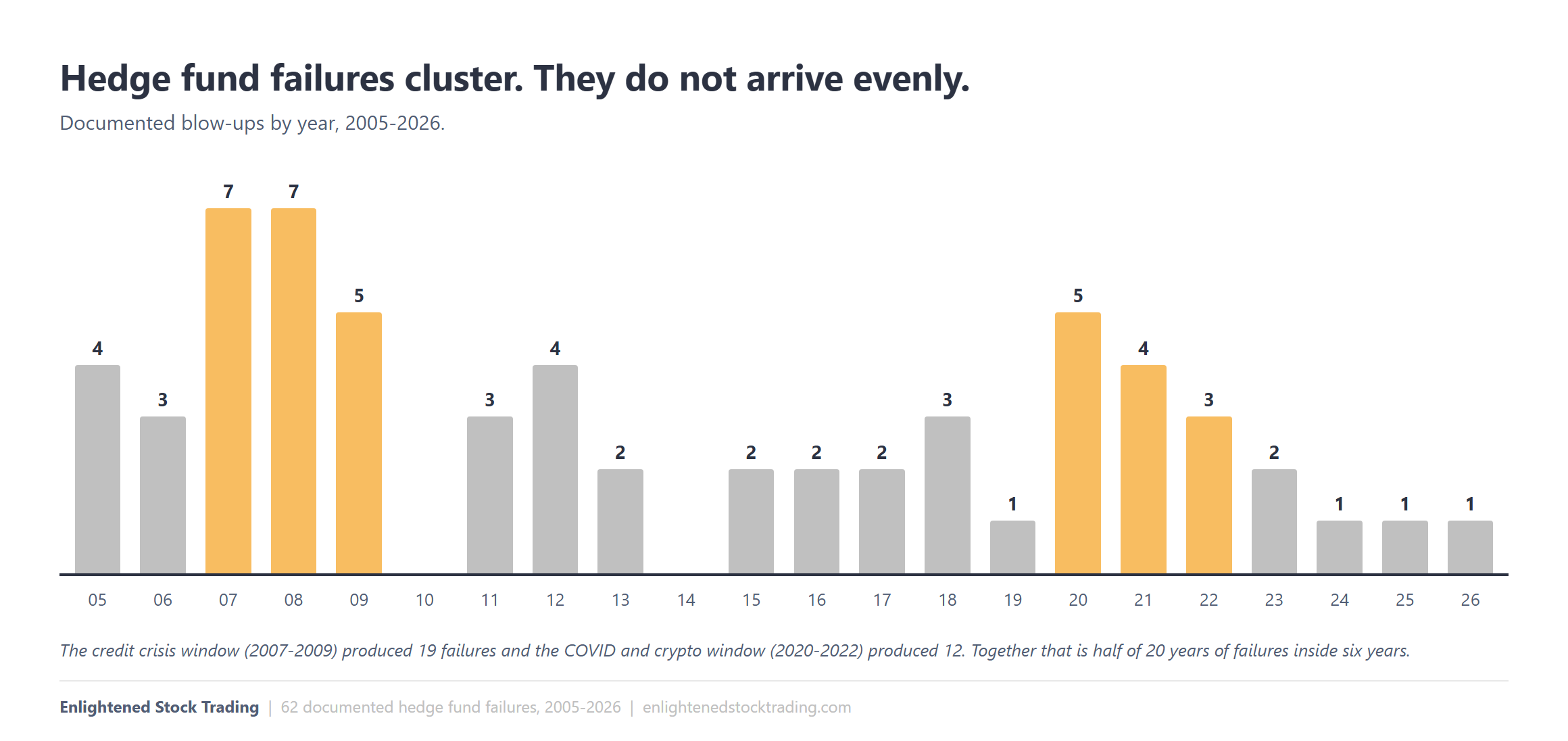
Failures do not arrive evenly. They cluster hard.
The credit crisis window of 2007 to 2009 produced 19 of the 62. The COVID and crypto window of 2020 to 2022 produced another 12. Together that is half of 20 years of failures compressed into six years. There were two full years, 2010 and 2014, with no major blow-up at all.
There is a lesson buried in that chart before we discuss a single fund. Risk does not show up on a schedule and it does not arrive in a steady drip. It sits quietly for years and then arrives all at once, which is precisely why a position size that feels comfortable in a calm market is the thing that kills you in a fast one.
What actually kills a hedge fund?
Fraud is the single largest category at 13 of 62 failures, followed by leverage and margin calls at 11, concentration at 10, and reputational or regulatory collapse at 10. Those four causes account for 71% of every failure on the list.
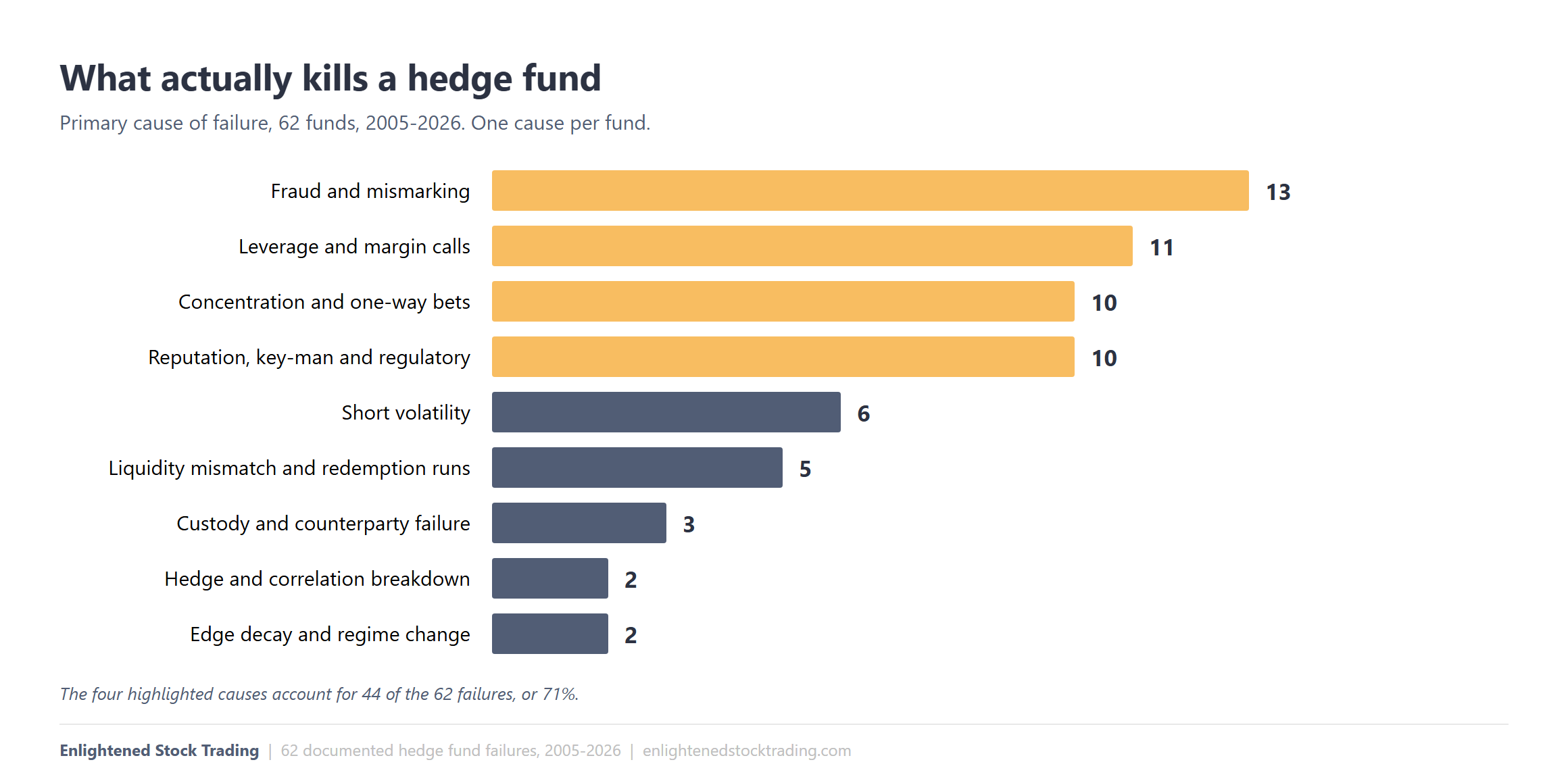
Each fund is assigned one primary cause, the thing without which it would probably still exist. Here is what each category means.
Fraud and mismarking (13 funds). The money was stolen, or the reported value was invented. Madoff, Bayou and WG Trading were Ponzi schemes. Platinum, Premium Point, Infinity Q and Direct Lending were real businesses holding real assets that the manager priced himself, at whatever number kept the returns looking smooth.
Leverage and margin calls (11 funds). The position was financed with borrowed money and the lender pulled the funding. Carlyle Capital, Peloton, Bear Stearns, Archegos and Three Arrows all died this way. In several cases the underlying asset was fine. The funding was not.
Concentration and one-way bets (10 funds). The fund held a position so large, or so singular, that there was no exit. Amaranth held natural gas spreads representing a huge share of the entire open interest. Everest Capital was short one currency.
Reputation, key-man and regulatory (10 funds). No trading loss required. Galleon, FrontPoint, Level Global, Odey and Segantii all had functioning strategies and died because investors and prime brokers left after a charge or a scandal.
Short volatility (6 funds). Selling options premium for years, then handing it all back in days. LJM, Malachite, Parplus, Allianz Structured Alpha, OptionSellers and Catalyst. Note the fatality rate: six entered this category and six were destroyed by it.
Liquidity mismatch and redemption runs (5 funds). The fund promised investors faster access to their money than its holdings could actually deliver.
Custody and counterparty failure (3 funds). The strategy was fine. The place holding the money failed. Ikigai and Galois both had assets stuck on FTX.
Hedge and correlation breakdown (2 funds). Both legs of a hedged position lost at the same time.
Edge decay (2 funds). No dramatic event. The strategy simply stopped working and the business bled out.
Was it fraud, or was it trading?
Fraud was the primary cause in only 13 of the 62 failures, or 21%. The other 79% lost the money legitimately.
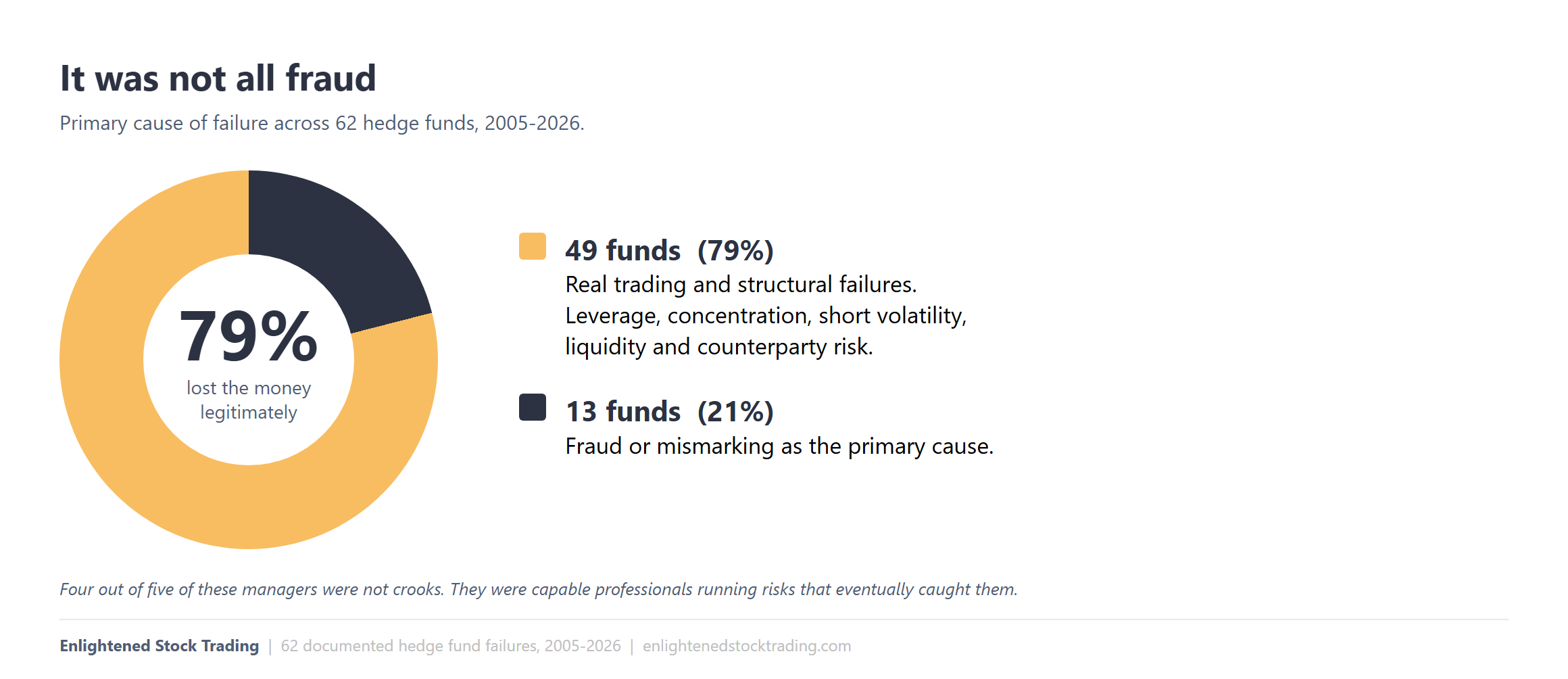
This matters more than it looks, because “they were crooks” is the most comfortable explanation available and it is wrong four times out of five.
Four out of five of these managers were supposedly competent professionals with real strategies, real risk teams, real compliance departments and, in many cases, decades of excellent returns behind them. Dwight Anderson at Ospraie rode a commodity boom for years. Andy Hall at Astenbeck was nicknamed the God of oil trading. John Meriwether had already been through Long-Term Capital and deliberately ran less leverage the second time.
All three closed their funds.
If failure were mostly a character problem, you could protect yourself by being honest. It is mostly a structural problem, which means you protect yourself with structure.
How much leverage was involved?
Leverage was present in 31 of the 62 failures, exactly half. Concentration appeared in 32, illiquid positions in 28, and fraud or misconduct somewhere in the story in 25.
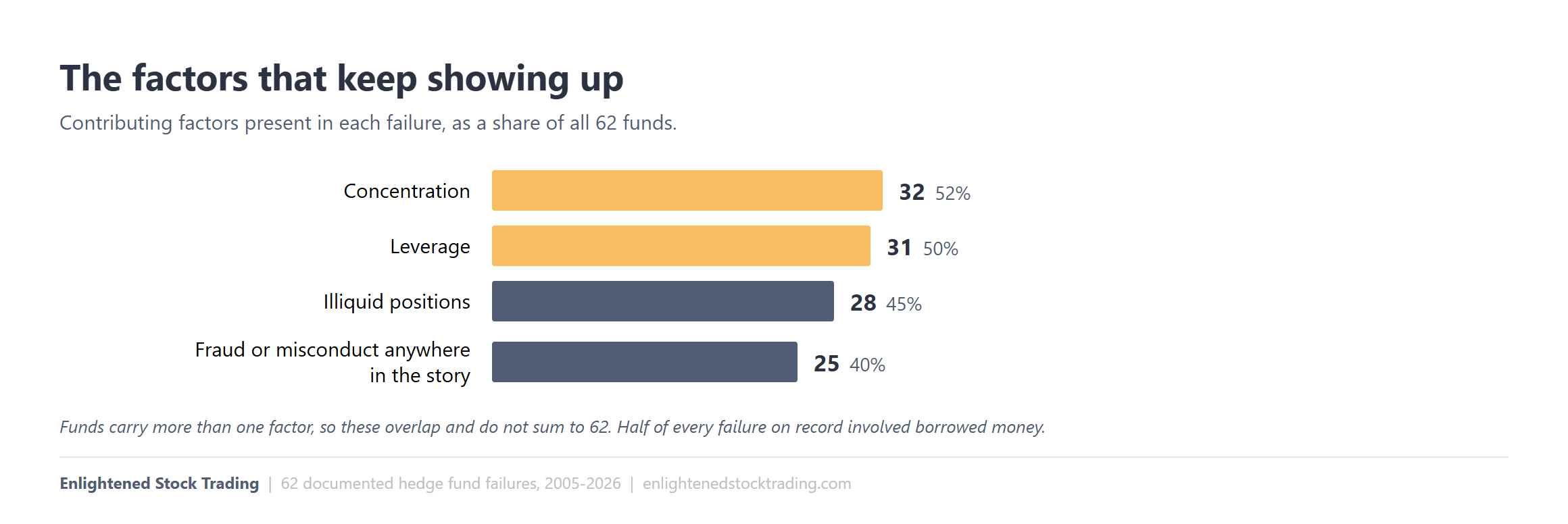
Those figures overlap, because most funds carried several factors at once. The interesting part is which combinations turn up together. Leverage on its own is survivable. Leverage on a concentrated position in an illiquid market is the specific combination that appears in Amaranth, Peloton, Focus Capital, Archegos and Three Arrows, and not one of those five survived.
That combination is worth memorising, because the retail version of it exists. Borrowed money, a position that is large relative to your account, in something that does not trade much. A leveraged small cap on margin is the same trade as Focus Capital, just with fewer zeros.
How fast does a hedge fund actually die?
Of the 49 market-driven failures, 29 went from fully operating to finished inside a single month. Thirteen of those took less than a week.
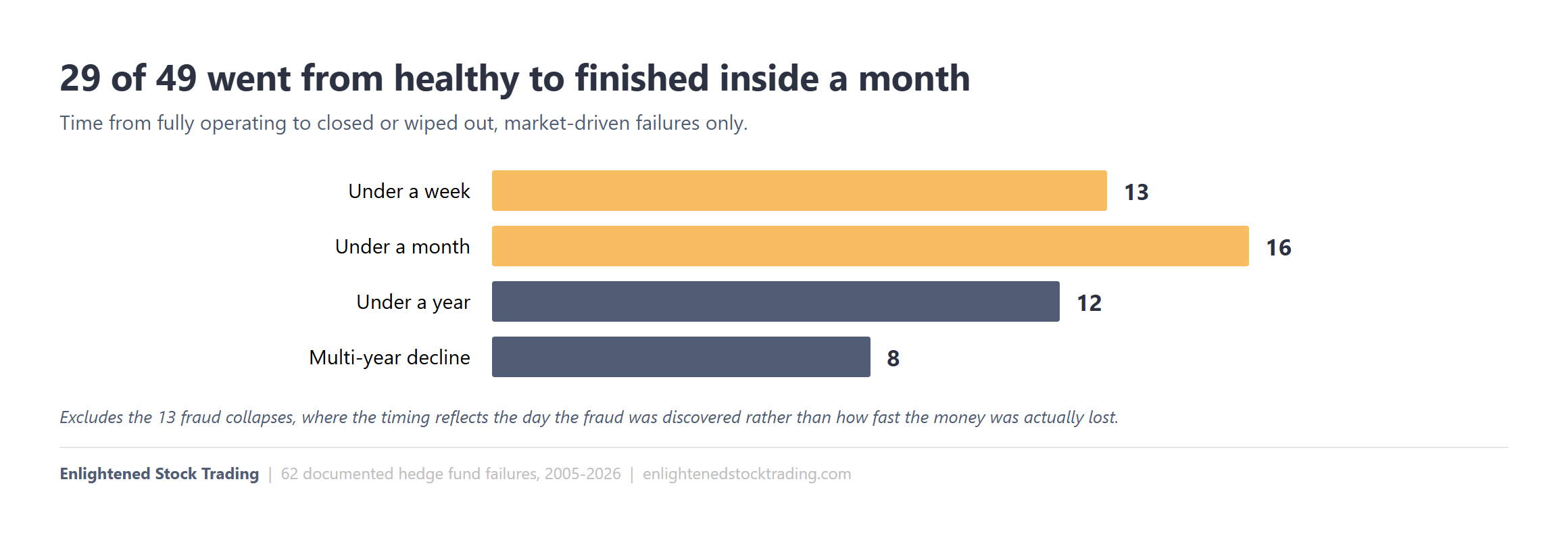
This chart excludes the 13 fraud collapses, because their timing reflects the day the fraud was discovered rather than how fast the money was lost.
Some specifics. Everest Capital Global was wiped out in one day when the Swiss National Bank abandoned its currency ceiling. LJM Preservation and Growth lost 80% across two trading sessions. Archegos lost roughly $20 billion in two days. Situational Awareness fell from a reported $20 billion to $45 billion to about $10 billion within days of its margin calls.
The practical implication is uncomfortable. There is no version of these events where a manager notices something going wrong on the Tuesday and calmly reduces risk by the Friday. The decisions that determined whether these funds lived were all made before the event, when everything was calm and the position looked sensible.
Your risk control is not something you apply during a crash. It is something you either installed beforehand or did not.
The complete list: 62 hedge fund blow-ups, 2005 to 2026
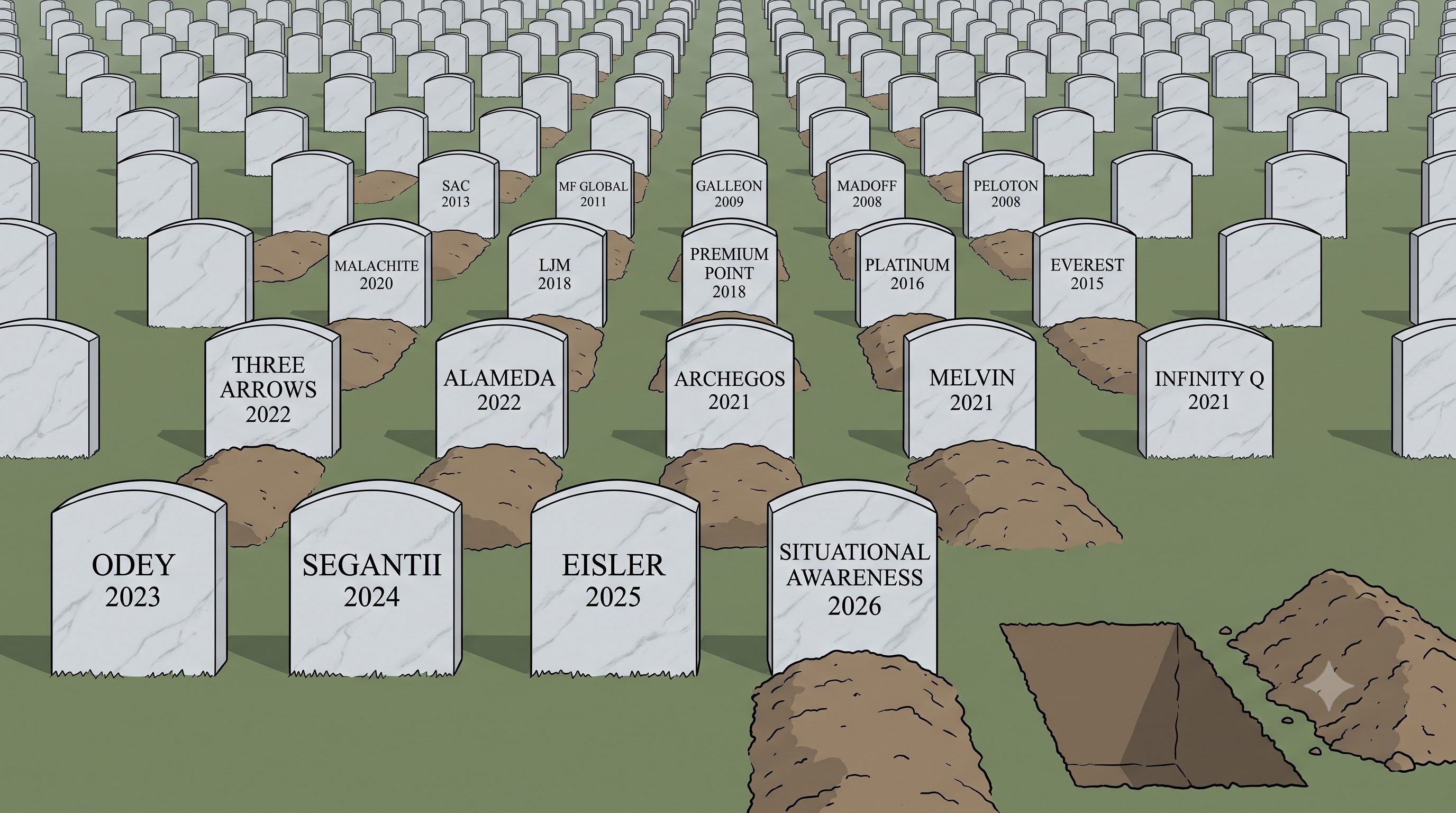
2005 to 2006: the pre-crisis warm-up
Marin Capital
Blew up: June 2005 | Approach: Convertible bond arbitrage, about $1.7bn
Long convertible bonds hedged with short equity. In May 2005 GM was downgraded to junk at the same time Kirk Kerkorian bid for the stock, so the bonds fell while the shares rose and both legs lost together. Every convert-arb desk in the market held the same book and tried to leave through the same door.
Bailey Coates Cromwell Fund
Blew up: June 2005 | Approach: Event-driven equity, London, about $1.3bn
A run of wrong-way directional bets on US stocks cost roughly a fifth of the fund’s value in months. Investors redeemed, which forced selling into the same falling positions. It closed within a year of being named a rising star.
Aman Capital
Blew up: 2005 | Approach: Credit derivatives, Singapore, about $242m
Founded by ex-UBS traders and billed as Asia’s next great hedge fund. Complex credit derivative positions moved against it in the 2005 dislocation and the losses ran well past expectations. The reputational damage travelled faster than the losses and investors left.
Bayou Hedge Fund Group
Blew up: August 2005 | Approach: Claimed short-term equity trading, about $450m raised
Bayou lost money almost from inception and fabricated returns rather than report it. It created its own fake accounting firm, Richmond-Fairfield Associates, to sign off the audits. Founder Samuel Israel III and his CFO both received 20-year sentences.
MotherRock LP
Blew up: August 2006 | Approach: Natural gas futures, about $400m
Founded by a former president of the NYMEX and positioned for natural gas prices to fall. It lost 24.6% in June 2006 and another 25.5% in July as the market spiked. Its main opponent in those trades was Amaranth, which blew up on the other side of the same market weeks later.
Amaranth Advisors
Blew up: September 2006 | Approach: Sold as multi-strategy with $9.2bn. Actually one natural gas calendar spread book
Trader Brian Hunter was long March gas and short April gas in a size that represented a huge share of total open interest. There was no way out without moving the price against himself. The fund lost about $6.6bn in roughly a week, more than 65% of its capital.
Vega Asset Management
Blew up: 2006 to 2007 | Approach: Global macro, roughly $12bn at peak
A run of losing macro calls from 2004 through 2006 hit the flagship fund hard. Macro investors have short patience, so redemptions compounded the trading losses. Assets fell from about $12bn to under $1bn.
2007 to 2008: the credit crisis kill zone
Dillon Read Capital Management
Blew up: May 2007 | Approach: UBS in-house hedge fund, mortgage credit and structured products
Built large subprime positions just as the underlying loans began defaulting. A first-quarter loss of around $125m was enough for UBS to shut it after two years and absorb the book. That decision proved far more expensive than the fund’s own losses.
Bear Stearns High-Grade Structured Credit Strategies Funds
Blew up: June to July 2007 | Approach: Highly rated subprime CDO tranches funded with repo leverage, about $1.6bn
A carry trade: borrow short, hold long-dated mortgage paper, keep the spread. It works while the collateral holds value and the repo market stays open. When delinquencies rose, dealers marked the CDOs down and issued margin calls the funds could not meet, and there was no bid at any price near the marks. Investors lost essentially everything.
Sowood Capital Management
Blew up: July 2007 | Approach: Credit relative value, about $3bn, run by Harvard’s former endowment manager
Long corporate bonds hedged with short equity and credit derivatives. The hedge relationship broke in the July 2007 dislocation as credit sold off while equities held, so both legs lost together. The fund lost more than 50% in weeks and Citadel bought the entire book at a distressed price.
Basis Yield Alpha Fund
Blew up: August 2007 | Approach: Australian manager running leveraged structured credit
Buying the same mortgage-linked paper as everyone else, financed by the same investment banks. Once dealers marked the collateral down, margin calls arrived faster than illiquid positions could be sold. Losses exceeded 80% and it filed for Chapter 15 bankruptcy protection.
Absolute Capital Management Holdings
Blew up: September 2007 | Approach: Cayman-based long/short equity, roughly $3bn
Founder Florian Homm resigned abruptly and disappeared. The funds were suspended when it emerged the portfolios held illiquid US micro-caps whose prices had allegedly been supported by the manager’s own buying. Reported NAV bore little relation to what the positions could be sold for.
Sentinel Management Group
Blew up: August 2007 | Approach: Cash management for brokers, marketed as a safe liquidity vehicle, about $1.5bn
Sentinel took client cash meant for low-risk instruments, pledged those client securities as collateral in its own leveraged repo lines, and bought higher-yielding illiquid paper. When credit markets seized, the leverage killed it and the commingling meant client assets were gone. More than $500m of customer money was lost.
Sailfish Capital Partners
Blew up: Late 2007 into 2008 | Approach: Credit relative value, roughly $2bn
Credit positions deteriorated through the second half of 2007 and investors began withdrawing, which is the fatal feedback loop for any leveraged credit book. Assets halved in about six months and the managers wound it down.
Peloton Partners ABS Fund
Blew up: February 2008 | Approach: Long AAA Alt-A mortgage securities, short subprime, levered about nine times, $1.8bn
The trade assumed the market was irrationally punishing high-quality mortgage paper. Instead lenders cut the amount they would lend against exactly those securities, forcing Peloton to sell into a market with no buyers, which pushed prices lower, which triggered more margin calls. Wiped out within days after returning 87% the year before.
Focus Capital Investors
Blew up: February 2008 | Approach: Concentrated activist stakes in Swiss small and mid-caps, using prime broker leverage
Large, illiquid, leveraged holdings in a handful of names. When those share prices fell in early 2008 the prime brokers issued margin calls, and there was no way to exit positions of that size in thin mid-caps without collapsing the price. The brokers liquidated the book.
Carlyle Capital Corporation
Blew up: March 2008 | Approach: $21.7bn of AAA agency mortgage bonds against $670m of equity, financed in repo. Leverage around 30 to 1
The assets were genuinely high quality government agency paper that ultimately paid off. It made no difference. Funding was overnight, and when repo lenders raised haircuts in March 2008 the fund had to post collateral it did not have. Within a fortnight the lenders seized and sold the portfolio.
Ospraie Fund
Blew up: September 2008 | Approach: Commodities and resource equities, long/short, about $2.8bn at peak
Long energy, mining and resource equities into the commodity peak of mid-2008. The fund lost 26.7% in August alone and 38.6% for the year. Dwight Anderson closed the flagship rather than trade through it.
Tontine Associates
Blew up: November 2008 | Approach: Highly concentrated deep-value US industrials and small caps
Concentrated, high beta and packed with economically sensitive small caps at the wrong point in the cycle. The funds fell about 65% in October 2008 alone and roughly 77% for the year. Redemptions forced selling into a market with no liquidity in those exact names.
Highland Crusader Fund
Blew up: October 2008 | Approach: Distressed debt and leveraged loans, grown from $20m to about $3bn
Distressed credit is illiquid by definition, and the fund offered redemption terms far more liquid than its assets. When credit markets froze, Highland suspended redemptions and entered a wind-down that lasted more than a decade. Investors later won a $189m arbitration award over the handling of it.
Bernard L. Madoff Investment Securities
Blew up: December 2008 | Approach: Claimed a split-strike conversion strategy. There was no strategy and no trading
The largest Ponzi scheme in history, paying redemptions out of new subscriptions and reporting near-impossible consistency for decades. The 2008 crash brought redemption requests he could not fund. Around $17.5bn of actual principal was lost. Every warning sign was visible in advance: a two-person auditor, self-custody, no independent administrator, and returns too smooth to be real.
2009 to 2013: fraud, regulation and the insider trading purge
Weavering Capital
Blew up: March 2009 | Approach: Marketed as low volatility macro fixed income, about $600m
The fund’s reported assets consisted largely of interest rate swaps valued at $630m, transacted with a British Virgin Islands shell company owned and controlled by the manager himself. The swaps were worthless and existed only to fabricate a NAV that hid real losses. Magnus Peterson received 13 years.
Scoop Management (Arthur Nadel)
Blew up: January 2009 | Approach: Six hedge funds claiming active equity trading
Nadel overstated the funds’ value by around $300m and disappeared, leaving a suicide note before being arrested days later. He and his partners had collected at least $97m in management and incentive fees on gains that never existed.
WG Trading / Westridge Capital
Blew up: February 2009 | Approach: Sold as market-neutral index arbitrage to endowments and pension funds, about $1.8bn
A 13-year fraud in which client money funded houses, horses and a multi-million dollar teddy bear collection. It survived so long partly because regulators had not examined the firm since 1995, and collapsed the moment the National Futures Association finally reviewed it.
JWM Partners
Blew up: July 2009 | Approach: Fixed income relative value, John Meriwether’s post-LTCM fund, about $2.7bn
Meriwether ran a similar convergence-arbitrage playbook to Long-Term Capital with lower leverage, and it failed the same way, just more slowly. The fund lost about 44% between September 2007 and February 2009 as spreads blew out and funding dried up.
Galleon Group
Blew up: October 2009 | Approach: Technology and healthcare long/short, about $7bn at peak
The strategy was profitable but the edge was illegal, sourced from corporate insiders and expert networks. Raj Rajaratnam was arrested in October 2009 and told investors within a week the funds would wind down. He received 11 years.
FrontPoint Partners
Blew up: 2011 | Approach: Multi-strategy long/short platform, about $7bn, made famous by its subprime short in The Big Short
A healthcare portfolio manager was charged with trading on inside information from a doctor in a drug trial. Investors redeemed en masse, roughly halving assets in weeks, and the firm shut. No bad trade was required.
Level Global Investors
Blew up: February 2011 | Approach: Equity long/short, about $4bn
The FBI raided the offices in November 2010 as part of the expert-network investigation. Investors withdrew immediately and the fund announced a wind-down three months later. A co-founder’s conviction was overturned on appeal years after the fund was already dead.
Diamondback Capital Management
Blew up: December 2012 | Approach: Multi-manager equity long/short, more than $2bn
Raided on the same day as Level Global in the same investigation. It survived two more years but never regained trust, and when clients pulled more than half a billion dollars the firm returned capital and closed.
Tiger Asia Management
Blew up: December 2012 | Approach: Asia-focused long/short run by Bill Hwang, more than $5bn at peak
Pleaded guilty to wire fraud over trading Chinese bank shares on confidential information and settled with the SEC for $44m. Hwang was barred from managing outside money and converted the remainder into a family office called Archegos, which appears again nine years later on this list.
MF Global
Blew up: October 2011 | Approach: Listed futures broker running a hedge-fund-style proprietary trade under Jon Corzine
A $6.3bn repo-to-maturity position in European peripheral sovereign bonds, financed short term, on the view that they would pay at maturity. Margin calls and a downgrade drained liquidity and the firm used segregated customer funds to plug the gap. Bankruptcy followed with a $1.6bn customer shortfall.
Peregrine Financial Group
Blew up: July 2012 | Approach: Futures commission merchant holding client margin
Founder Russell Wasendorf forged bank statements for close to 20 years to conceal that roughly $215m of segregated client money was missing. The fraud unravelled when the industry moved to electronic balance confirmations after MF Global. He received 50 years.
BlueGold Capital
Blew up: April 2012 | Approach: Directional oil macro, about $1bn
Co-founded by Pierre Andurand after spectacular early returns. The fund fell 34% in 2011 and liquidated the following year, returning about 98% of investor capital.
FX Concepts
Blew up: October 2013 | Approach: Systematic currency models, once the largest currency hedge fund in the world at about $14bn
The models were built on currency trends and interest rate differentials, and coordinated quantitative easing after 2009 flattened exactly those signals. Assets fell from about $12bn in 2009 to $661m by September 2013 and the firm filed for bankruptcy. A three-decade edge died quietly.
SAC Capital Advisors
Blew up: 2013 | Approach: Multi-manager equity trading, roughly $14bn
Pleaded guilty to insider trading, paid a record $1.8bn, and was barred from managing outside capital. Eight employees were convicted. Investors got their money back, but a $14bn firm ceased to exist as a hedge fund.
2015 to 2019: volatility sellers and valuation games
Everest Capital Global Fund
Blew up: 15 January 2015 | Approach: Global macro and emerging markets, $830m, part of a $3bn firm founded in 1990
Short the Swiss franc, a popular carry trade because the Swiss National Bank had pledged to defend a ceiling against the euro. When the SNB abandoned that ceiling without warning, the franc rose as much as 41% in minutes and there was no liquidity to exit. A 24-year-old fund was wiped out in a single day.
Third Avenue Focused Credit Fund
Blew up: December 2015 | Approach: Deep distressed credit inside a daily-liquidity US mutual fund
The fund owned some of the least liquid credit in the market while promising daily redemptions. When high yield sold off, redemptions overwhelmed what could be sold, so the manager barred withdrawals entirely and liquidated over years.
Platinum Partners
Blew up: December 2016 | Approach: Marketed as market-neutral, delivering roughly 17% a year for a decade
Actually a portfolio of illiquid related-party energy assets, distressed consumer loans and life settlements, valued by the manager rather than the market. Falling oil prices destroyed the largest holdings, so new investor money paid redemptions to earlier investors. Executives were arrested over an alleged $1bn fraud.
Visium Asset Management
Blew up: June 2016 | Approach: Healthcare long/short plus credit, $8bn at peak
Three traders were charged with insider trading, including obtaining confidential government information about drug approvals, and separately with mismarking illiquid bonds to inflate NAV. Investors redeemed instantly and the firm wound down within weeks.
Catalyst Hedged Futures Strategy Fund
Blew up: December 2016 to February 2017 | Approach: Selling and hedging S&P 500 futures options in a mutual fund, $4.6bn at peak
The hedges were adequate in normal conditions and inadequate in a fast directional move. A rally in late 2016 caught the book badly positioned and it lost more than 20% while equities were rising. Assets collapsed by well over 90%.
Astenbeck Capital Management
Blew up: August 2017 | Approach: Discretionary long oil and commodities, run by Andy Hall
Hall’s thesis was that US shale could not keep growing at low prices. Shale kept growing and oil stayed low for years longer than the fund’s capital could tolerate. The flagship fell about 30% in the first half of 2017 and he closed it.
LJM Preservation & Growth Fund
Blew up: 5 to 6 February 2018 | Approach: Selling short-dated S&P 500 options premium, sold to conservative retail investors
Short volatility going into the Volmageddon spike. The share price fell 55.8% on 5 February and a further 54.6% on 6 February, an 80% loss in 48 hours, and the fund was liquidated. The CFTC and SEC charged the managers with lying to investors about the worst-case daily loss the strategy could produce.
OptionSellers.com
Blew up: November 2018 | Approach: Naked short calls on natural gas and naked short puts on crude, in individual managed accounts, about $150m
Both legs exploded in the same week when natural gas spiked about 60% while crude collapsed. Because the options were naked and the accounts leveraged, losses exceeded account equity entirely. Clients received an email titled “Catastrophic Loss Event” telling them the money was gone and they owed the clearing broker on top.
Premium Point Investments
Blew up: 2016 to 2018 | Approach: Mortgage credit funds holding illiquid RMBS, more than $2bn at peak
Inflated reported NAV by over $100m using inflated broker quotes obtained through a quid pro quo arrangement, plus a manipulated valuation method. Reported performance was fictional and fees were charged on it. Founder Anilesh Ahuja received 50 months.
Direct Lending Investments
Blew up: March 2019 | Approach: Private credit to small businesses, more than $1bn, marketed on consistent double-digit returns
A large borrower stopped performing and founder Brendan Ross falsified records to book interest income never received, keeping reported returns and his own fees intact. This ran from 2013 to 2019 before the SEC intervened.
2020 to 2023: volatility, leverage and crypto
Malachite Capital Management
Blew up: March 2020 | Approach: Short equity volatility through options and variance swaps, about $600m supporting $1.5bn of exposure
Two former Goldman Sachs derivatives traders producing consistent low-20% returns since 2013 by systematically selling volatility. The COVID crash sent volatility to record levels and variance swaps convexed against the fund, so losses expanded faster than the underlying move. It left counterparties with a hole roughly twice the size of the fund.
Parplus Partners
Blew up: March 2020 | Approach: Equity volatility and variance swaps
The founder publicly boasted about charging no management fee because the fund “eats what it kills”. It was short volatility and long equity exposure into the fastest crash in market history, failed to post margin, and left clearing broker ABN Amro with a $200m loss.
Ronin Capital
Blew up: March 2020 | Approach: Chicago proprietary trading firm and CME clearing member, large exposure to Parplus
When Parplus imploded, Ronin could not meet margin calls. On 20 March 2020 two central counterparties began liquidating its portfolios and the CME auctioned its futures book to other members. A 22-year-old firm ceased to exist in a week.
Allianz Global Investors Structured Alpha Funds
Blew up: March 2020 | Approach: Options strategies sold to pension funds with a promise of remaining hedged against sharp downturns, about $11bn
The managers quietly stopped buying the far out-of-the-money puts that provided the crash protection because they were expensive. That boosted returns in calm markets and removed the entire point of the strategy. The funds lost between 33% and 97%, destroying about $6bn of pension money, and Allianz paid roughly $6bn in settlements.
Marble Ridge Capital
Blew up: 2020 | Approach: Distressed debt, roughly $1bn
Founder Dan Kamensky pressured a rival bidder to withdraw from bidding on Neiman Marcus assets, then was recorded telling him not to make him the antagonist. He was charged with bankruptcy fraud and extortion and the firm wound down. No trading loss was involved.
Archegos Capital Management
Blew up: 26 to 29 March 2021 | Approach: Bill Hwang’s family office, roughly $20bn concentrated in under a dozen names via total return swaps at multiple prime brokers, about five times leverage
Because the exposure was synthetic, Archegos never disclosed its holdings, and each bank believed it was one of a few lenders rather than one of many financing the same book. When ViacomCBS announced a share sale, margin calls arrived from every bank at once against positions representing enormous portions of the free float. Around $20bn evaporated in two days and the banks lost more than $10bn, with Credit Suisse alone losing $5.5bn.
Infinity Q Diversified Alpha
Blew up: February 2021 | Approach: Multi-strategy using exotic OTC derivatives, about $1.7bn in the mutual fund
Chief Investment Officer James Velissaris was manually adjusting the inputs of the third-party pricing model used to value the fund’s swaps, inflating reported NAV since at least 2017. The SEC discovered it and the fund suspended redemptions overnight.
White Square Capital
Blew up: June 2021 | Approach: London equity long/short with a significant short book, about $440m
Short GameStop and other heavily shorted names when the Reddit-driven squeeze forced short covering at any price. The manager concluded the equity long/short model itself was under threat and returned capital.
Melvin Capital Management
Blew up: January 2021, closed May 2022 | Approach: Fundamental long/short with a concentrated, publicly identifiable short book, about $12.5bn at peak
Melvin’s GameStop short was visible through public options filings and Reddit traders targeted it deliberately, driving losses of 53% in January 2021 alone. Citadel and Point72 injected $2.75bn but the damage was permanent, and further losses in 2022 finished it.
Three Arrows Capital
Blew up: June to July 2022 | Approach: Crypto directional and arbitrage, about $10bn at peak, borrowing heavily on the founders’ reputation with little collateral
Long the Terra/LUNA ecosystem, staked ether and a large locked GBTC position, all funded with borrowed money. The Terra collapse destroyed the first leg and the resulting drawdown triggered margin calls it could not meet. It went from $10bn to zero in weeks owing about $3.5bn, taking lenders Voyager and BlockFi with it.
Alameda Research
Blew up: November 2022 | Approach: Crypto market making and directional trading, sister company to the FTX exchange
The balance sheet was propped up by FTT, the token issued by its own affiliated exchange, and funded with FTX customer deposits via a hidden credit line. When a leaked balance sheet exposed the concentration, the token collapsed and roughly $8bn of customer money was missing. Sam Bankman-Fried received 25 years.
Ikigai Asset Management
Blew up: November 2022 | Approach: Crypto hedge fund, long-biased with active trading
Ikigai held the large majority of its assets on FTX for custody and trading convenience. When the exchange froze withdrawals that money was gone. The trading strategy was irrelevant to the outcome.
Galois Capital
Blew up: February 2023 | Approach: Crypto quantitative and market-neutral strategies, about $200m
Roughly half the fund’s assets were stuck on FTX when it failed and were effectively unrecoverable. The SEC later charged the firm over custody failures. A legitimate, profitable strategy destroyed by where the assets were held.
2023 to 2026: reputation, consolidation and the AI trade
Odey Asset Management
Blew up: 2023 | Approach: Contrarian global macro and long/short equity, one of the best known names in British hedge funds
After media reports of misconduct allegations against the founder, prime brokers including JPMorgan and Goldman Sachs served notice on their agreements. Without prime brokerage a hedge fund cannot function. Investors redeemed, funds were gated, and a 30-year firm was broken up in under six months with no trading loss involved.
Segantii Capital Management
Blew up: May 2024 | Approach: Asia-focused multi-strategy known for block trading, roughly $5bn
Hong Kong regulators charged the firm and its founder with insider dealing relating to a block trade. Institutional investors immediately signalled redemptions and Segantii returned capital and liquidated rather than manage a run.
Eisler Capital
Blew up: 2025 | Approach: Multi-strategy platform running many independent trading teams
The multi-strategy model needs consistent performance to justify its pass-through cost structure. Eisler ended 2025 down 14.3%, investors withdrew, and the fixed cost of running dozens of teams became unsustainable.
Situational Awareness LP
Blew up: July 2026 | Approach: Concentrated thematic AI investing, long AI infrastructure and short software incumbents, up to about four times leverage
Launched in 2024 by a former OpenAI researcher then in his early twenties, it returned 439% net in the first half of 2026 and well over 1,000% since launch by the end of June. Reported assets at the start of July range from about $20bn to $45bn, depending on the outlet and the measure, all on one leveraged theme. In July both legs moved against it at once as semiconductors fell and software stocks such as Adobe rallied. It sold most or all of its public stock book, reported at $16bn to $20bn, in a single block, mostly to Citadel, at a reported discount of about 10%, and was left with about $10bn, mostly in private stakes. Its own investor letter put July at minus 67% and the year to date still at about plus 80%.
What can an individual trader learn from each one?
Every fund above translates into one sentence a private trader can act on. This is the whole list, compressed.
| Fund and what killed it | Year | The lesson |
|---|---|---|
| Marin Capital Hedge breakdown |
2005 | A hedge is only a hedge until both legs move the same way. |
| Bailey Coates Cromwell Concentration |
2005 | A brilliant recent record buys you no time when the money can leave. |
| Aman Capital Liquidity |
2005 | If you cannot price it daily you cannot risk-manage it daily. |
| Bayou Group Fraud |
2005 | An auditor nobody has heard of is not a detail. Check who checks the numbers. |
| MotherRock Concentration |
2006 | Being right about the eventual price is worthless if the margin call arrives first. |
| Amaranth Advisors Concentration |
2006 | Never hold a position so large that your own exit moves the price. |
| Vega Asset Management Liquidity |
2006 | Consecutive losing years end careers. Plan for the drawdown you can sit through. |
| Dillon Read Leverage |
2007 | Sitting inside a large institution is not a risk control. |
| Bear Stearns High-Grade Leverage |
2007 | A carry trade is a short volatility trade wearing a suit. |
| Sowood Capital Hedge breakdown |
2007 | When the hedge fails, leverage decides whether it is a bad month or a final one. |
| Basis Yield Alpha Leverage |
2007 | Paper losses become real the moment somebody else controls your funding. |
| Absolute Capital Fraud |
2007 | If the manager’s own buying holds the price up, there is no price. |
| Sentinel Management Fraud |
2007 | Segregation of client money is a promise, not a fact. Verify the custodian. |
| Sailfish Capital Liquidity |
2007 | Losses and withdrawals feed each other. The second one finishes you. |
| Peloton Partners Leverage |
2008 | Fund of the year to zero in fourteen months. A track record is not a risk control. |
| Focus Capital Leverage |
2008 | Position size in a thin market is measured in days to exit, not dollars. |
| Carlyle Capital Leverage |
2008 | You can be completely right on the asset and still be wiped out by the funding. |
| Ospraie Fund Concentration |
2008 | A multi-year winning theme is the most dangerous thing to own at the top of it. |
| Tontine Associates Concentration |
2008 | High beta in a bull market and high beta in a crash are the same position. |
| Highland Crusader Liquidity |
2008 | Never promise yourself liquidity your holdings cannot deliver. |
| Madoff Fraud |
2008 | Returns too smooth to be real are not real. Volatility is the price of a genuine edge. |
| Weavering Capital Fraud |
2009 | Related-party counterparties are a red flag, not a technicality. |
| Scoop Management Fraud |
2009 | Fees charged on fictional gains are still real money leaving your account. |
| WG Trading Fraud |
2009 | Endowments get defrauded too. Other investors’ size is not your due diligence. |
| JWM Partners Leverage |
2009 | The same strategy fails the same way twice. Less leverage delays it, it does not fix it. |
| Galleon Group Reputation / regulatory |
2009 | An edge that depends on information you should not have is a liability. |
| FrontPoint Partners Reputation / regulatory |
2011 | One person’s conduct can end a business that made no trading mistake. |
| Level Global Reputation / regulatory |
2011 | Investors leave on the allegation, not the verdict. |
| Diamondback Capital Reputation / regulatory |
2012 | Reputational damage compounds slowly, then all at once. |
| Tiger Asia Reputation / regulatory |
2012 | The same manager blew up far larger nine years later. Behaviour repeats. |
| MF Global Leverage |
2011 | A funding mismatch turns a hold-to-maturity trade into a forced sale. |
| Peregrine Financial Fraud |
2012 | Confirm balances with the institution, never with the person who benefits. |
| BlueGold Capital Concentration |
2012 | Two outstanding years do not entitle you to a third. Cut risk after outsized wins. |
| FX Concepts Edge decay |
2013 | Edges die quietly. Monitor live results against backtest expectation and act early. |
| SAC Capital Reputation / regulatory |
2013 | Process integrity is part of the strategy, not an overhead on top of it. |
| Everest Capital Global Concentration |
2015 | A trade that feels safe because an authority defends it is the most crowded trade there is. |
| Third Avenue Liquidity |
2015 | Check that you can get out before you check what you can earn. |
| Platinum Partners Fraud |
2016 | If the manager sets the price, the track record is an opinion. |
| Visium Reputation / regulatory |
2016 | Two integrity failures, either one fatal alone. Culture is a risk factor. |
| Catalyst Hedged Futures Short volatility |
2017 | “Hedged” in the name is marketing. Read what the strategy actually does. |
| Astenbeck Concentration |
2017 | Being early is the same as being wrong if your capital runs out first. |
| LJM Preservation & Growth Short volatility |
2018 | Know your worst-case day before you size the position, not after. |
| OptionSellers.com Short volatility |
2018 | Naked short options carry unlimited risk. You can finish a trade owing money. |
| Premium Point Fraud |
2018 | Illiquid holdings need independent pricing or the returns are fiction. |
| Direct Lending Fraud |
2019 | Suspiciously smooth credit returns mean losses are deferred, not avoided. |
| Malachite Capital Short volatility |
2020 | Selling volatility works until the day it takes back every year at once. |
| Parplus Partners Short volatility |
2020 | Charging no management fee is not a risk control. Position size is. |
| Ronin Capital Counterparty |
2020 | Your largest risk can be sitting inside somebody else’s book. |
| Allianz Structured Alpha Short volatility |
2020 | Insurance you cancel to save money is a gamble, whatever the brochure says. |
| Marble Ridge Reputation / regulatory |
2020 | One phone call ended a billion dollar fund with no trading loss at all. |
| Archegos Leverage |
2021 | Total exposure is what matters, not exposure per account. |
| Infinity Q Fraud |
2021 | A pricing model the manager can adjust is not third-party. |
| White Square Capital Concentration |
2021 | A crowded short in a low-float stock is a trade with a queue at the exit. |
| Melvin Capital Concentration |
2021 | If the market can see your position, the market can trade against it. |
| Three Arrows Capital Leverage |
2022 | Borrowing against an asset you also hold is one position, not two. |
| Alameda Research Fraud |
2022 | Collateral you issue yourself is not collateral. |
| Ikigai Counterparty |
2022 | Where your money is held matters more than what it is invested in. |
| Galois Capital Counterparty |
2023 | A good strategy cannot save you from a bad custodian. |
| Odey Asset Management Reputation / regulatory |
2023 | Key-man risk is a portfolio risk. Ask what happens if one person stops. |
| Segantii Capital Reputation / regulatory |
2024 | The charge ends the business, not the conviction. |
| Eisler Capital Edge decay |
2025 | A business can fail on running costs even when no single trade blows up. |
| Situational Awareness Leverage |
2026 | Extraordinary returns are usually leverage wearing a costume. |
The three risks you are actually carrying
Most traders manage one risk and believe they have managed all of them. The 62 funds above died across three distinct risks, and the second one is the one almost nobody sizes for.
Risk 1: trade risk
This is the distance from your entry to your stop, expressed as a percentage of your account. It is what most people mean when they say “I risk 1% per trade”.
I personally risk 0.5% or less per trade, and the arithmetic explains why. Run 10 consecutive losses, which any real system produces eventually:
- Risking 10% per trade leaves you $35 of every $100
- Risking 1% per trade leaves you $90
- Risking 0.5% per trade leaves you $95 and a working account
The conventional 2% rule is already aggressive. As an account grows, 0.5% is a sensible ceiling rather than a starting point. The full working is in the position sizing guide.
Risk 2: catastrophic risk
Here is the trap, and it is the reason several funds on this list are dead.
Position size comes out of a formula: account equity multiplied by risk per trade, divided by the distance from entry to stop. Look at what happens when that distance is small. A tighter stop produces a bigger position. Risk 0.5% with a stop 10% away and you hold a modest parcel. Risk the same 0.5% with a stop 1% away and you are holding ten times as much stock.
Your trade risk is identical in both cases. Your catastrophic risk is not.
A stop loss is an instruction to sell at a price. It is not a guarantee that the price will be available. If the stock gaps through your stop overnight on a fraud allegation, a failed trial result, a profit warning or a bankruptcy filing, you exit far below your stop and the size of that hole is set by how much stock you were holding, not by where the stop was.
This is precisely how the funds died. Everest Capital was short the Swiss franc because a central bank had promised to defend a floor, so the risk looked tiny and the position was enormous. When the floor vanished the currency moved 41% in minutes and there was no price at which to exit. LJM was short options with modelled worst-case losses that were comfortable, until the market handed it two days that its model said were not possible. OptionSellers clients had sized against normal volatility and finished owing their broker money.
Every one of them controlled trade risk and ignored catastrophic risk.
The fix is a second, independent limit. Cap total position size at 5% to 10% of account equity, regardless of what the position sizing formula returns. If the formula says buy $40,000 of a stock in a $100,000 account because the stop is tight, the formula is overruled. That single cap means a holding going to zero overnight costs you 10% and a bad quarter, rather than your account.
Two limits, both applied, and the smaller position wins.
Risk 3: exposure and correlation risk
The third risk is what all your positions do together.
You can hold twenty positions, each sized correctly, each capped at 10%, and still have one position. If they are all long, all in the same sector, or all driven by the same theme, a single event moves them together. Correlations spike in a crash. Systems that looked independent in normal conditions get hit at the same time, because they were all exposed to the same side of the same market.
Archegos is the purest illustration. Nine prime brokers, each seeing a reasonable book, financing what was actually one concentrated position. Each broker’s individual risk assessment was fine. The total was fatal. Situational Awareness ran the same structure with a theme instead of a stock, long AI infrastructure and short software, and lost on both legs in the same fortnight because both legs were expressions of one view.
Exposure risk is controlled at the portfolio level:
- Total capital deployed. How much of the account is at risk at once, not per trade.
- Leverage. I cap my own stock system leverage below 1.5 times. Two times is aggressive. Traders running five or ten times leverage are, in my view, guaranteed to blow up eventually. Look back at the list: Archegos ran about five times, Situational Awareness four, Peloton nine, Carlyle thirty. Every single one sits inside the band that ends in liquidation. More on that in why too much leverage is dangerous.
- Genuine diversification. Three to six truly uncorrelated systems beats ten that share the same logic. Ten trend-following systems that move together give you almost no diversification, just more admin. Timeframe diversification helps, and adding a system that profits in falling markets actively cancels drawdown rather than merely staggering it. The method is in how to build a portfolio of trading systems and capital allocation in trading.
The test is simple and it is a backtest, not an opinion. Run all your systems together as one portfolio. If the maximum combined drawdown is meaningfully lower than the worst single component, diversification is working. If they are about the same, correlation is eating the benefit and you need a different mix.
The eight laws of not blowing up
1. You can finish a trade owing money
I had a friend who made $6 million trading stocks. Three weeks later he was at minus $300,000. He owed his broker and had to mortgage his house to pay it back.
Twelve years later, OptionSellers.com clients received an email titled “Catastrophic Loss Event” telling them that their money was gone and that they owed the clearing broker on top of it. Same outcome, different decade, several extra zeros.
Neither of those is possible without leverage or naked short options. Trade with cash and the floor is zero. Add borrowed money and the floor disappears.
2. Leverage does not create the loss. It removes your ability to wait
Present in 31 of the 62 failures. Carlyle Capital held government agency paper that ultimately paid in full, and still went to zero in a fortnight, because the funding was overnight and the assets were not.
Leverage has no effect on whether your analysis is correct. What it changes is who decides when the trade ends, because the more you borrow, the smaller the adverse move your lender will tolerate before closing the position on your behalf. A trade that might have come good over six months gets settled in six days by somebody else.
3. Size to liquidity, not to conviction
Concentration was the most common factor on the whole list, present in 32 of 62. Amaranth’s position was so large that its own exit moved the price against it. Focus Capital could not sell Swiss mid-caps at any price. Melvin’s shorts were visible in public filings and traders queued up on the other side.
The retail translation: before you size a position, ask how many days it would take to exit at normal volume. If the answer is more than one, the position is too big regardless of what your stop says.
4. A tight stop is not a small position
Covered in full above, and it belongs in the laws because it is the least understood item on the list. Trade risk and catastrophic risk are different numbers and they need different limits. Size for the stop, then cap for the disaster, then take the smaller of the two.
5. Diversification you have not stress-tested is not diversification
Marin and Sowood were hedged right up until both legs fell together. Amaranth was marketed as multi-strategy and was one spread. Situational Awareness held a long book and a short book that were the same opinion twice.
Test it with a combined backtest across a real crisis period. Anything else is a story about diversification.
6. Selling volatility is collecting small cheques and writing one enormous one
Six funds on this list sold volatility for income. Six were destroyed by it. That is the worst survival rate of any category here.
LJM handed back years of premium in 48 hours. Allianz Structured Alpha stopped buying the crash protection because it was expensive, which boosted returns in calm markets and removed the only thing standing between pensioners and a $6bn loss.
7. If you cannot independently price it, you cannot claim the return
Platinum, Premium Point, Infinity Q and Direct Lending. Four funds, four different asset classes, one mechanism: the manager set the price. Reported returns were an opinion and the fees charged on them were real.
For a private trader this is the argument for liquid, exchange-traded instruments with a real closing price, and for backtesting on clean data rather than trusting a performance story.
8. Ruin is usually psychological before it is financial
The most common form of ruin is not a margin call. It is quitting at the worst possible moment, right before the system recovers.
The recovery arithmetic is unforgiving. A 30% drawdown needs a 43% gain to get back. A 50% drawdown needs 100%. A 90% drawdown needs 1,000%. Every percentage point deeper makes recovery exponentially harder, which is why keeping drawdowns small is the foundation rather than a refinement.
Two numbers to know before you start, not after. Your system’s maximum historical drawdown from backtesting, multiplied by 1.5 for safety, because markets keep producing new worsts. And your genuine tolerance, the drawdown at which you would stop sleeping. If the first exceeds the second, you have a position sizing problem to fix now, while it is still theoretical. The drawdown calculator will do the arithmetic for you.
Which brings us to the sentence that explains all 62 funds on this page:
Your maximum drawdown is always ahead of you, not behind you.
Peloton was fund of the year fourteen months before zero. Situational Awareness was up 439% for the first half of the year a few weeks before the margin calls started. Everest Capital had a 24-year record on the morning of 15 January 2015. Not one of them had seen their worst day yet.
Neither have you.
How does a systematic process prevent these failures?
A rules-based process prevents them by deciding the answers in advance, when nothing is at stake.
Look again at how fast these funds died. Twenty-nine of the 49 market-driven failures were finished inside a month, thirteen inside a week. There was no window in which a manager calmly reassessed. Every decision that mattered had already been made months earlier (badly!), in a calm market, when the position looked reasonable.
That is what separates a system from an opinion:
- Position size is calculated, not chosen. A formula plus a hard equity cap removes the moment where conviction inflates the size. Amaranth, Melvin and Archegos were all conviction-sized.
- The exit exists before the entry. Written stops and exit rules mean you are never deciding what to do while losing money.
- Leverage is a fixed parameter, not a response to opportunity. It gets set once, tested in a backtest through 2008 and 2020, and left alone.
- Diversification is measured, not assumed. A combined portfolio backtest tells you whether your systems are genuinely independent.
- Drawdown is planned before it happens. You already know the number, so the drawdown is uncomfortable rather than a crisis of faith.
None of it is complicated. All of it has to be in place before the event, because during the event there is no time.
That is exactly what the Trader Success System is built to install: proven systems, defined position sizing, tested diversification and a written process, so your survival does not depend on making a good decision in a bad week.
Methodology and inclusion criteria
What counts. Hedge funds and fund-like vehicles that failed between 2005 and 2026, where investors lost most or all of their capital, or the firm was forced out of existence. A handful of adjacent vehicles are included where the failure mechanism is identical to a hedge fund blow-up and the lesson is the same: MF Global and Peregrine (broker-dealers holding client money), Third Avenue Focused Credit and LJM (mutual funds), Allianz Structured Alpha (institutional managed products), OptionSellers.com (managed accounts), and Archegos (a family office). Each is flagged in its entry.
What is excluded. Funds that closed after poor performance while returning most investor capital, unless the closure was forced. Long-Term Capital Management (1998) and Barings (1995) fall outside the 20-year window and appear only as context.
How a primary cause was assigned. Many funds carried several failure factors. The primary cause is the one without which the fund would probably still exist. Contributing factors are counted separately, which is why the factor chart overlaps and does not sum to 62.
Speed measurement. The speed chart covers only the 49 market-driven failures. Fraud collapses are excluded because their timing reflects the date of discovery rather than how quickly the money was actually lost.
Sources. Contemporaneous reporting, regulatory filings and court records, listed in full at the foot of this page. Where a regulator or a court has ruled, the primary record is cited in preference to news coverage.
Last updated: August 2026, 62 funds. This list will be revised annually. Situational Awareness LP was added days after its collapse. Its entry was corrected on 2 October 2026 after a check of the size, leverage and sale figures against the original reporting. The classified dataset was published as a free download on 2 October 2026.
Can I use this data?
Yes. The full classified dataset behind every chart on this page is free to download, with no email address required. Use it in articles, research, lectures and teaching material.
Download the Hedge Fund Graveyard dataset (CSV, 62 funds, 16 columns)
Each row is one fund. The contributing-factor columns overlap, so a fund can carry several, while the primary cause is exclusive. That is why the factor counts do not add up to 62.
| Column | What it holds |
|---|---|
id |
Row number, 1 to 62, in chronological order of failure. |
fund |
Fund or vehicle name as listed on this page. |
blew_up |
When it failed, as precisely as the record allows (month and year, or year only). |
year |
Year of failure. |
approach |
What the fund was actually doing, and its approximate size. |
primary_cause |
The cause without which the fund would probably still exist, in detail (for example Fraud (Ponzi)). |
cause_category |
The primary cause grouped into one of nine categories, as used in the causes chart. |
leverage |
Y if leverage contributed to the failure. |
concentration |
Y if concentrated positions contributed. |
illiquid_positions |
Y if illiquid holdings contributed. |
fraud_or_misconduct |
Y if fraud or misconduct appears anywhere in the story, even when it was not the primary cause. |
speed_code |
D under a week, W under a month, M under a year, Y multi-year decline. |
speed |
Time from healthy to finished, in words. |
in_speed_analysis |
Y for the 49 market-driven failures used in the speed chart. N for fraud collapses, whose timing reflects discovery, not trading. |
why_it_died |
Summary of the failure, as published on this page. |
lesson |
The one-sentence lesson for an individual trader, as published on this page. |
Licence. The dataset and the charts are published under Creative Commons Attribution 4.0 (CC BY 4.0). You can reuse and adapt them for any purpose, including commercially, as long as you credit Enlightened Stock Trading and link to this page.
Embed a chart. Copy the code under any chart and paste it into your page. The code links back to this page, so the credit travels with the chart.
What kills hedge funds: primary cause of 62 blow-ups
<a href="https://enlightenedstocktrading.com/hedge-fund-failures/"><img src="https://enlightenedstocktrading.com/wp-content/uploads/2026/08/hedge-fund-graveyard-1-causes.png" alt="Chart of hedge fund blow-ups by primary cause showing fraud and leverage as the top killers of 62 funds" width="1160" height="578" style="max-width:100%;height:auto;" /></a><br />Source: <a href="https://enlightenedstocktrading.com/hedge-fund-failures/">The Hedge Fund Graveyard, Enlightened Stock Trading</a>
Contributing factors: leverage, concentration, illiquidity and fraud
<a href="https://enlightenedstocktrading.com/hedge-fund-failures/"><img src="https://enlightenedstocktrading.com/wp-content/uploads/2026/08/hedge-fund-graveyard-2-factors.png" alt="Chart showing leverage present in 31 of 62 hedge fund blow-ups and concentration in 32 as the most common factors" width="1160" height="388" style="max-width:100%;height:auto;" /></a><br />Source: <a href="https://enlightenedstocktrading.com/hedge-fund-failures/">The Hedge Fund Graveyard, Enlightened Stock Trading</a>
Hedge fund blow-ups by year, 2005 to 2026
<a href="https://enlightenedstocktrading.com/hedge-fund-failures/"><img src="https://enlightenedstocktrading.com/wp-content/uploads/2026/08/hedge-fund-graveyard-3-by-year.png" alt="Chart of hedge fund blow-ups by year 2005 to 2026 showing failures clustering in crisis windows" width="1160" height="548" style="max-width:100%;height:auto;" /></a><br />Source: <a href="https://enlightenedstocktrading.com/hedge-fund-failures/">The Hedge Fund Graveyard, Enlightened Stock Trading</a>
How fast do hedge funds die?
<a href="https://enlightenedstocktrading.com/hedge-fund-failures/"><img src="https://enlightenedstocktrading.com/wp-content/uploads/2026/08/hedge-fund-graveyard-4-speed.png" alt="Chart showing 29 of 49 market-driven hedge fund blow-ups finished inside a month and 13 inside a week" width="1160" height="398" style="max-width:100%;height:auto;" /></a><br />Source: <a href="https://enlightenedstocktrading.com/hedge-fund-failures/">The Hedge Fund Graveyard, Enlightened Stock Trading</a>
Fraud or trading? 21% of blow-ups were fraud
<a href="https://enlightenedstocktrading.com/hedge-fund-failures/"><img src="https://enlightenedstocktrading.com/wp-content/uploads/2026/08/hedge-fund-graveyard-5-fraud-vs-trading.png" alt="Donut chart showing fraud caused only 21% of hedge fund blow-ups while 79% were legitimate trading failures" width="1160" height="502" style="max-width:100%;height:auto;" /></a><br />Source: <a href="https://enlightenedstocktrading.com/hedge-fund-failures/">The Hedge Fund Graveyard, Enlightened Stock Trading</a>
Cite this research.
Reid, A. (2026). The Hedge Fund Graveyard: 62 hedge fund blow-ups, 2005 to 2026 [Data set]. Enlightened Stock Trading. https://enlightenedstocktrading.com/hedge-fund-failures/
Corrections. If you find an error, or a failure that belongs on the list, tell us through the contact page. Confirmed corrections go into the next annual revision.
Frequently asked questions
What is the biggest hedge fund blow-up of all time?
By dollars lost in a single event, Archegos Capital Management in March 2021, where roughly $20 billion of capital evaporated in two days and prime brokers lost more than $10 billion unwinding the positions. By fund losses, Amaranth Advisors lost about $6.6 billion in a week in 2006. By investor money defrauded, Madoff remains the largest at roughly $17.5 billion of actual principal.
How often do hedge funds fail?
Hundreds close every year, mostly quietly and with capital returned. Major failures where investors lose most or all of their money are rarer, at 62 documented cases over 20 years, and they cluster heavily in periods of market stress rather than arriving evenly.
Do hedge funds blow up because of fraud?
Usually not, and that is the uncomfortable part. Fraud was the primary cause in 13 of the 62 failures, or 21%. The other 79% were legitimate businesses run by professionals who understood leverage, concentration, short volatility and liquidity risk perfectly well, and took those risks anyway. They were not deceived by anybody. They should have known better.
What is the difference between risk per trade and catastrophic risk?
Risk per trade is the distance from entry to stop as a percentage of your account. Catastrophic risk is what you lose if the stop does not work, because the market gaps past it overnight. A tight stop produces a large position for the same trade risk, which increases catastrophic risk. Both need separate limits: a percentage risk per trade, plus a hard cap on position size as a percentage of account equity.
How much leverage is safe for a private trader?
Far less than most traders assume. I cap my own stock system leverage below 1.5 times and consider 2 times aggressive for an end-of-day portfolio. Every leveraged fund on this list operated somewhere between four and thirty times, and not one of them survived. These were professional managers with risk teams who had watched other funds die at those levels and did it anyway. Beginners should trade with cash and no leverage at all.
Can a stop loss protect me from a blow-up?
Only partly. A stop loss is an instruction to sell at a price, not a guarantee that price will be available. Overnight gaps, trading halts and bankruptcies all execute far below the stop. Stops control ordinary trade risk; position size caps control catastrophic risk.
The uncomfortable conclusion
The people on this list were not amateurs. They ran Harvard’s endowment, they were named fund of the year, they had Nobel-adjacent pedigrees and 24-year track records and risk committees and compliance departments and daily VaR reports.
Four out of five of them were not crooks. They were supposedly capable professionals who lost money in ways that were entirely explainable afterwards and entirely invisible at the time. But one thing is in common with pretty much every fund on the list – the managers should have known better!
You are running the same risks with less capital, no risk committee and nobody checking your position sizes. The only genuine advantage you have is that you can decide the rules in advance and follow them, because nobody is paying you to take more risk than you want to.
That advantage is worth nothing until the rules are written down.
If you want long term success in the markets, The Trader Success System can help you get there by showing you how to correctly backtest your trading strategies, build proven systems, manage risk and allocate capital to meet your objectives. Learn the skills the ‘professionals’ above clearly lacked – Join The Trader Success System today and master systematic trading within 6 months.
Sources
Where a regulator or a court has ruled on a fund, the primary record is cited ahead of news coverage. Citations without a link are to filings and reports that have no stable public URL.
Primary records: enforcement actions, court judgments and regulatory filings
- SEC Litigation Release 19406, SEC v. Samuel Israel III, Daniel E. Marino and the Bayou funds, 2005. sec.gov
- SEC Press Release 2008-293, SEC Charges Bernard L. Madoff for Multi-Billion Dollar Ponzi Scheme, 11 December 2008. sec.gov
- SEC Complaint and Press Release 2009-10, SEC v. Arthur Nadel, Scoop Capital and Scoop Management, January 2009. Complaint (PDF) · Press release
- Jones Day, Weavering Capital secures $450 million judgment in the largest hedge fund fraud in British history, English High Court, 2012. jonesday.com
- SEC Litigation Release 21928 and Press Release 2011-91, SEC v. Joseph F. “Chip” Skowron III (FrontPoint Partners), 2011. Litigation release · Press release
- SEC Press Release 2011-51, SEC Charges Securities Professionals and Traders in International Hedge Fund Portfolio Pumping Scheme (Florian Homm, Absolute Capital Management), 2011. sec.gov
- SEC Press Release 2012-264 and Litigation Release 22569, SEC v. Tiger Asia Management and Sung Kook (Bill) Hwang, 2012. Press release · Litigation release
- CFTC v. Peregrine Financial Group and Russell R. Wasendorf Sr., complaint filed 10 July 2012, and the related recovery of misappropriated customer funds. Complaint (PDF) – CFTC release
- US Department of Justice, S.D.N.Y., SAC Capital management companies plead guilty to insider trading charges, 2013, and the subsequent sentencing, 2014. Guilty plea – Sentencing
- CFTC and SEC enforcement actions against LJM Funds Management, LJM Partners and Anthony Caine, 2019. Summarised by GARP, LJM Fund Managers Face CFTC, SEC Charges. garp.org
- US Department of Justice, S.D.N.Y., Premium Point Investments founder and CEO Anilesh Ahuja sentenced to 50 months, and the related sentencing of trader Jeremy Shor, 2019. Ahuja · Shor · SEC Litigation Release 25890
- US Department of Justice, C.D. Cal., Owner of investment firm that managed over $1 billion arrested (Brendan Ross, Direct Lending Investments), 2019, and SEC Litigation Release 24865. DOJ · SEC
- US Department of Justice, S.D.N.Y., New York hedge fund founder arrested, pleads guilty, and is sentenced for bankruptcy fraud (Daniel Kamensky, Marble Ridge Capital), 2020 to 2021. Arrest · Guilty plea · Sentencing
- SEC Litigation Release 25575, SEC v. James Velissaris (Infinity Q Diversified Alpha), and the SEC temporary order suspending redemptions, February 2021. Litigation release · Federal Register order
- SEC Investment Advisers Act Release 6597, In the Matter of Catalyst Capital Advisors LLC, 2024. sec.gov
- CFTC v. Sentinel Management Group and two executive officers, 2008, and SEC Litigation Release 20624; US Department of Justice, N.D. Ill., on the 2014 conviction and sentencing of CEO Eric A. Bloom and the head trader for a $665 million fraud. CFTC – SEC – DOJ sentencing
- CFTC v. MF Global Inc., MF Global Holdings Ltd., Jon S. Corzine and Edith O’Brien, for the unlawful misuse of nearly $1 billion of customer funds, 2013, and the 2017 order against Corzine. CFTC charges – Corzine order
- SEC notice of application and temporary order permitting Third Avenue Trust to suspend redemptions in the Focused Credit Fund, 16 December 2015. Federal Register
- UBS AG announcement of the closure of Dillon Read Capital Management, 3 May 2007, following a first-quarter loss on US subprime positions. WealthBriefing
- Securities and Futures Commission of Hong Kong, insider dealing proceedings against Segantii Capital Management, Simon Sadler and Daniel La Rocca, 2024. sfc.hk – FinanceAsia
Contemporaneous reporting
2005 to 2006. Financial Planning, Marin Capital, convertible bond hedge fund, calls it quits, and HedgeCo on the same closure, 2005 (financial-planning.com – hedgeco.net). The Washington Post, Once-hot London hedge fund to close (Bailey Coates Cromwell), 21 June 2005 (archived copy). Risk.net, Aman Capital Global Fund closes, 2005 (risk.net). Institutional Investor, Vega sets the record straight, and The Hedge Fund Journal on Vega Asset Management’s decline from $12bn, 2006 to 2007 (institutionalinvestor.com – thehedgefundjournal.com). Natural Gas Intelligence, MotherRock hedge fund stung by gas trade losses, 2006 (naturalgasintel.com).
Amaranth Advisors. Hilary Till, The Amaranth Collapse: What Happened and What Have We Learned Thus Far?, EDHEC Risk and Asset Management Research Centre (PDF · SSRN).
2007 to 2008. Forbes, Basis Capital liquidates hedge fund, 2007 (forbes.com). Bloomberg, Sailfish credit hedge fund loses half its assets, 2008 (bloomberg.com). Fortune and CNN Money, Ex-Goldman Sachs stars forced to liquidate hedge fund (Peloton Partners), 2008 (archived copy). Kellogg School of Management, A tale of two hedge funds: Magnetar and Peloton, 2009 (kellogg.northwestern.edu). NBC News, Carlyle Capital on the brink of collapse, 2008 (nbcnews.com). Hedgeweek, Focus Capital becomes latest casualty of market turbulence, on the forced liquidation of its Swiss mid-cap portfolio, February 2008 (hedgeweek.com). Forbes, Ospraie fund falls from the sky, and NBC News, Ospraie Management to close flagship fund, 2008 (forbes.com · nbcnews.com). Bloomberg, Tontine Capital to liquidate two stock hedge funds after losses, 2008 (bloomberg.com).
2009 to 2013. NBC News, Galleon Group to shut down hedge funds, 2009 (nbcnews.com). City A.M., Meriwether fails again as his hedge firm JWM shuts down its main fund, 2009 (cityam.com). Fox Business, Hedge fund Diamondback to shut down, 2012 (foxbusiness.com). Institutional Investor, Wall Street: no firm is above the law, on Level Global and Diamondback (institutionalinvestor.com). Pensions & Investments, BlueGold energy hedge fund to liquidate, 2012 (pionline.com). Bloomberg and CNBC on the wind-down of FX Concepts, 2013 (bloomberg.com · cnbc.com).
2015 to 2019. CNBC, Everest Capital falls victim to Swiss franc, shutters largest fund, and Bloomberg, Swiss franc trade is said to wipe out Everest’s main fund, 2015 (cnbc.com · bloomberg.com). Fortune, Platinum Partners executives arrested in $1 billion fraud, 2016 (fortune.com). Bloomberg, Visium to shut four remaining hedge funds as manager charged, 2016 (bloomberg.com), and the US Department of Justice on the sentencing of Stefan Lumiere (justice.gov). CNBC and Bloomberg on the closure of Andy Hall’s Astenbeck flagship, 2017 (cnbc.com · bloomberg.com). CNBC, Hedge fund crashes after wrong-way volatility trade, and Reuters on the closure of the LJM fund, 2018 (cnbc.com · reuters via Yahoo Finance). CNBC, A risky natural gas bet gone awry leads to weepy YouTube confessional video, and Silver Law on the OptionSellers.com “Catastrophic Loss Event” notice, November 2018 (cnbc.com – silverlaw.com).
2020 to 2023. Harel Jacobson, Epic failures: lessons from volatility fund blow-ups, covering Malachite, Parplus, Ronin and Allianz Structured Alpha (medium.com). Risk.net, Hedge fund Parplus said to be source of ABN’s $200m loss and The mysterious disappearance of a Chicago trading giant (risk.net · risk.net). Institutional Investor, How to lose a billion dollars without really trying and A hedge fund CEO bragged about not taking management fees (institutionalinvestor.com · institutionalinvestor.com). CNN Business, Archegos Capital: a little-known hedge fund caused widespread chaos on Wall Street, 2021 (cnn.com). NBC News on the collapse of Infinity Q (nbcnews.com). Financial Times, via Benzinga, on White Square Capital closing after GameStop losses, 2021 (benzinga.com). CNN Business, Melvin Capital to shut after heavy losses on meme stocks, 2022 (cnn.com). CNBC, From $10 billion to zero: how a crypto hedge fund collapsed, and Three Arrows Capital plunges into liquidation, 2022 (cnbc.com · cnbc.com). KPMG, The collapse of FTX (archived copy). CoinDesk and The Block on Ikigai Asset Management having the large majority of its assets trapped on FTX, November 2022 (coindesk.com – theblock.co). FXStreet on Galois Capital’s wind-down and subsequent SEC settlement (fxstreet.com).
2023 to 2026. Pensions & Investments, Odey Asset Management closing; staff, funds move to new firms, 2023 (pionline.com). Bloomberg, Segantii hedge fund to shutter amid insider trading charges and The rise and fall of Simon Sadler’s Segantii, 2024 (bloomberg.com · bloomberg.com). Hedgeweek, Eisler Capital ends 2025 down 14.3% as multi-strategy hedge fund winds down (hedgeweek.com). CNBC, AI investor Leopold Aschenbrenner forced to unwind all public stock positions and How Leopold Aschenbrenner built a $45 billion AI hedge fund and lost most of it in days, July 2026 (cnbc.com · cnbc.com), and Bloomberg, Situational Awareness assets fall to $10 billion after losses (bloomberg.com). Reuters, With Situational Awareness AI deal, Citadel’s Griffin rides to the rescue again, July 2026 (reuters.com). The New York Times, syndicated in The Sydney Morning Herald, We let you down: the child prodigy at the centre of a $28 billion Wall Street fire sale (the figure is in Australian dollars), August 2026 (smh.com.au).
Background and analysis
- Mark Jickling, Hedge Fund Failures, Congressional Research Service Report RL33746, updated 30 September 2008. everycrsreport.com
- New York University Stern School of Business, Hedge Funds in the Aftermath of the Financial Crisis. stern.nyu.edu