
Capital allocation in trading is the process of deciding how much of your total trading capital each of your trading systems is allowed to use. Position sizing manages risk at the level of a single trade. Capital allocation manages risk at the level of the whole portfolio. Get it right and your systems work together, your capital stays productive, and your equity curve smooths out. Get it wrong and your systems fight each other for the same money, your cash sits idle, and your results disappoint you for reasons you cannot see.
If you trade more than one system – or you plan to – this is one of the most important skills you can develop. It is also one of the most overlooked. Most traders pour months into finding an edge and then allocate capital to it on a whim. This guide fixes that, from the ground up, for a 100% systematic, end-of-day trader.
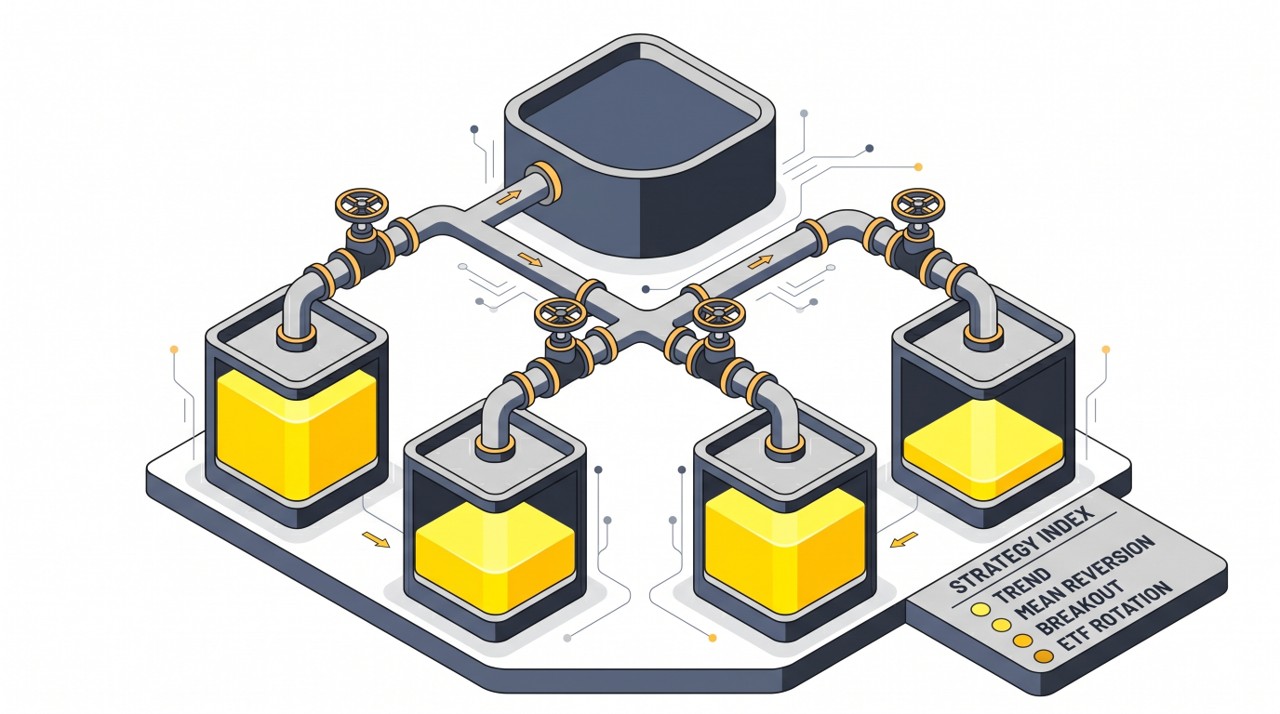
What is capital allocation in trading?
Capital allocation in trading is the decision about what percentage of your total account each system is permitted to deploy. It is the layer that sits above position sizing.
Think of it as two separate jobs:
- Capital allocation decides how much of the account System A, System B, and System C each get to work with.
- Position sizing decides how big each individual trade is inside the capital a system has been given.
A simple example. You have a $100,000 account and three systems. You allocate 40% to a trend following system, 30% to a mean reversion system, and 30% to a breakout system. The trend system now sizes its trades based on its $40,000 slice. The other two do the same with theirs. Capital allocation sets the boundaries. Position sizing operates within them.
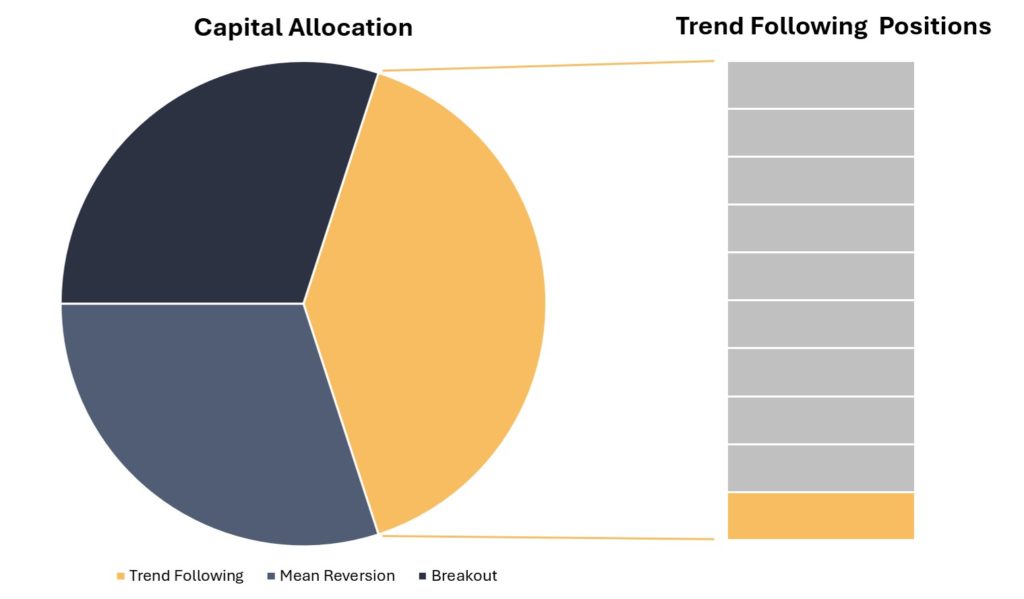
This distinction matters because the two solve different problems. Position sizing stops one bad trade from hurting you. Capital allocation stops one system, one strategy type, or one market condition from quietly taking over your entire account.
Why does capital allocation matter more than most traders think?
Capital allocation matters because every percentage you assign to a system is not just a number – it is a decision about your time, your stress, and the life you are trying to build.
Most traders treat allocation as a pure returns problem. They ask, “Which split gives the highest CAGR?” That is the wrong first question. Every allocation choice also decides:
- How much time you spend trading each day
- How much admin you have to handle
- How much volatility you have to stomach
- How many open positions you are juggling at once
Have you ever rebalanced your portfolio, shifted some weights around, and then felt uneasy afterwards, like something was not quite right? That feeling is rarely about the numbers. It is about misalignment. Your allocation stopped matching the way you actually want to trade and live.
This is the part the spreadsheets miss. A portfolio can look excellent on paper and still be one you abandon within three months because it demands more time, more attention, or more emotional tolerance than you have. The best traders are not just well backtested. They are well aligned.
How do you align capital allocation with your trading objectives?
You align capital allocation with your objectives by defining your goals specifically first, then filtering every allocation decision through them.
Step 1: Define your objectives clearly
“I want better returns” is not an objective. It is a hope. Real objectives are specific and personal:
- “I want to spend no more than 30 minutes a day trading.”
- “I never want more than 100 open positions at once.”
- “I am aiming for 20-25% annual return with a maximum 15% drawdown.”
- “I prefer low-frequency systems because I work full time.”
Write them down. These become the filter every capital allocation decision must pass through. If your objective is to keep admin low, allocating heavily to three high-frequency systems will drain your energy and your consistency – no matter how good the backtest looks.
Step 2: Let your objectives guide every adjustment
Every time you change your system mix, pause and ask three questions:
- Does this setup still reflect my goals?
- Am I comfortable with the time, effort, and volatility this portfolio demands?
- Is this allocation sustainable for me, not just for the spreadsheet?
Step 3: Reduce friction between you and your portfolio
Most traders quit not because their strategy failed, but because the strategy did not fit them. Internal friction shows up as avoided weekly reviews, skipped signals, constant second-guessing, and eventually inconsistent results. If your system mix feels heavy and chaotic, it is. Your systems should support the way you live, not fight against it.
How do you build a capital allocation model?
You build a capital allocation model by starting with a maximum percentage for each system and then using your backtest exposure data to deploy capital efficiently without taking on hidden leverage. There are two broad approaches.
The simple method: equal allocation
The most straightforward approach is to divide capital evenly. Ten systems, 10% each. This approach avoids overlap, keeps things easy to manage, and ensures every system always has its slice.
The downside is significant. Most systems are not invested 100% of the time. A mean reversion system might sit in cash for weeks, then deploy hard during a panic. If you give it a fixed 10% and it is only in the market 20% of the time, a large chunk of your capital does nothing. Idle cash is a drag on performance.
The smarter method: dynamic allocation using backtest data
Instead of fixed slices, use your historical backtest exposure to guide allocation. Here is the process:
- Assign a maximum capital percentage to each strategy. For example, Strategy A: max 50%. Strategy B: max 75%.
- Look at daily exposure from the backtest. Use your results to see how much each strategy was actually invested, day by day.
- Combine strategies to analyse total exposure. Overlay the data to see how much capital the whole portfolio used at once.
- Adjust allocations to keep leverage acceptable. If two strategies are rarely in the market at the same time, their combined allocations can exceed 100% – because in practice they do not conflict.
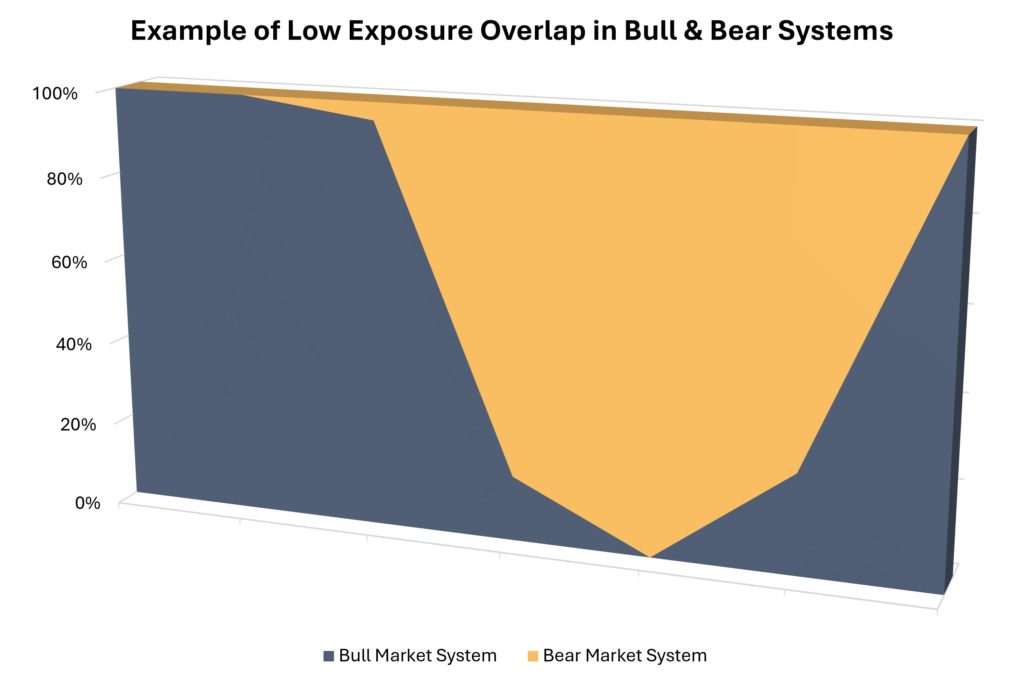
Consider a bull-market system and a bear-market system as illustrated above. They rarely trade at the same time. You could allocate close to 100% to each and still rarely exceed your account balance in practice. Markets are not perfectly clean, so some overlap will happen, which is exactly why testing combined exposure across all your systems is the key step. This method reduces idle cash, increases capital efficiency, and keeps your real-world leverage realistic.
How much capital should each trading system get?
Each system gets a fixed percentage of your total account equity, and that percentage – not the system’s own balance – sets the limit on how much it can deploy at any time.
This is where many traders go wrong, so let us walk through it with numbers.
You have a $50,000 account. You decide System One gets 50% of total capital. That means $25,000 is allocated to System One, and the other $25,000 sits idle for now. That is fine. Capital allocation is about permission, not forcing trades.
Your system uses 5% of its equity per position. With $25,000 allocated, each trade is $1,250 and you can hold a maximum of 20 positions. Once those 20 slots are full, you stop. No new trades. No exceptions. This is not optional discipline – it is how the system survives.
Now the part that trips people up. Say System One does well and its allocated capital grows from $25,000 to $30,000. Many traders think, “It made money, so I will just keep trading bigger.” That is not how capital allocation works.
Recalculate based on total account equity. Your account is now $25,000 idle cash plus $30,000 in System One, which is $55,000 total. System One is still allocated 50% of total capital, so its new maximum is $55,000 x 50% = $27,500.
At any point, you ask one question: is my current exposure above or below $27,500? If you are below, you may take another trade. If you are above, you wait. No opinions. No forecasting. Just rules. This keeps system growth controlled, scales position sizing as equity grows, and prevents one winning system from silently dominating the account. Signals are cheap. Capital is not.
Should you manually switch systems on and off?
No. Manually switching systems on and off based on what feels right is one of the most damaging habits a systematic trader can have.
It seems logical. The market looks weak, so you pause your trend system. You expect volatility, so you fire up mean reversion. The moment you do this, you are no longer systematic. You are reacting – and reaction reintroduces the fear and hope that systematic trading exists to remove.
The better approach is to build the market judgement into each system, then let capital allocation do the rest. A well-built system already knows when it should and should not trade:
- A trend following system might only trade when the index is above its 200-day moving average.
- A mean reversion system might only trade when volatility is high.
If those conditions are not met, the system stays in cash on its own. You do not make that call. The system does. So instead of deciding which system to trade, you allocate capital across all of them and let each one decide when to act:
- 15% to a trend following system
- 10% to a mean reversion system
- 20% to a breakout system
- 15% to a long-term ETF rotation system
Each system monitors its own conditions. When one says “do not trade,” that capital stays in cash or is available to another active system. This combination of self-managing systems and fixed capital allocation is what produces a smooth, stable equity curve over time.
How do you achieve true diversification across systems?
True diversification comes from combining systems that are genuinely different by design, not from simply adding more systems that all trade the same way.
This is the trap that catches traders trying to scale. They find two or three systems with good risk-adjusted returns and assume that stacking them spreads the risk. But if those systems are all low-exposure and based on similar signals, stacking them does not diversify anything. It gives you a portfolio that all trades at the same time and sits in cash at the same time.
Low-exposure systems, like many mean reversion strategies, often trade in short, intense bursts. They wait for a panic, take a handful of trades, then go quiet. Stack two or three that all react to the same conditions and they all pile in together when panic hits, then all vanish together when the market stabilises. That is clustering, not synergy. It produces spikes in exposure followed by long gaps of inactivity.
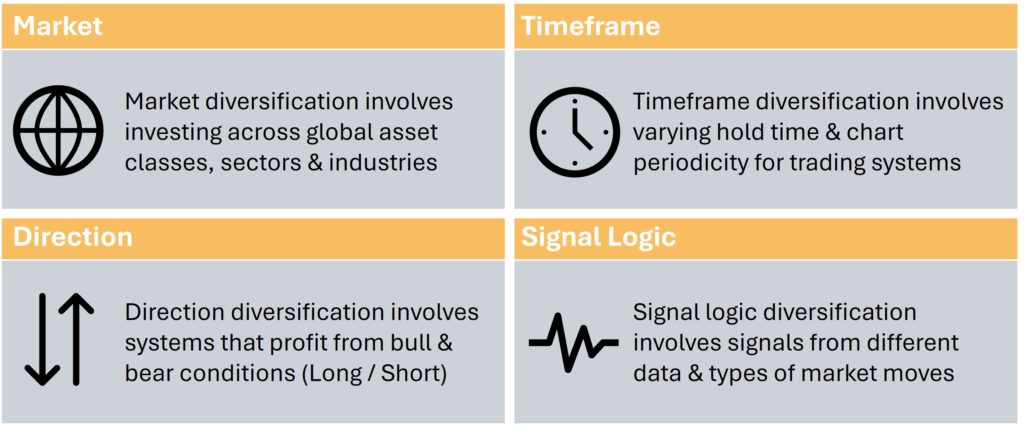
To diversify properly, build difference into your systems across four dimensions:
- Market: Trade across the ASX, US, TSX, Hong Kong, and crypto. Different markets move differently.
- Timeframe: Combine daily systems with weekly or longer-term models. This creates natural signal separation.
- Direction: Include both long and short systems. One thrives in fear, the other in euphoria.
- Signal logic: Blend mean reversion, trend following, breakout, and volatility-based logic. Do not just repackage the same idea in different wrappers.
Where does correlation fit in?
Correlation is important, but do not start there. Traders often jump straight to correlation matrices hoping to engineer a diversified portfolio. Correlation is a lagging indicator of poor design. Start with system logic, timing, and how and why your systems generate trades. Only once you have built a mix of non-overlapping systems should you use correlation to confirm what the design already tells you. Otherwise you are applying a band-aid instead of fixing the wound.
Here is a useful truth: your capital allocation will expose system overlap faster than any backtest can. If multiple systems hit maximum exposure at the same moment, your capital spikes to fully committed and then sits idle shortly after. That is signal overlap revealing itself. For more on how diversification protects your account, see our guide to risk management for traders.
What should you do when one market is running much hotter than the rest?
When one part of the market is outperforming everything else – tech stocks surging, a single index making new highs week after week, a sector that seems to go up no matter what – capital allocation becomes genuinely difficult. Not because the maths gets harder, but because human nature kicks in.
The logical response feels like loading up. Every chart looks bullish. The financial media is breathless with excitement. And somewhere in your world there is a person like “buddy Bob” – a colleague or friend who went all-in on the hot market months ago and will not stop talking about how much money he is making. The gap between his returns and yours starts to feel uncomfortable.
This is when capital allocation discipline matters most. It is also when most traders abandon it.
Why chasing recent performance destroys long-term results
Markets that have been running hot often cool quickly – and they almost never announce the top in advance. If you shift a large allocation toward a single market or sector based on recent returns, you are making a bet on continuation. Sometimes that bet pays off. More often it does not.
The deeper problem is structural. When you over-allocate to what is currently working, you undo the diversification that protects you. Your portfolio, which was built to perform across different market conditions, suddenly becomes dependent on one environment staying exactly as it is. When that environment changes – and it always does – the concentration that felt like an opportunity reveals itself as a risk.
Ask yourself a different question. Instead of “how much more could I make by adding more capital here?”, ask “does adding more here genuinely improve my portfolio’s risk-adjusted return, or does it just increase my exposure to one market condition?”
When you run that second question through your backtesting, the answer is almost always more instructive than your gut feeling.
Start modest when allocating to any new system in a strong market
When you do decide to add a system in a hot market – and there are valid reasons to do so – start with a smaller allocation than you think you need.
It reduces the psychological risk. If you launch a new system with 30% of your capital and it immediately draws down because the trend stalls, the loss is large and the temptation to abandon the system before it has had a fair chance is real. Start with 10-15%, let it prove itself in live trading over several months, and scale up once you have direct experience with how it behaves.
It limits the damage from bad timing. Even a well-designed, well-backtested system can have a rough start if launched near a trend reversal. A modest initial allocation means a bad entry does not define your view of the system before it has earned that verdict.
Buddy Bob may outperform you this year. That is fine. In ten years, your disciplined, diversified portfolio will be at new equity highs while he is still recovering from the margin call he never saw coming.
Capital allocation is not about capturing every trend. It is about surviving every reversal.
Can you plan capital allocation before you trust a system?
Yes. You do not need to fully trust a system before you plan its place in your portfolio. You only need to trust it when you are ready to trade it live.
This belief – “I am not confident in the system yet, so I cannot allocate to it” – stops more traders from progressing than almost anything else. It creates a bottleneck where you test one system after another with no clarity on where it all leads.
Instead, design your ideal end-state portfolio first. Map out the version of your trading business that includes multiple uncorrelated systems, diversified markets, and balanced risk. Even if you have not built or tested all of those systems yet, you can lay out the vision in your capital allocation spreadsheet:
- Assign target percentages to each system
- Include placeholders for systems you will develop later
- See how your capital would spread across strategies
You are not committing real dollars. You are creating the blueprint. Then you build confidence one system at a time – backtest it, learn the rules, understand the risk profile, and go live when you are ready. Once it is trading with confidence, move to the next. If a system fails to stack up during testing, just set its allocation to zero, redistribute that capital, or slot in a new candidate. The plan adjusts. The process stays the same. You do not need to trust a system to plan for it – only to trade it.
What do you do with capital after switching a system off?
When you switch a system off, you reallocate that freed-up capital using rules you defined in advance – you do not leave it idle and you do not chase a new trade on impulse.
Turning off a system is not a break in your portfolio logic. It is a reallocation moment, and it should have been anticipated in your trading plan. Idle capital is unproductive capital, and it drags down performance. You have two logical options.
Option 1: Reallocate to existing systems. If the rest of your portfolio is strong and well diversified, take the freed allocation – say 10% – and distribute it proportionally across your remaining systems. This is not doubling down. Your next trades become slightly larger but stay within your defined position sizing rules. This works well when you have no major gap in market coverage and your existing systems are performing.
Option 2: Fill a strategic gap with a new system. Maybe you already know your portfolio is missing a crypto strategy, a short system, or exposure to a new market. If you have a tested, validated system ready, this is your window to deploy. Just do not force it – only activate systems that are already proven and aligned with your objectives.
The key principle: reallocation is just as rules-based as entry, exit, and position sizing. Ask yourself now, before it happens: if I switch off a system tomorrow, do I know exactly what I will do with the capital? If the answer is no, that is the gap to fix. For more on when a system has earned the right to be switched off, read what to do when your trading system hits its maximum historical drawdown.
What are the most common capital allocation mistakes?
The most common mistakes all come from letting emotion or sloppy maths override the rules. Watch for these:
- Letting a winning system silently exceed its allocation. Growth is good. Unchecked growth concentrates your risk.
- Using a system’s own equity instead of total account equity when recalculating limits.
- Forgetting to recalculate allocations after meaningful gains or losses.
- Taking trades just because signals exist. A signal is permission to consider a trade, not a reason to exceed your allocation.
- Adding similar systems and calling it diversification. More systems that trade alike is more of the same risk, not less.
- Starting with correlation instead of design. Build difference in first, then confirm with the numbers.
You can pressure-test the maths behind your allocation and risk per trade with our free position size calculator.
Putting your capital allocation framework together
Capital allocation is the discipline that turns a collection of separate systems into a single, coherent trading business. It decides how much each system can use, keeps any one strategy from dominating, recalculates as your equity changes, and lets each system trade only when its own rules say so. Done well, it produces what every systematic trader is really after: consistent, controlled performance you can actually stick with.
Most traders never build this layer. They size individual trades carefully and then leave the portfolio-level decisions to guesswork. That gap is exactly where consistency leaks away.
Inside the Trader Success System, we go deep into this process and give you the capital allocation spreadsheet, portfolio-level exposure tracking, and a step-by-step method for integrating multiple systems – so your capital is always working where it should, without overlap or overexposure. If you are ready to stop guessing and start running your trading like the business it is, that is where to begin.
Frequently asked questions about capital allocation in trading
What is capital allocation in trading?
Capital allocation in trading is the process of deciding what percentage of your total account each of your trading systems is allowed to use. It sits above position sizing: capital allocation sets how much capital each system gets, while position sizing decides how large each individual trade is within that capital.
What is the difference between capital allocation and position sizing?
Capital allocation manages risk at the portfolio level by dividing your total account between systems. Position sizing manages risk at the trade level by deciding how much to risk on each individual position within a system’s allocated capital. You need both: position sizing protects you from a single bad trade, capital allocation protects you from a single system or strategy dominating your account.
How much capital should I allocate to each trading system?
Assign each system a fixed percentage of your total account equity based on your objectives and the system’s backtested exposure. Because most systems are not invested all the time, systems that rarely trade at the same time can have combined allocations above 100% without creating real leverage. Always recalculate each system’s dollar limit from total account equity as your balance changes.
Should I turn my trading systems on and off based on market conditions?
No. Manually switching systems on and off reintroduces emotion and discretion. Instead, build the market condition rules into each system – for example, a trend system that only trades above the 200-day moving average – and let it move to cash automatically. Allocate capital across all your systems and let each one decide when to trade.
How do I diversify a portfolio of trading systems?
Diversify by designing systems that differ across four dimensions: market (ASX, US, Hong Kong, crypto), timeframe (daily, weekly, long term), direction (long and short), and signal logic (trend, mean reversion, breakout, volatility). Adding more systems that all trade the same way is not diversification. Use correlation analysis last, to confirm good design rather than to create it.
What should I do with capital after switching off a trading system?
Reallocate it using rules you set in advance. Either distribute the freed capital proportionally across your remaining systems while staying within your position sizing rules, or deploy it into a tested, validated system that fills a known gap in your portfolio. The decision should be rules-based, not an emotional reaction to having idle cash.



Thank you Adrian. This article is extremely helpful and comprehensive. You’re doing a great job in focusing on important topics that define success and failure as traders over the long term instead of creating hyped content that doesn’t add much value.
Hi Steph,
Great to hear from you! Thanks for your great feedback, very much appreciated. I’m really glad that you’re finding the content useful. There is way too much hyped content out there that promises the world and doesn’t add any legitimate value. I strive to avoid this myself.
Enjoy the website. Let me know if you’ve got any questions that I can help with.
Adrian