You found a system that works. The backtest looked clean, the equity curve pointed up, and for a while it did exactly what you hoped. Then the market changed, the system went quiet or slipped into a long drawdown, and you were left staring at your screen wondering whether it was broken or just resting. That is the moment most traders discover the truth about a single system: it is fragile, not because the rules are wrong, but because no single set of rules works in every market condition.
The fix is not a better system. It is a portfolio of them.
Portfolio construction for traders is the process of combining several complete, rules-based trading systems into one account so that something is usually working while another system waits out its bad stretch. Done well, it turns a jagged, one-system equity curve into a smoother, steadier climb. This guide shows you how to build that portfolio: the axes you diversify across, how uncorrelated systems cut your drawdown, how to allocate capital across systems, and how position sizing holds it all together.

What is portfolio construction in systematic trading?
Portfolio construction in systematic trading is the deliberate assembly of multiple trading systems, and the capital allocated to each, into one portfolio designed to produce more consistent returns than any single system could on its own.
Notice the reframe. In mainstream finance, a “portfolio” is a mix of assets: stocks, bonds, property, cash. That kind of diversification matters for a long-term investor, but it is not what a systematic trader means. For us, the portfolio is a portfolio of systems. Each system is a full set of rules that decides what to buy, when to buy, how much to buy, and when to sell. You are not blending assets. You are blending edges.
This distinction is the whole game. Two traders can both hold twenty stocks, but the one running four uncorrelated systems has a genuinely diversified portfolio, while the one running a single system across twenty stocks is exposed to one point of failure dressed up to look diversified. When that single system stops working, all twenty positions feel it at once.
Why isn’t one trading system enough?
One system is not enough because every trading system, without exception, has losing periods, and a single system forces you to sit through every one of them with no relief.
A good system is not a system that never loses. It is a system with a real, backtested edge that also spends meaningful stretches of time out of sync with the market. A long-term trend following system does nothing useful in a choppy, sideways market. A mean reversion system gets run over in a strong, relentless trend. Neither is broken during those periods. They are simply waiting for the conditions they were built for.
If that one system is all you trade, three things happen:
- You ride the full depth of every drawdown, because you have nothing offsetting it.
- You lose confidence during the flat periods and start to interfere, which quietly destroys the edge you paid for in the backtest.
- You become fragile to a single change in market character, which is exactly the risk you cannot see coming.
The deeper and longer a drawdown runs, the more likely you are to abandon the system near its low, right before it recovers. Managing drawdown in trading is far less about willpower than most traders think. It is about building a portfolio where the drawdowns are shallower in the first place, because they do not all arrive on the same day.
What does it mean to diversify a portfolio of trading systems?
Diversifying a portfolio of trading systems means combining systems whose good and bad periods happen at different times, so their individual drawdowns partly cancel out at the portfolio level.
The word “diversification” gets thrown around loosely. Holding more stocks is not diversification if one system picks all of them. Real diversification for a systematic trader comes from spreading your trading across several distinct dimensions, so that no single market condition can hurt every part of your portfolio at once. There are six of these dimensions, and the more of them you deliberately spread across, the smoother your combined result becomes.
What are the six axes of trading system diversification?
The six axes of trading system diversification are instruments, parameters, systems, direction, timeframes, and profit drivers. Each one adds a layer of independence to your portfolio, and the biggest gains come from the last three.
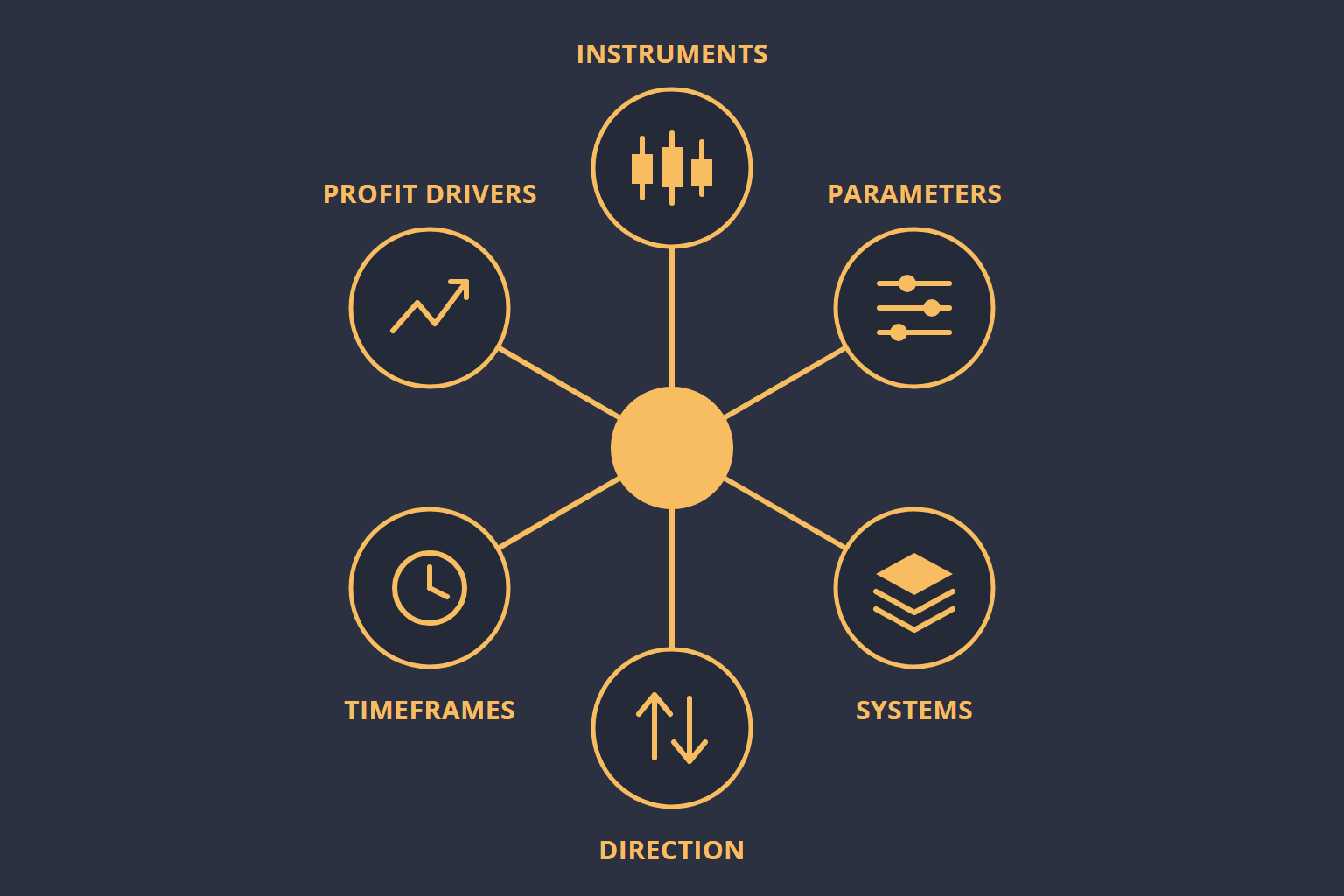
1. Instruments. Hold many stocks rather than concentrating capital in a few. This is the shallowest form of diversification and the one most traders stop at. It helps, but on its own it leaves you exposed to one system and one style.
2. Parameters. Run the same system at several parameter settings at once instead of betting everything on one “best” setting. A trend system using a 180, 200, and 220 day filter across three slices of capital is less fragile than the same system pinned to a single value. This also protects you from the curve fitting trap, where one exact parameter looks brilliant in the backtest and disappoints in live trading.
3. Systems. Run several genuinely different systems. This is where portfolio construction really begins, because different rule sets respond to the market in different ways.
4. Direction. Trade both long and short. Long systems suffer when the market falls; short systems actually make money in exactly those conditions. Adding short exposure gives you a built-in hedge against the events that hurt your long positions most. It is one of the few ways to have something in your portfolio that profits from a market crash rather than being punished by it.
5. Timeframes. Combine systems with different holding periods. A long-term system might hold winners for over a year, while a short-term system is in and out within weeks. When conditions deteriorate quickly, the faster system exits well before the slower one, which pulls your portfolio out of harm’s way sooner and reduces the total damage.
6. Profit drivers. This is the most powerful axis. Combine systems that make money from fundamentally different market behaviours: trend following profits from sustained moves, mean reversion profits from pullbacks snapping back, and momentum or volatility systems profit from other patterns again. Two trend systems are still both trend systems, and they will struggle together. A trend system and a mean reversion system are built to shine in opposite conditions, so one is often working while the other waits.
Adding more of the last three axes, direction, timeframe, and profit driver, does far more for your portfolio than adding a tenth stock to a single system ever will.
How does combining uncorrelated systems smooth the equity curve?
Combining uncorrelated systems smooths the equity curve because their drawdowns do not happen at the same time, so the losing period of one system is partly offset by the winning period of another.
This is the mathematical heart of portfolio construction, and it is simpler than it sounds. Every system produces a stream of daily returns. When two systems have low correlation in those daily returns, the days one is losing are often days the other is flat or gaining. Layer several low-correlation systems together and the peaks and troughs partly cancel. The combined equity curve rises with shallower dips than any single system that built it.
Picture two long systems. One holds trends for over a year on average. The other is far shorter term and stops taking new trades quickly when conditions turn. When the market rolls over hard, the short-term system is already stepping aside and moving to cash while the long-term system is still holding and absorbing the fall. On its own, the long-term system takes the full hit. Run together, the short-term system’s early exit cushions the portfolio, and the drawdown you actually live through is meaningfully shallower.
Add a short system to that same portfolio and the effect goes further. While your long systems are under pressure in a falling market, the short system is making money. The drawdowns are not just staggered anymore. Some of them are actively cancelled. That is the difference between a portfolio you can hold through a crisis and one you abandon at the worst possible moment.
How do you measure correlation between trading systems?
You measure correlation between trading systems by calculating the correlation of their daily returns, not their prices, and looking for systems with low or negative correlation to each other.
Here is the practical process:
- Backtest each system on its own and export its daily equity curve.
- Convert each equity curve into a series of daily returns.
- Calculate the correlation coefficient between each pair of systems’ daily returns.
- Build a correlation matrix so you can see, at a glance, which systems move together and which move independently.
A correlation near +1 means two systems win and lose on the same days: adding the second one buys you almost no diversification. A correlation near zero means they move independently, which is what you want. A negative correlation means they tend to move in opposite directions, which is the strongest diversification of all and usually comes from pairing long and short systems.
The lower the average correlation across your systems, the more the drawdowns offset, and the smoother the combined result. When you evaluate a new system to add, the first question is not only “does it have an edge?” but “how does it correlate with what I already run?” A mediocre system with near-zero correlation to your portfolio can improve your overall result more than an excellent system that simply duplicates an edge you already have.
How do you allocate capital across multiple trading systems?
You allocate capital across multiple trading systems using a top-down cascade: decide each system’s share of your total capital first, then size individual trades within each system’s allocation, and recalculate the whole thing regularly as your account changes.
This is the layer that separates a real trading portfolio from a pile of systems competing for the same money. Here is the framework, top down.
Step 1 – Decide the portfolio split first. Before you size a single trade, set the percentage of total capital each system gets. For example:
- System 1 (long-term trend following): 40%
- System 2 (mean reversion): 25%
- System 3 (momentum): 20%
- System 4 (short system): 15%
These weights are set in advance, driven by each system’s expected performance, its volatility, and how well it complements the others. The primary driver of the weighting is genuine diversification: what return driver each system captures. Piling weight into three systems that all trade the same way does not improve the portfolio, no matter how good each one looks alone.
Step 2 – Size each trade within its system’s allocation. Once a system’s share is set, position sizing for its trades is calculated against that system’s capital, not the whole account. If you have $200,000 and System 1 gets 40%, that system works with an $80,000 base. Risk 1% per trade within it and each trade risks $800.
Step 3 – Recalculate daily. Each day, walk back down the cascade: total capital now, each system’s percentage, the dollars per system, then the risk per trade inside each system. Position sizes then adjust automatically as your account grows or shrinks. The framework is fully dynamic and keeps you disciplined without a single judgement call.
This portfolio-level allocation is a different question from position sizing inside a system, and most traders never separate the two. If you want the deeper mechanics and worked examples, our guide on capital allocation in trading covers the cascade in full.
One more rule to decide in advance: what happens when you switch a system off. When a system stops earning its place, you either redistribute its capital proportionally across the remaining systems, within your position sizing rules, or you deploy it into a new validated system that fills a gap. Decide this before you need it. The worst version of this decision is the one made emotionally, in the moment, under pressure.
How does position sizing work when running several systems?
Position sizing across several systems works by risking a small, fixed percentage of each system’s allocated capital per trade, sizing each position against market volatility, and capping total risk at the portfolio level.
The core mechanism is volatility-based risk sizing. For each trade:
- Set a maximum risk per trade, typically 0.5% to 1% of that system’s allocated capital. In practice 1% is often too high; plenty of good systems risk 0.5% or less. The right number comes from backtesting against your objectives, not from a rule of thumb.
- Use the Average True Range to set your stop distance in dollar terms, so the stop reflects how much the stock actually moves.
- Calculate position size as the risk dollars divided by the ATR-based stop distance.
Because the stop is tied to volatility, you take smaller positions in wild markets and slightly larger ones in calm markets, while the dollar risk stays constant. Our full position sizing guide walks through the formula in detail, and you can run the numbers for any trade with the position size calculator.
On top of per-trade risk, a portfolio of systems needs three portfolio-level guardrails:
- Portfolio heat. Cap the total percentage of capital at risk across all open positions, across all systems, at any one time. A common ceiling is 10%. This stops several systems from quietly stacking risk on the same day.
- Maximum position size. Cap any single stock at, say, 5% of total capital, even if the risk math would allow more. A stock can gap down through your stop overnight, and this cap limits that damage.
- Leverage. Start with none. For a portfolio of end-of-day stock systems, 2x is already aggressive; keeping leverage under 1.5x is prudent. Traders using 5x or 10x are not running a portfolio, they are running a countdown.
If you want to fine-tune how much to risk mathematically, the Kelly Criterion is a useful reference point, though most traders are better served trading a fraction of full Kelly to keep drawdowns tolerable.
How many trading systems do you need?
You need enough systems to cover several uncorrelated profit drivers and both market directions, which for most traders means somewhere between three and six well-chosen systems, not twenty.
More systems is not automatically better. Adding a system that is highly correlated with one you already run gives you almost no extra diversification while adding real complexity to manage. The value comes from independence, not headcount. Three genuinely uncorrelated systems, say a long-term trend follower, a mean reversion system, and a short system, will out-diversify ten trend systems that all move together.
Start with one system you have fully validated and can actually trade through a drawdown. Add a second only when it earns its place on two counts: it has its own tested edge, and it has low correlation to the first. Repeat. The portfolio grows one deliberate, uncorrelated system at a time, and each addition should visibly smooth the combined equity curve or it does not belong.
How do you build a portfolio of trading systems step by step?
You build a portfolio of trading systems by validating one system at a time, adding each new system only when it is both profitable and uncorrelated, then binding them together with a capital allocation and position sizing framework.
Here is the operational sequence:
- Validate your first system. Build and backtest one complete, rules-based system. Confirm it has a real edge and that the edge holds across nearby parameter values, not just one lucky setting.
- Trade it until you trust it. Run it live at a size you can hold through its normal drawdown without interfering. A system you cannot follow is worth nothing, however good the backtest.
- Add an uncorrelated system. Choose your next system to fill a gap: a different profit driver, a different direction, or a different timeframe. Check the correlation of daily returns before you commit.
- Allocate capital across the systems. Set each system’s percentage share using the top-down cascade, weighted by diversification and expected performance.
- Apply consistent position sizing and portfolio guardrails. Volatility-based risk per trade inside each system, plus portfolio heat, maximum position, and leverage caps across the whole account.
- Monitor and maintain. Track each system’s live performance against its backtest, watch the correlations, and have your rules ready for when a system needs to be paused or replaced.
This is exactly the progression we teach inside the Trader Success System: start with one proven system, then build outward into a diversified portfolio with the allocation and risk framework to run it calmly.
What are the most common portfolio construction mistakes?
The most common portfolio construction mistakes are stacking correlated systems, running systems with no capital allocation model, switching systems on and off emotionally, and using leverage to paper over a portfolio that is not truly diversified.
- Correlated systems disguised as diversification. Three trend systems are one bet in three costumes. If your systems win and lose on the same days, you have complexity without protection.
- No allocation model. Running several systems without deciding each one’s share of capital leads to accidental concentration, systems fighting over the same money, and no plan when one underperforms.
- Emotional switching. Turning a system off because it is in drawdown, right when it is closest to recovering, is the fastest way to lock in the loss and miss the rebound. Decide your on/off rules in advance and follow them.
- Leverage as a crutch. Reaching for leverage to boost returns from a thin, one-driver portfolio does not fix the fragility, it multiplies it. Diversify first, then consider modest leverage, never the other way around.
Avoid these four and you are already ahead of most traders who call themselves diversified.
Frequently asked questions
What is portfolio construction in trading?
Portfolio construction in trading is the process of combining several complete, rules-based trading systems, and the capital allocated to each, into one account. The goal is more consistent returns than any single system could produce, because the systems’ drawdowns happen at different times and partly offset each other.
How is a portfolio of trading systems different from a diversified stock portfolio?
A diversified stock portfolio spreads money across many assets, but if one system picks all those stocks, it is still one edge and one point of failure. A portfolio of trading systems spreads across several independent edges, each with its own rules, direction, timeframe, and profit driver, so no single market condition hurts everything at once.
How do you allocate capital across multiple trading systems?
Use a top-down cascade. First set each system’s percentage of total capital based on diversification and expected performance. Then size each trade against that system’s allocated capital, not the whole account. Recalculate daily so position sizes adjust automatically as your account grows or shrinks.
How many trading systems should I run?
Most traders are well served by three to six uncorrelated systems that cover different profit drivers and both market directions. Beyond that, adding correlated systems adds complexity without much extra diversification. Start with one validated system and add each new one only when it is both profitable and uncorrelated.
How do uncorrelated systems reduce drawdown?
Uncorrelated systems have losing days at different times, so when one system is in drawdown another is often flat or gaining. Combined, their equity curves partly cancel each other’s dips, producing a smoother overall curve and a shallower maximum drawdown than any single system.
Build your portfolio of systems
A single trading system will always leave you at the mercy of one market condition. The way out is not a better system, it is a portfolio of uncorrelated systems, bound together by a clear capital allocation framework and consistent position sizing, so that something is usually working while another system waits out its turn. That is what a smoother equity curve is actually made of.
If you are starting from one system, or from none, the simplest first step is to get a proven, rules-based system running with a sound process around it. Our free 10-Minute Trading Formula shows you how to do exactly that in a few minutes a day.
When you are ready to build the full portfolio, with multiple systems, the capital allocation cascade, and the risk framework to run them calmly, the Trader Success System is the complete path from one system to a diversified portfolio of them.