Search for “quantitative trading” and you get a very specific picture of who is allowed to do it.
A maths or physics degree, probably a master’s. Fluent Python, ideally C++. Tick data, machine learning and a desk at a hedge fund or a bank. Page one of Google is written by certification bodies, brokers selling courses in Python, and a Reddit thread full of people describing their jobs at trading firms.
That picture is accurate for one kind of quant. It is also the reason thousands of analytical people who would make excellent quantitative traders never start. They read it and assume the door is shut.
It is not. I have been trading systematically with my own capital for more than 20 years, and the traders I have watched succeed at it include engineers, accountants, nurses and teachers. I have also watched maths graduates blow up their accounts because they could not follow their own rules through a losing streak.
This guide explains what quantitative trading actually is, how the institutional version differs from the version a private trader runs, which strategies make sense at each scale, and the step-by-step process for building a quantitative trading system you can trade from home in a few minutes a day.
What Is Quantitative Trading?
Quantitative trading is buying and selling financial assets using objective, testable rules derived from data, instead of opinion, news or gut feel. Every decision – what to trade, when to enter, when to exit and how much to risk – is defined in advance and validated on historical data before real money is committed.
The word “quantitative” simply means the decisions are based on things you can measure. Price, volume, volatility, the distance from a moving average, the rank of a stock’s momentum against its peers. If a rule cannot be expressed as a number or a true/false condition, it is not quantitative.
Three things define a quantitative approach:
- Rules are objective. Two people given the same rules and the same data would take exactly the same trades.
- Rules are tested. The strategy is backtested on historical data to measure how it behaved, including how bad its worst periods were.
- Rules are followed. The trader executes the system as tested, rather than overriding it when it feels uncomfortable.
That third point is the one the textbooks skip and the one that decides most outcomes.
What Does A Quantitative Trader Actually Do?
A quantitative trader researches trading ideas, turns them into precise rules, tests those rules on historical data, and then runs the surviving strategies with strict risk controls. The daily reality looks very different depending on whether that person works at an institution or trades their own account.
At a hedge fund or bank, the job is usually split across a team. Researchers look for statistical patterns. Developers build the infrastructure. Risk managers set limits. Portfolio managers decide how much capital each strategy receives. A single “quant trader” might only touch one slice of that chain.
A private quantitative trader does the whole chain alone, but at a scale where it is manageable:
| Task | Institutional quant | Private quant trader |
|---|---|---|
| Research ideas | Teams of PhDs, alternative data sets | Market observation, trading books, backtesting software |
| Build and test strategies | Custom code in Python or C++ | Backtesting platforms such as RealTest or AmiBroker |
| Execute trades | Co-located servers, millisecond execution | End-of-day orders, often automated |
| Manage risk | Dedicated risk department | Position sizing rules and a portfolio of systems |
| Time spent trading | Full-time career | 5-10 minutes a day once systems are built |
Most of the work for a private trader happens up front, while building and testing systems. Once a portfolio of systems is running, the daily process is short: download data, run the systems, place the orders, and get on with the day.
Is Quantitative Trading The Same As Algorithmic Or Systematic Trading?
They overlap heavily, and in everyday conversation most people use them interchangeably. The useful distinction is what each term emphasises.
| Term | What it emphasises | Example |
|---|---|---|
| Quantitative trading | Decisions derived from data and statistics | A rule based on a stock’s 200-day rate of change rank |
| Systematic trading | A complete, fixed set of rules followed consistently | Entry, exit, position size and filters all defined in advance |
| Algorithmic trading | A computer generating or executing the orders | Software placing orders automatically at the open |
| High-frequency trading | Speed, holding periods of milliseconds to seconds | Market-making and latency arbitrage |
A private trader running end-of-day rules-based systems is doing quantitative trading and systematic trading. If their orders are placed by software, it is algorithmic trading as well. What they are not doing, and should not attempt, is high-frequency trading.
If you want the full breakdown of what a complete rule set contains, the guide to trading systems covers each component.
How Do Hedge Funds Do Quantitative Trading?
Hedge funds use quantitative trading at a scale that shapes every choice they make. The most famous example is Renaissance Technologies, founded by mathematician Jim Simons, whose Medallion Fund became the benchmark for what a data-driven approach can achieve.
Institutional quant funds typically compete on:
- Data – enormous data sets, including tick data and alternative data like credit card transactions or satellite images
- Infrastructure – computing power and execution speed measured in microseconds
- People – large teams of researchers, programmers and risk specialists
- Strategy breadth – statistical arbitrage, market-making and high-frequency strategies that exploit tiny, fleeting inefficiencies
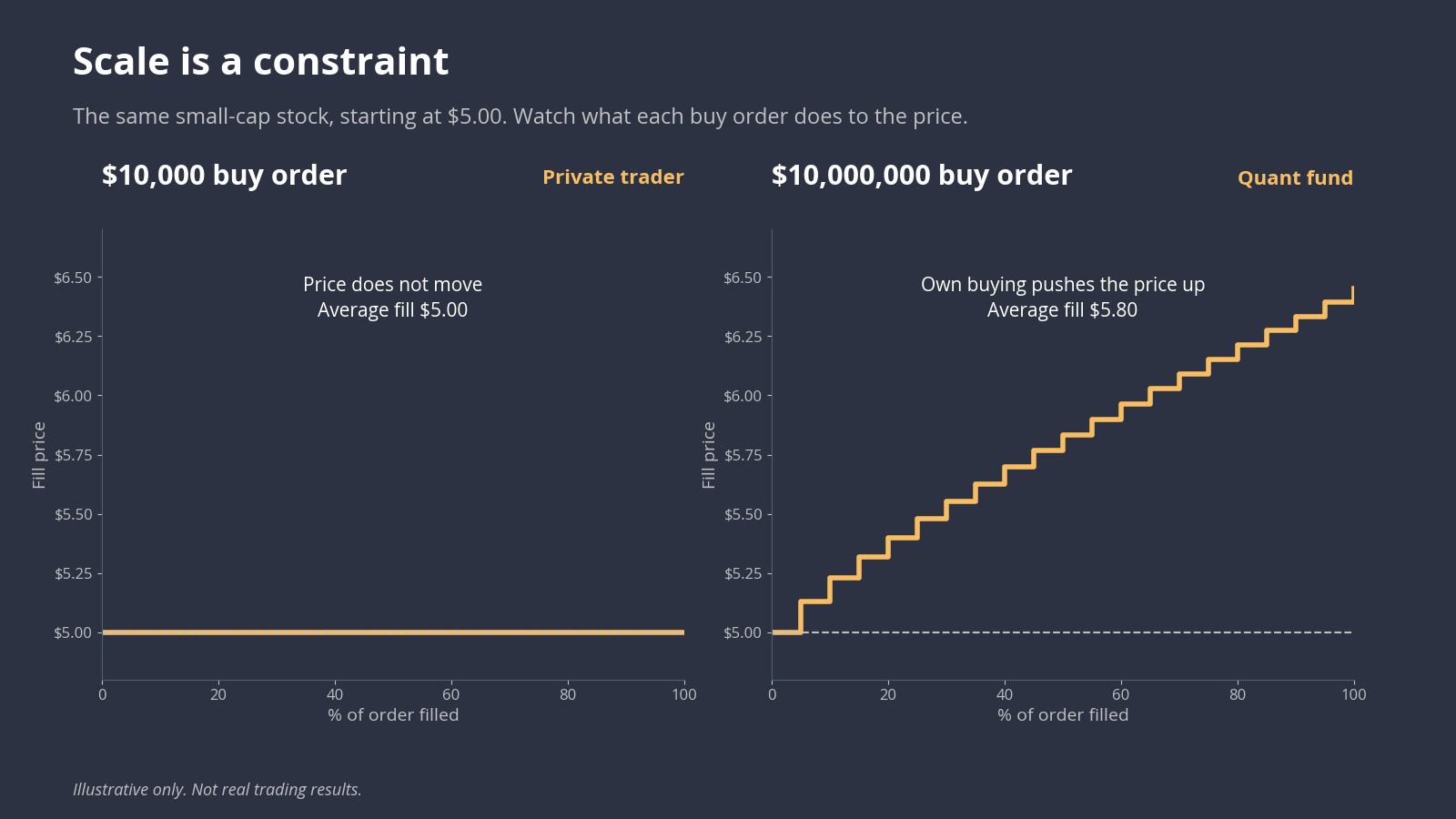
Here is the part the career guides leave out. Scale is also a constraint.
A fund needs somewhere in the range of tens of millions of dollars under management just to cover its costs. At that size, it cannot trade most small-cap stocks, because its own buying would push the price up before the position was filled. It is forced into large, liquid instruments where the competition is fiercest and the edges are thinnest. Many funds are also expected to stay close to fully invested, and they answer to investors who judge them on smooth monthly returns.
Can An Individual Trader Do Quantitative Trading?
Yes, and a private trader has structural advantages that a large fund cannot buy.
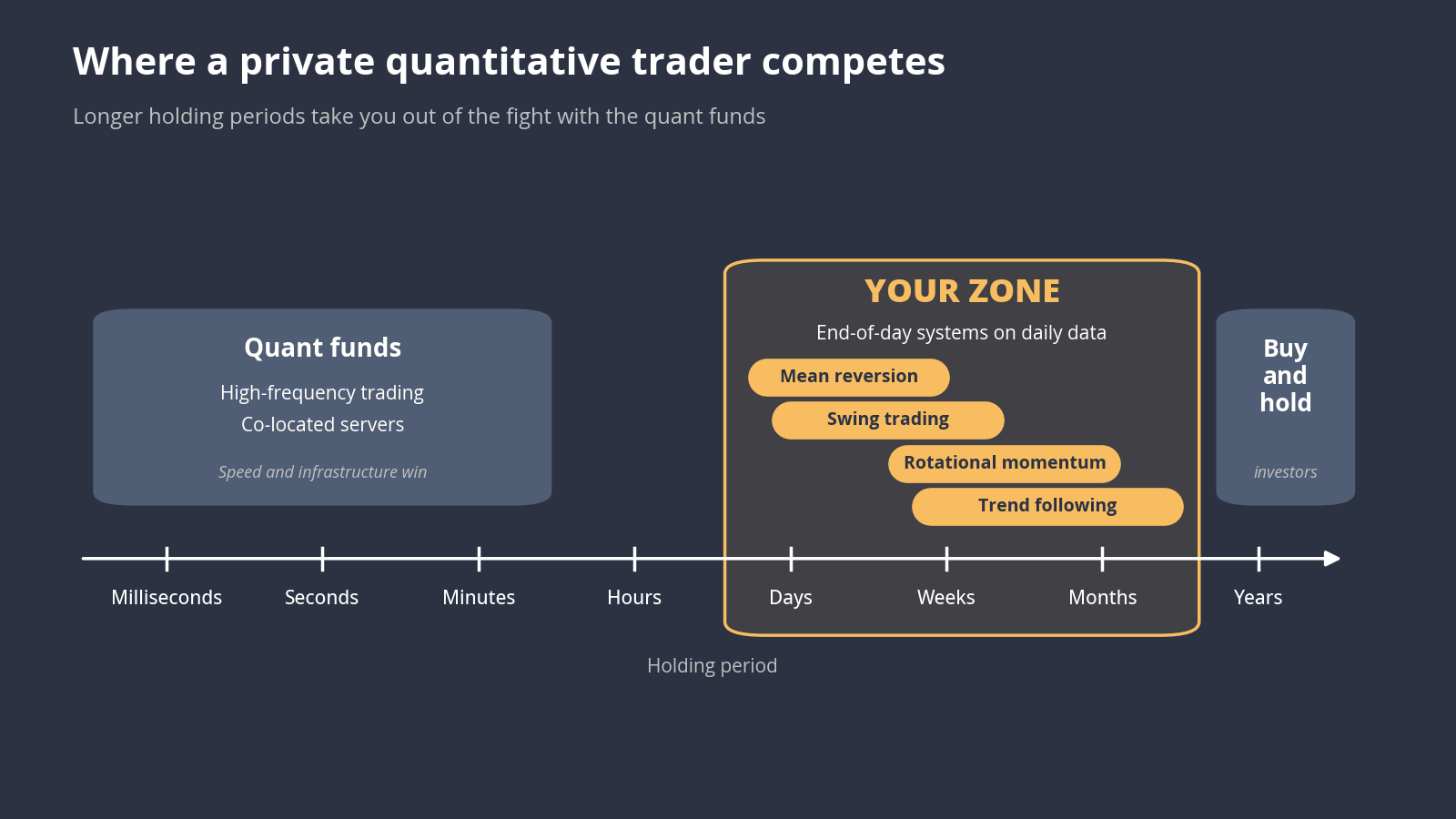
The mistake is trying to copy the institutional playbook. You will never out-compute a quant fund at high-frequency strategies, so don’t enter that fight. The longer your holding period, the less you are competing with institutional algorithms and the more you are competing with discretionary retail traders, which is a far better fight to pick.
What a private quantitative trader can do that a fund cannot:
- Trade small and mid-cap stocks. A position of $10,000 does not move the price. A position of $10 million does.
- Go to cash quickly. When your market filter turns bearish, you can exit everything at the next open. Many funds cannot.
- Accept a lumpier equity curve. You answer to yourself, not to investors reviewing monthly statements, so you can choose higher long-term returns with larger drawdowns if you can handle them.
- Keep costs low. Small positions mean small slippage, and end-of-day systems need no expensive infrastructure.
- Run strategies with limited capacity. An edge that can only absorb a few hundred thousand dollars is worthless to a fund and perfectly good for you.
The timeframes that suit private quantitative traders are swing trading (days to weeks), mean reversion (days to weeks), trend following (weeks to months) and rotational momentum strategies (rebalanced weekly or monthly). All of them run on daily data.
What Skills Do You Need To Become A Quantitative Trader?
To trade your own capital quantitatively, you need logical thinking, basic maths, backtesting skills, sound risk management and the discipline to follow tested rules. You do not need a PhD, a finance degree or a job at a hedge fund.
Here is what each of those looks like in practice.
Maths at a high school level. Percentages, averages, win rates, the average size of a win versus a loss, and calculating a position size from the amount you are prepared to risk. If you can use a spreadsheet, you have enough maths to start.
Structured, logical thinking. “If this condition is true, take this action.” Quantitative rules are chains of conditions. People with an engineer’s brain tend to find this the most natural part of the process.
Backtesting skill. Knowing how to test a strategy properly on historical data, and more importantly knowing how to read the results and spot when a backtest is lying to you. This is the skill that separates people who build working systems from people who build beautiful equity curves that fall apart live. The guide to backtesting is a good place to start.
Risk management. Position sizing, stop losses and diversification across several systems. These determine whether you survive long enough for your edge to show up.
Discipline. Following your system through a drawdown when every instinct says to switch it off. No amount of mathematical ability substitutes for this.
Do You Need To Know How To Code?
No. Modern backtesting platforms let you build and test rules-based systems with far less programming than most people expect, and some traders never write a line of general-purpose code. Coding helps, but it is not the entry ticket.
A word of caution on the current shortcut. A lot of people now use ChatGPT or Claude to write strategy code for them. One prospective student told me, “I can’t do a bloody thing in the code without Claude and ChatGPT.” Another described their progress this way: “It’s not making much money in backtesting, but we just got it to work. It’s compiling.”
Code that compiles is not an edge. AI can write the syntax, but it cannot tell you whether your test has a future leak, whether your data includes delisted stocks, or whether your twelve rules are overfitted to the last five years. That judgement is the actual skill of a quantitative trader.
What Are The Main Quantitative Trading Strategies?
Most quantitative trading strategies fall into a handful of families, each exploiting a different type of market behaviour. The table shows which ones suit a private trader running end-of-day systems.
| Strategy type | What it exploits | Typical holding period | Suits a private trader? |
|---|---|---|---|
| Trend following | Prices that keep moving in one direction | Weeks to months | Yes |
| Mean reversion | Short-term overreactions that snap back | Days | Yes |
| Rotational momentum | The strongest stocks tending to stay strong | Weeks, rebalanced periodically | Yes |
| Short selling systems | Weak stocks and falling markets | Days to weeks | Yes, with care |
| Pairs trading and statistical arbitrage | Temporary divergence between related assets | Days to weeks | Partly, simpler versions only |
| High-frequency and market-making | Microsecond inefficiencies and bid-ask spreads | Seconds or less | No |
The real power comes from combining them. A trend following system and a mean reversion system tend to make money at different times, so running both smooths the equity curve and reduces overall drawdown. That is why serious quantitative traders build a portfolio of trading systems rather than hunting for one perfect strategy.
How Do You Build A Quantitative Trading System?
You build a quantitative trading system by defining the market behaviour you want to capture, turning it into testable rules, backtesting those rules honestly, validating them on data they have never seen, and then going live with small size. Here is the process I use.
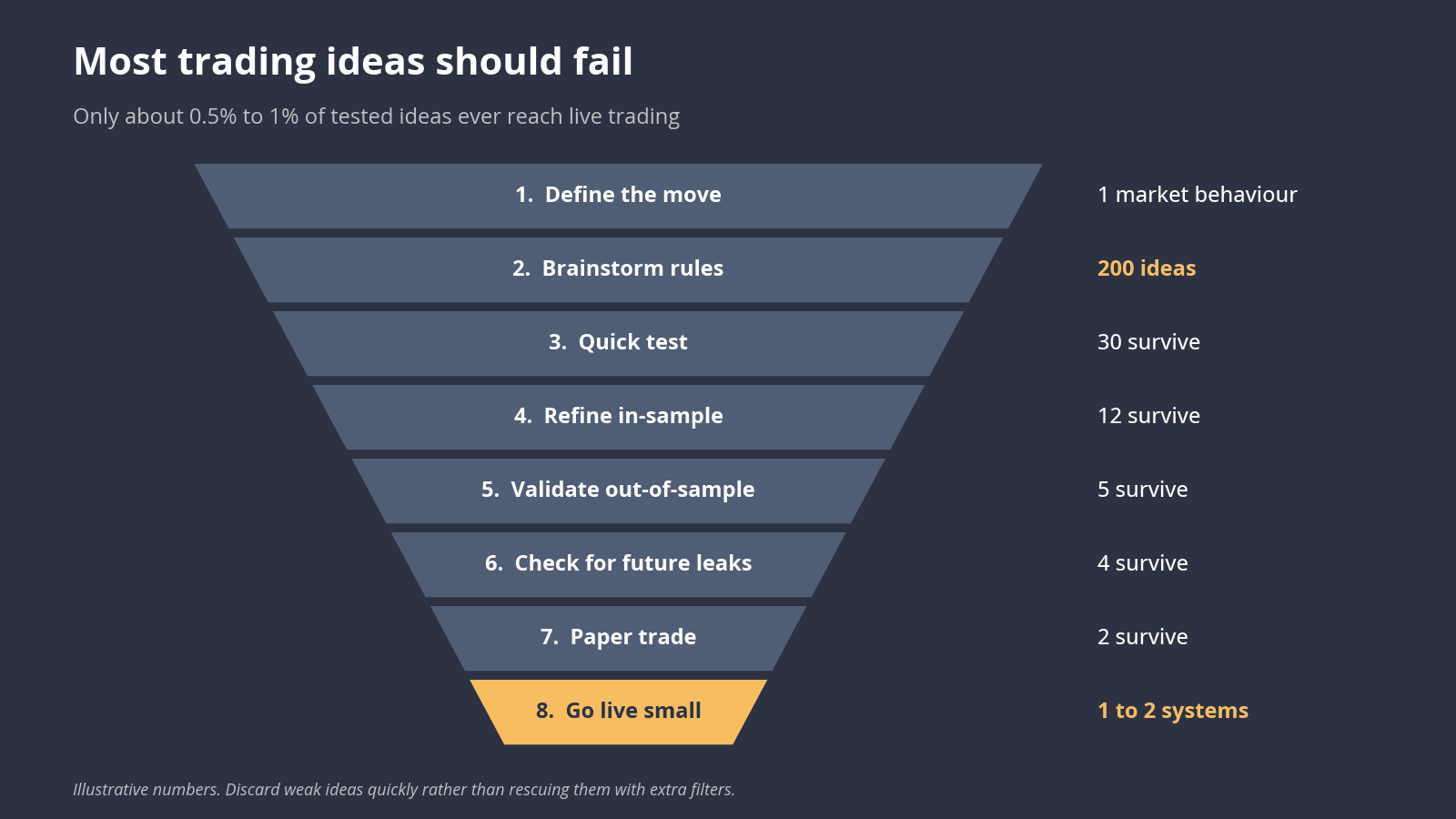
- Define the move you want to capture. Before touching software, be specific about the behaviour you are hunting. A stock breaking to a new 52-week high? An oversold stock in a long-term uptrend? Without this, you are throwing indicators at a backtester and hoping, which is data mining.
- Brainstorm candidate rules. Write several possible entries, exits and filters for that move, each with a logical reason to exist.
- Test combinations quickly. Run the raw, unoptimised combinations. Most ideas fail, and that is normal. In my experience only a very small fraction of tested ideas, somewhere around 0.5% to 1%, ever make it to live trading. Your job at this stage is throughput, so discard weak ideas quickly rather than rescuing them with extra filters.
- Refine on in-sample data. Check that every rule meaningfully improves results across a large number of trades, that the equity curve rises steadily rather than depending on one lucky period, and that small changes to parameters do not collapse performance.
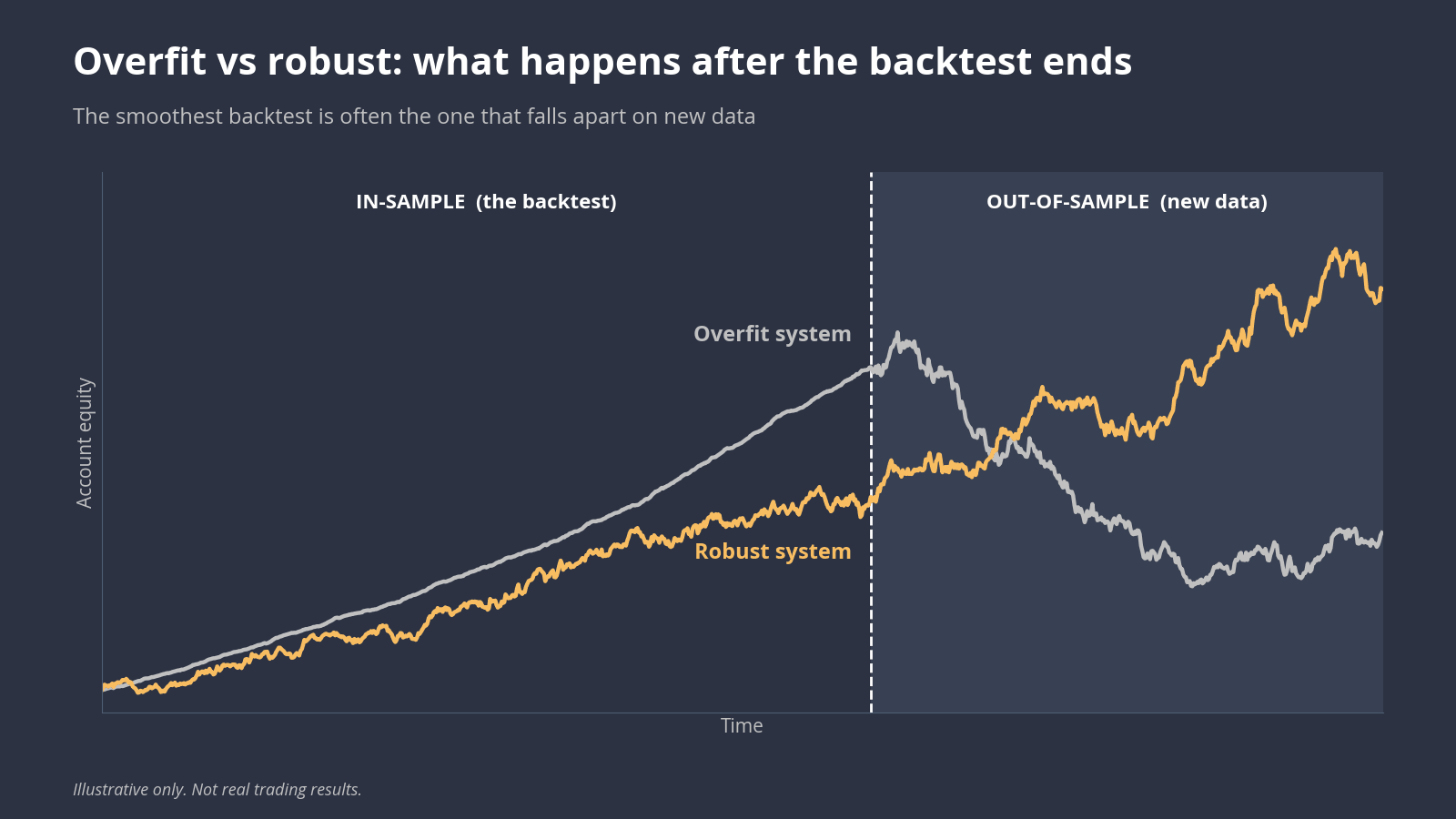
- Validate out of sample. Test on data the system has never seen. If performance falls apart, the system was overfitted.
- Check for future leaks. Walk through the logic and ask whether you genuinely had every piece of information at the moment the trade was triggered.
- Paper trade or walk forward. Run it in real time without money to catch execution problems a backtest cannot show.
- Go live small, then scale. Real money teaches you about order execution, broker quirks and your own emotions in a way no simulation does. Increase size only once live results behave like the backtest.
The full walkthrough, with examples at each stage, is in the guide to trading system development.
What Are The Biggest Quantitative Trading Mistakes?
The most expensive quantitative trading mistake is overfitting: building a system that describes the past perfectly and predicts nothing. The others are close behind.
Overfitting. It happens when you add a rule after a bad period specifically to avoid that loss, when you run endless optimisation passes, or when you stack filters without a reason for each one. The better question to ask is not “how do I make this system more profitable?” but “how do I make this system more robust?” The guide to trading system optimization shows how to improve a system without curve fitting it.
Bad data. Free data usually excludes stocks that were delisted, which quietly removes every company that went bust from your test and inflates the results. One prospect put it perfectly: “I was using free data, so I didn’t really trust the results.” If you are testing stocks, you need survivorship-bias-free data from a provider such as Norgate Data.
Future leaks. Using today’s closing price to generate a signal you supposedly acted on before the close. Backtests with limit orders and ranking rules are particularly vulnerable.
Obsessing over entries. There is no perfect entry indicator. Exits, position sizing and portfolio-level risk control have at least as much effect on results, so give them equal attention.
Overriding the system. A trader who switches a system off during a drawdown and back on after the recovery gets all of the pain and none of the profit. If you cannot follow a system through its historical worst period, it is the wrong system for you, however good the backtest looks. Understanding drawdown in trading before you go live is what makes following through possible.
Is Quantitative Trading Profitable?
Quantitative trading can be profitable, but only when a strategy has a genuine, tested edge that survives trading costs and the trader follows it consistently. Being quantitative guarantees nothing. A precise set of rules can lose money just as precisely.
What a quantitative approach does give you is knowledge. Before you risk a dollar, you know roughly how often the system wins, how big its average win and loss are, how long its losing streaks have lasted and how deep its drawdowns have been. That turns trading from hoping into managing a known set of probabilities.
The core measure is expectancy: the average amount you make or lose per trade, per dollar risked. You can calculate it for any system with the trading expectancy calculator. A positive expectancy across a large number of trades, with a drawdown you can live with, is the minimum standard for a system worth trading. The article on what a trading edge is explains how to tell a real one from a statistical accident.
What Software And Data Do You Need For Quantitative Trading?
A private quantitative trader needs three things: a backtesting platform, clean historical data and a broker that can accept orders efficiently.
- Backtesting platform. RealTest is my first recommendation for stock traders. It is fast, built for portfolio-level testing and ships with an AI coding reference file you can use with modern AI assistants. AmiBroker is a capable alternative with a large user base.
- Historical data. Survivorship-bias-free, split and dividend adjusted daily data. For stocks this is non-negotiable, because testing on data that excludes delisted companies produces results you cannot trust.
- Broker and execution. A broker with good market access and an API, so your end-of-day orders can eventually be placed automatically. Automated trading systems remove the daily manual step entirely.
You do not need a server farm, tick data or a Bloomberg terminal. A reasonable laptop running end-of-day systems is enough.
How Do You Get Started With Quantitative Trading?
Start by learning the process, not by hunting for a strategy. The traders who struggle are usually the ones who jump straight to indicators and skip the foundations.
A sensible path looks like this:
- Set clear goals. Decide what return you want, what drawdown you can tolerate and how much time you can give it.
- Learn how to backtest properly. Understand data quality, future leaks and overfitting before you trust any result.
- Build or adopt one simple system. A long-only trend following or mean reversion system on stocks with four to six rules is a good first build.
- Trade it small. Learn execution and your own reactions with money that does not matter much.
- Add uncorrelated systems. Build a portfolio of strategies that make money at different times.
- Automate. Once the process is stable, remove yourself from the daily order entry.
Learn Quantitative Trading The Systematic Way
If you are an analytical person who has read the career guides and assumed quantitative trading needs a PhD and a hedge fund, the process above is the actual job. It is learnable. What usually slows people down is doing it alone: years of trial and error, testing on bad data, and building systems that looked brilliant until they went live.
The Trader Success System teaches you how to design, backtest and trade a portfolio of quantitative trading systems on end-of-day data, with mentoring from traders who run these systems with their own money. You learn why each system works, not just which buttons to press, so you can trade with conviction through the drawdowns that make most traders quit.
You can see the full curriculum on the quantitative trading course page.
Remember – you are only one trading system away.
Frequently Asked Questions
What is quantitative trading in simple terms?
Quantitative trading means using objective, data-based rules to decide what to buy, when to buy it, when to sell and how much to risk. The rules are tested on historical data before any money is committed, and then followed consistently instead of being overridden by emotion or news.
Do you need a degree to be a quantitative trader?
Not to trade your own money. Institutional quant roles usually require degrees in maths, physics or computer science, but a private quantitative trader needs high school maths, logical thinking, backtesting skills and discipline. Many successful systematic traders come from engineering, accounting and other non-finance careers.
Do quantitative traders need to know Python?
No. Python is common at institutions, but private traders can build and test rules-based systems in dedicated backtesting platforms such as RealTest or AmiBroker. Programming helps, but understanding how to test properly and avoid overfitting matters far more than the language you use.
Is quantitative trading the same as high-frequency trading?
No. High-frequency trading is one narrow type of quantitative trading that holds positions for milliseconds and depends on expensive infrastructure. Most quantitative trading suitable for individuals uses daily data, with holding periods of days to months.
Is quantitative trading profitable for individuals?
It can be, when a system has a genuine tested edge that survives trading costs and the trader follows it consistently. Individuals have real advantages over funds, including the ability to trade small-cap stocks and move to cash quickly, but no rule set guarantees profits and every system experiences drawdowns.
How much time does quantitative trading take each day?
Building and testing systems takes significant time up front. Once a portfolio of end-of-day systems is running, the daily process of updating data, generating signals and placing orders typically takes 5-10 minutes, and it can be automated.
What is the best software for quantitative trading?
For private stock traders running end-of-day systems, RealTest is the first recommendation because of its speed and portfolio-level backtesting, with AmiBroker a capable alternative. Pair either with survivorship-bias-free historical data so your backtest results can be trusted.