Here is a question worth sitting with before you buy your first leveraged ETF.
The Nasdaq-100 rises 10% one day and falls 9.09% the next. It is back exactly where it started. You owned a 3x leveraged ETF on that index the whole time. How much did you make?
Most people say zero. Some say “three times zero, so zero”. The real answer is that you lost 5.45%, and nothing in the market went against you. The index went nowhere. You paid for the trip anyway.
That one example explains most of what goes wrong with leveraged ETFs, and most of what the product pages leave out. A leveraged ETF is a genuinely useful instrument in the right hands, and I trade them. But they reward a trader who understands the mechanics and has tested the rules, and they quietly punish anyone who buys one as “the index, but more”.
This article covers what a leveraged ETF actually is, the daily reset that drives everything, the maths of volatility decay, the risks that matter more than the fees, and how a systematic, end-of-day trader decides whether a leveraged ETF belongs in a portfolio at all.
What Is A Leveraged ETF?
A leveraged ETF is an exchange-traded fund that aims to deliver a fixed multiple, usually 2x or 3x, of the daily return of an index, sector, commodity or single stock. If the S&P 500 rises 1% today, a 2x S&P 500 fund aims to rise about 2% today, and a 3x fund about 3%.
The fund does not borrow money in your name. It gets the extra exposure inside the fund, mostly through total return swaps and futures contracts with large banks, then resets that exposure at the end of every trading day.
There are three main families:
- Leveraged long (bull) funds – 2x or 3x the daily return of the index.
- Inverse funds – -1x, -2x or -3x the daily return, so they rise when the index falls.
- Single-stock leveraged funds – 2x exposure to one company, such as a large technology stock. These are the newest and the most volatile of the lot.
Some of the most heavily traded US examples:
| Ticker | What it targets | Daily multiple |
|---|---|---|
| SSO | S&P 500 | 2x |
| UPRO / SPXL | S&P 500 | 3x |
| QLD | Nasdaq-100 | 2x |
| TQQQ | Nasdaq-100 | 3x |
| SQQQ | Nasdaq-100 | -3x (inverse) |
| TNA | Russell 2000 small caps | 3x |
| SOXL | Semiconductor index | 3x |
| TECL | Technology sector | 3x |
This is a list of what exists, not a list of what to buy. Whether any of them belongs in your account is a question only a backtest can answer, and we will get to that.
How Does A Leveraged ETF Work?
A leveraged ETF works by resetting its exposure every day so that the next day’s return is, again, the target multiple of the index’s return. That daily reset is the single most important thing to understand about these products.
Here is what happens at the close each day in a 2x fund with $100 of investor money:
- The fund holds $200 of exposure to the index.
- The index rises 5%. Exposure is now worth $210, and the fund’s net assets are $110.
- To get back to 2x, the fund needs $220 of exposure, so it adds $10 of exposure at the close.
Now run it the other way. The index falls 5%. Exposure drops to $190, net assets drop to $90, and the fund needs only $180 of exposure, so it sells $10 at the close.
Read that again, because it is the engine behind everything that follows. A leveraged ETF buys after up days and sells after down days, every single day, by design. It is a mechanical momentum strategy wrapped in a fund. In a steady trend, that works in your favour. In a market that chops back and forth, it buys high and sells low, over and over.
The fund manager is not doing anything wrong. That is exactly what “2x the daily return” requires. The trouble only starts when you hold one for longer than a day and expect “2x the return”.
Why Do Leveraged ETFs Lose Value Over Time?
Leveraged ETFs lose value over time in sideways, volatile markets because of volatility decay: compounding a multiplied daily return is not the same as multiplying the return over a longer period. The bigger the daily swings and the higher the leverage, the bigger the gap.
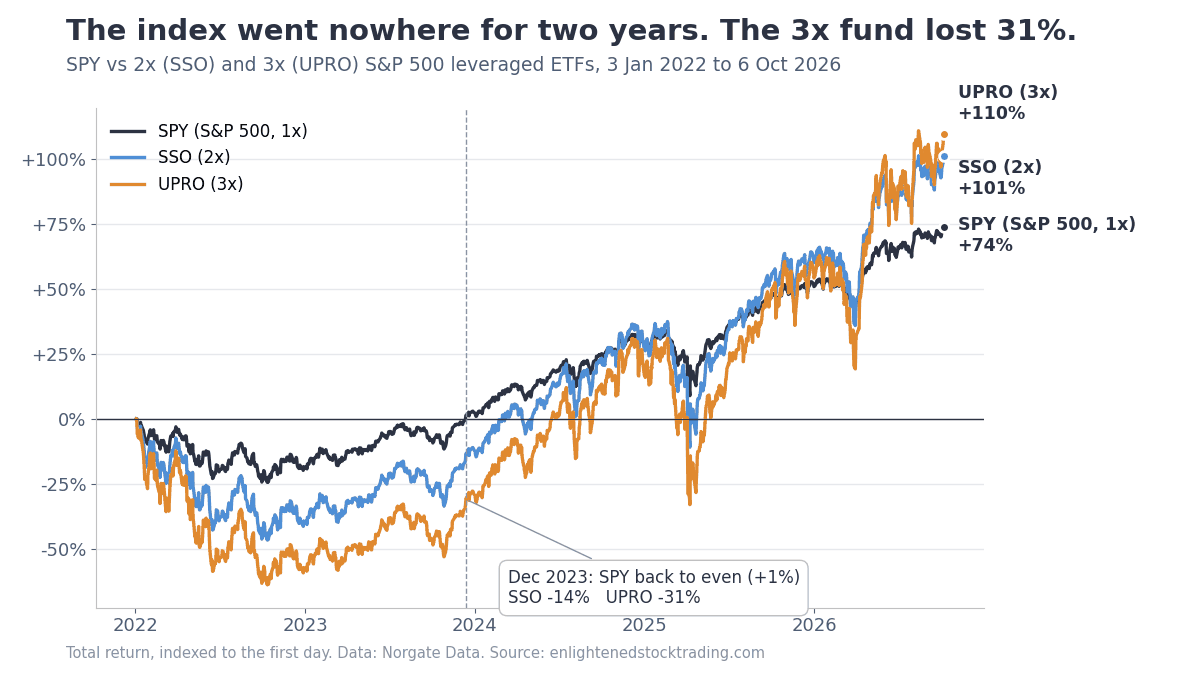
Go back to the opening example:
| Day | Index | 1x | 2x | 3x |
|---|---|---|---|---|
| Start | 100.00 | 100.00 | 100.00 | 100.00 |
| Day 1: index +10% | 110.00 | 110.00 | 120.00 | 130.00 |
| Day 2: index -9.09% | 100.00 | 100.00 | 98.18 | 94.55 |
| Result | 0.00% | 0.00% | -1.82% | -5.45% |
The index finished flat. The 2x fund lost 1.82%. The 3x fund lost 5.45%. Nobody charged a fee. That is pure arithmetic.
Now stretch it out. Suppose an index alternates +3% and -3% for 20 trading days, a choppy month with no direction:
- The index loses 0.90%.
- A 2x fund loses 3.54%.
- A 3x fund loses 7.81%.
Nine times the decay for three times the leverage. That is not a coincidence.
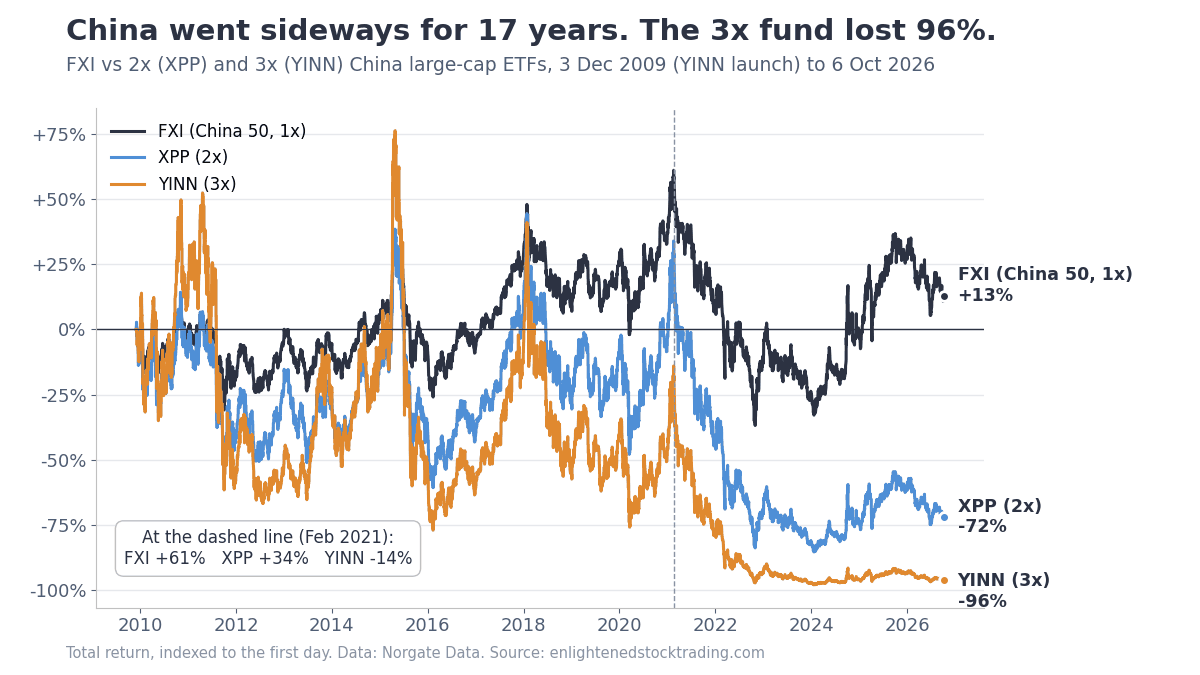
The volatility decay formula
There is a useful approximation for how much a daily-reset fund lags the simple multiple each year. For leverage L and annualised volatility σ:
Annual drag ≈ (L² – L) / 2 × σ²
Plug in some realistic numbers:
| Index volatility | 2x fund drag per year | 3x fund drag per year |
|---|---|---|
| 15% (calm market) | about 2.2% | about 6.7% |
| 20% (normal equity market) | about 4.0% | about 12.0% |
| 30% (stressed market) | about 9.0% | about 27.0% |
The drag grows with the square of volatility and roughly the square of leverage. Double the volatility and the drag quadruples. That is why a 3x fund on a volatile sector like semiconductors behaves so differently from a 2x fund on the S&P 500, even when both look like “just leverage” on the fact sheet.
Decay is not the whole story
To be fair to the product, here is the other side. In a smooth trend, the daily reset works for you. If an index rises 1% a day for 10 days:
- The index gains 10.46%.
- A 2x fund gains 21.90%, more than double.
- A 3x fund gains 34.39%, more than triple.
So the honest summary is not “leveraged ETFs always decay”. It is that a leveraged ETF’s long-run result depends on the path the index takes, not just where it ends up. Strong, low-volatility trends help. Volatile, directionless markets hurt. And you do not know in advance which one you are about to get.
That uncertainty is exactly why a systematic trader does not decide this by opinion.
What Are The Real Risks Of Leveraged ETFs?
Volatility decay gets most of the attention, but it is not the risk that ends trading accounts. These are the ones that matter, roughly in order of damage.
1. Drawdowns far bigger than your backtest shows
Most leveraged ETFs launched after 2006, and many of the popular ones after 2009. That means their price history starts after the 2000-2002 tech crash and, for some, after the 2008 crisis. A backtest on that history has never seen a real bear market.
This trap catches a lot of traders. I came across a system on TQQQ that was being promoted publicly with an equity curve that looked fantastic. TQQQ only started trading in 2010, so the backtest had never been through 2008 or the 2000 tech bubble. Testing the same logic on QQQ, which has the longer history, told a very different story. The implied drawdown on the 3x version was devastating, in the region of 80 to 90%.
You do not need a hypothetical to see this. In calendar 2022, QQQ fell by roughly a third. TQQQ fell by close to 80%. A 3x fund does not give you 3x the drawdown. Because of the daily reset in a falling, volatile market, it can give you far worse.
2. Gap risk on a single day
A 3x fund loses everything if its index falls 33.3% in one day. A 2x fund loses everything at 50%. Those sound like impossible numbers until you remember that the S&P 500 fell about 20% on a single day in October 1987. A 3x S&P 500 fund on that day would have lost around 60% of its value before anyone could act.
Most funds have provisions for extreme days, and some have closed or changed their structure after shocks. Read the prospectus for what your fund does. But do not build a plan that relies on that clause.
3. Recovery maths
Losses are asymmetric. A 50% loss needs a 100% gain to recover. An 80% loss needs a 400% gain. Leverage makes deep drawdowns more likely, and deep drawdowns take disproportionately long to climb out of. You can model this for any drawdown with the drawdown calculator.
4. Costs above the headline fee
Leveraged ETFs typically charge expense ratios of around 0.8% to 1% a year, well above a plain index ETF. On top of that, the fund pays financing costs on its swap exposure, which rise with interest rates, plus the trading cost of rebalancing every day. These are not itemised on your statement, but they come out of the fund’s return. When rates are high, that hidden carry is significant.
5. Survivorship bias in the list of funds
Leveraged ETFs close regularly. The ones that blew up or failed to attract assets disappear from the screener, and the list you see today is the list of survivors. If you test a “basket of leveraged ETFs” using only the funds that exist now, your results are biased upward before you start. More on this in survivorship bias in trading.
Regulators have been saying a version of all this since 2009, when FINRA warned that because these funds reset daily, they are typically unsuitable for retail investors who plan to hold them for longer than one trading session unless those investors understand and monitor the position. That is not a reason to never touch them. It is a reason to know exactly what you are holding.
Is A Leveraged ETF The Same As Trading On Margin?
No. A leveraged ETF gives you leverage inside the fund, while margin gives you leverage inside your brokerage account by borrowing against your own capital. The difference matters in three ways.
| Leveraged ETF | Margin account | |
|---|---|---|
| Who borrows | The fund | You |
| Maximum loss | The money you put in the fund | Can exceed your account, in theory |
| Margin calls | None on the fund position | Yes, if equity falls below maintenance |
| Leverage over time | Reset to the target every day | Drifts as prices move, until you change it |
| Decay | Yes, from the daily reset | No reset decay, but you pay interest |
The “no margin call” feature is real and useful. Your loss on a leveraged ETF is capped at what you invested. But that cap is not the same thing as safety. A position that can lose 80% without a margin call has still lost 80%.
If you want the broader view of why leverage is the common thread in nearly every famous blow-up, the Hedge Fund Graveyard lists 62 of them. The funds in that list were not short of intelligence or risk staff. Many of them were running leverage of 4 to 30 times.
How Should A Systematic Trader Think About Leveraged ETFs?
A systematic trader treats a leveraged ETF as a position-sizing decision with a path-dependence problem attached, not as a way to get rich faster. The leverage is not where the edge comes from. The rules are.
Here is the framing I use.
Leverage is sizing, not edge
If a system has no edge on QQQ, it does not suddenly have one on TQQQ. You have just turned a small expected loss into a bigger one. Leverage multiplies whatever is already there, including the costs.
So the first question is never “which leveraged ETF?” It is “does this set of rules have a positive expectancy on the underlying market, through bear markets, after costs?” Only once the answer is yes does the instrument choice matter, and the guide to tradable instruments covers how to make it. If you need a way to check that, the trading expectancy calculator is the place to start.
Capital efficiency is the legitimate reason
There is a good reason to use a leveraged ETF in a systematic portfolio, and it is not “more return”. It is capital efficiency.
Say a system calls for $30,000 of Nasdaq-100 exposure. You could buy $30,000 of QQQ, or about $10,000 of TQQQ. For a one-day holding, the exposure is roughly the same. The difference is that the TQQQ version ties up $10,000 instead of $30,000, which frees capital for other, uncorrelated systems in a portfolio of trading systems, and caps the loss on that position at $10,000.
For a short holding period, that trade-off can make sense. For a long one, the path dependence above means the two positions will drift apart, and you need to know by how much before you rely on it.
Holding period is the deciding variable
Because decay builds the longer you hold through volatile, directionless markets, the style of system matters enormously:
- Short-hold mean reversion systems, which are in and out within a few days and in cash most of the time, spend little time exposed to decay. This is the setting where leveraged ETFs are most often used. Q Bounce, one of the systems in the US Edge System Portfolio, is a mean reversion system that trades TQQQ on exactly this basis.
- Long-hold trend trading systems spend weeks or months in the position. They benefit in strong trends and suffer in choppy ones, so the backtest has to cover both.
- Buy and hold is where leveraged ETFs do the most damage to people who did not expect it.
Cap the total leverage, not just the instrument
Every leveraged ETF position adds leverage to the whole account, not just to that slot. My own rule is that total portfolio exposure across all systems sits at around 130% of capital at most, and for mean reversion systems specifically I do not add leverage on top of the instrument. A 3x ETF is already three times the exposure per dollar. Count it that way when you add up what you hold.
For beginners, the answer is simpler: no leverage until you have a tested system, live experience, and a clear understanding of your own risk of ruin.
How Do You Backtest A Leveraged ETF Strategy Properly?
You backtest a leveraged ETF strategy properly by testing the rules on the longest honest history you can build, including periods before the fund existed, and by judging the result on drawdown and robustness rather than return. Here is the process.
1. Test the logic on the underlying first. Run the rules on the unleveraged index ETF (SPY, QQQ, IWM) back through 2000-2002 and 2008. If the system does not hold up there, stop. Leverage will not rescue it.
2. Extend the leveraged history with a simulation. For periods before the fund launched, build a synthetic series from the index’s daily returns multiplied by the leverage factor, less an allowance for the expense ratio and financing cost. It will not match the real fund to the cent, but it shows you what the 2008 and 2000-2002 drawdowns would have done, which is the information the real history cannot give you.
3. Compare the simulated series to the real one where they overlap. If the two track closely since the fund’s launch, you can trust the simulation for the earlier years more. If they diverge, find out why before relying on it.
4. Use data that includes delisted funds. A data source with delisted securities, such as Norgate Data, lets you test across leveraged ETFs that have since closed, which removes the survivorship bias in a basket test.
5. Test across a basket of the same leverage. When I test a single-instrument system across other leveraged ETFs, I keep the leverage level the same, so the decay profile is comparable and the same parameter settings have a fair chance of working across all of them. A 3x system tested on a mix of 2x and 3x funds is not a clean test. The method is covered in backtesting one system on many tickers.
6. Size against the worst case, not the average. Your backtesting software will happily optimise leverage upward, because more leverage always maximised historical return. Ignore it. Ask two questions instead: what is the worst thing that could happen to this position at this size, and what happens to the whole account if that coincides with a market-wide fall? If either answer is not one you can live with, cut the size. The risk of ruin calculator and the position size calculator help put numbers on it.
None of this is unique to leveraged ETFs. It is the same discipline covered in the guide to backtesting. Leveraged ETFs just punish skipping a step faster than anything else.
Should You Hold A Leveraged ETF Long Term?
For most traders, no. Holding a leveraged ETF long term means accepting volatility decay, drawdowns far larger than the index, and a result that depends on the path the market takes rather than where it ends up. Some long holds have done very well in strong bull markets, and those are the examples that get shared. The ones that lost 80% or closed are not.
If you are considering it anyway, the rule is the same as for any other position: write the rules down, test them through at least one full bear market using a simulated history, and size the position so the worst drawdown in that test would not end your trading. If that size is too small to be interesting, that is the backtest telling you something.
Frequently Asked Questions
What is the main risk of a leveraged ETF?
The main risk is a drawdown far larger than the underlying index, caused by the multiplied daily return and the daily reset in a falling, volatile market. In 2022, QQQ fell by roughly a third while the 3x TQQQ fell close to 80%.
Can a leveraged ETF go to zero?
Yes, in principle. A 3x fund loses its full value if the index falls 33.3% in a single day, and a 2x fund if it falls 50%. Leveraged ETFs can also lose most of their value over a prolonged bear market and are sometimes closed by the issuer.
How long should you hold a leveraged ETF?
Leveraged ETFs are designed around a one-day holding period. Holding longer is possible, but the result drifts away from the simple multiple, especially in volatile markets. A systematic trader decides the holding period from a backtest, and short-hold systems are the most common use.
Do leveraged ETFs have margin calls?
No. The leverage sits inside the fund, so you cannot lose more than you invested and you do not receive a margin call on the position. Buying a leveraged ETF on margin is a different matter.
Are 3x leveraged ETFs riskier than 2x?
Yes, and by more than 50%. Volatility decay rises roughly with the square of leverage, so a 3x fund suffers about three times the decay of a 2x fund on the same index, and its single-day wipeout threshold is a 33% fall instead of 50%.
What is the difference between a leveraged ETF and an inverse ETF?
A leveraged ETF multiplies the daily return of an index. An inverse ETF delivers the opposite of the daily return, so it rises when the index falls. Leveraged inverse ETFs, such as -3x funds, combine both and suffer the same daily-reset decay.
The Bottom Line On Leveraged ETFs
A leveraged ETF is not “the index, but more”. It is a daily-reset, path-dependent instrument that rewards strong trends, punishes choppy markets, and can produce drawdowns far beyond anything its short history suggests.
Used inside a tested set of rules, with a short holding period and sensible position sizing, it can make a portfolio more capital-efficient. Used on a hunch or a promoted equity curve, it is one of the fastest ways to find out what an 80% drawdown feels like.
The difference between those two outcomes is not the instrument. It is whether you have rules, a backtest that covers a real bear market, and the discipline to follow both.
If you want help building that, the Trader Success System takes you from rules on paper to tested, sized and automated systems, including how to choose instruments and set leverage across a portfolio. And if you would rather start with systems that are already built and tested, including one that trades TQQQ, look at the US Edge System Portfolio.
Remember – You are only one trading system away!