I have read more than 150 trading books. Maybe 5 to 10 of them genuinely changed how I trade.
Most of the psychology ones did not make that list, and I want to be honest with you about why before you spend another weekend reading.
Every “best trading psychology books” list you will find makes the same quiet promise: read these, fix your head, trade better. The books get recommended, the reader nods along, and six months later the same trader is still moving their stop “just this once” and still taking the trade they swore they would skip.
The books are not the problem. The theory of change is.
A psychology book asks you to out-think fear and greed in real time, with money on the line, while the market is moving. That is the hardest possible place to win a fight with your own brain. There is a much easier way, and I will get to it.
First, the reading list – because several of these books are genuinely excellent, and they are worth your time for reasons most lists never explain.
What are the best trading psychology books?
The nine trading psychology books worth reading are Trading in the Zone and The Disciplined Trader by Mark Douglas, Way of the Turtle by Curtis Faith, Trade Your Way to Financial Freedom and Super Trader by Van Tharp, Market Wizards by Jack Schwager, Thinking, Fast and Slow by Daniel Kahneman, Fooled by Randomness by Nassim Taleb, and Trading Psychology 2.0 by Brett Steenbarger.
Here is the short version before the detail:
| Book | Author | What it actually gives you |
|---|---|---|
| Way of the Turtle | Curtis Faith | Psychology and a real system, in the same book |
| Trading in the Zone | Mark Douglas | Thinking in probabilities instead of predictions |
| The Disciplined Trader | Mark Douglas | Why your mind fights your rules |
| Trade Your Way to Financial Freedom | Van Tharp | Position sizing, expectancy and objectives |
| Super Trader | Van Tharp | A structured path through the mental work |
| Market Wizards | Jack Schwager | Evidence that no single style is “the” answer |
| Thinking, Fast and Slow | Daniel Kahneman | The science under every trading bias |
| Fooled by Randomness | Nassim Taleb | Telling luck apart from edge |
| Trading Psychology 2.0 | Brett Steenbarger | Process over willpower |
Read on for what each one does well and, more usefully, what each one will not do for you.
Can reading trading psychology books fix your discipline problem?
No. Reading psychology books alone will not fix a discipline problem, and I have said this for years.
If you are struggling with discipline, the solution is removing the need for discretion in the first place, not building more willpower through reading.
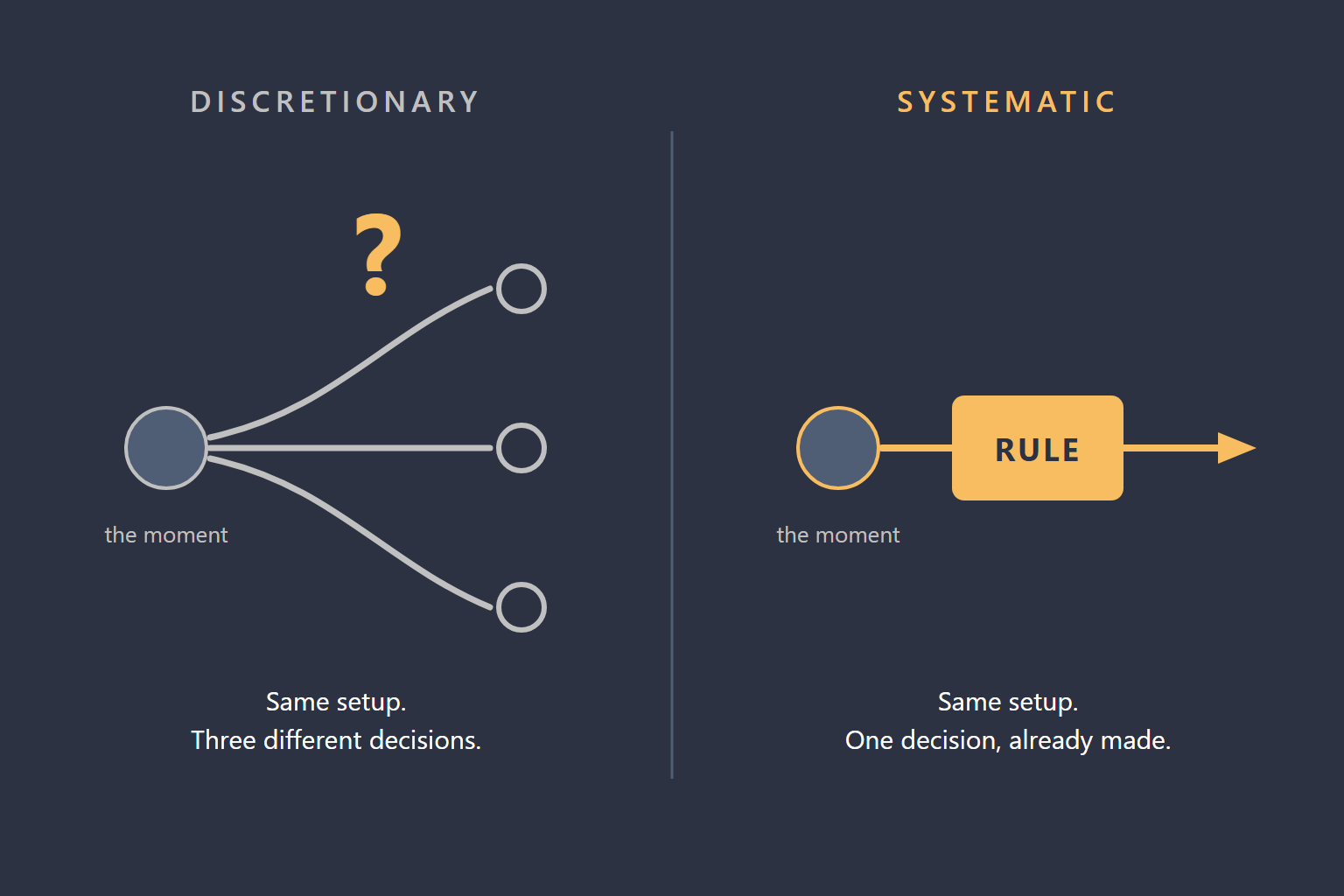
Think about what a discipline problem actually is. It is the gap between a decision you made calmly, in advance, and a different decision you made under pressure with money at stake. Every psychology book on the list above tries to close that gap by strengthening the person making the second decision. That is also the standard advice in most trading psychology material, and it is why so much of it disappoints.
There is another way to close it. Stop making the second decision.
If you have a fully objective, rules-based trading system that tells you exactly when to enter, exactly when to exit, and exactly how much to risk, there is very little left for your emotions to interfere with. You are not deciding whether this pullback looks weak. You are reading a signal your system generated and placing an order. Much of what people call a psychology problem quietly disappears when the discretion goes.
That is not an argument against reading these books. It is an argument for reading them in the right order, and for the right reason. More on that below.
One thing I will say clearly: do not let anyone convince you that you are psychologically broken because you are struggling. You have capital, you are doing the work, and you are reading this. That is not the profile of someone who cannot do it. It is the profile of someone who has been handed the wrong tool.
The 9 trading psychology books worth your time
1. Way of the Turtle – Curtis Faith
My top recommendation overall, and the reason it heads this list is that it refuses to separate the two halves of the problem.
Faith was one of the original Turtles, the group Richard Dennis famously recruited and taught to trade a mechanical trend-following system. The book covers the mindset, but it covers it alongside the actual rules, the actual position sizing, and the actual results. You see why the traders who struggled struggled, and it was rarely because they lacked information.
It is the closest thing on this list to an honest answer to the question “what does it actually feel like to follow a system through a bad stretch?”
What it will not do: it will not hand you a system for today’s markets. The Turtle rules are decades old and widely published. Treat them as an illustration of what a complete mechanical trading system looks like, not as a strategy to trade. Anything you intend to risk money on needs testing on current data.
2. Trading in the Zone – Mark Douglas
The most cited trading psychology book in existence, and deservedly so. Douglas’s central contribution is the shift from predicting to thinking in probabilities.
His argument runs like this: you do not know what will happen on the next trade, and you never will. But if you have an edge, you know roughly what happens across a large sample. The moment you accept that any individual trade is essentially random within a positive-expectancy process, the emotional weight of that single trade largely evaporates.
For a systematic trader this is the single most useful idea in the psychology literature, because it is exactly the mental model a backtest gives you. A backtest is a probability statement. Douglas explains, in plain language, why your brain resists believing it.
We have a full profile of Mark Douglas and his work if you want the deeper background on his ideas.
What it will not do: Douglas diagnoses beautifully and prescribes vaguely. The book tells you to accept the risk and think in probabilities. It does not tell you how to build the thing that makes probabilities knowable. That part is on you.
3. The Disciplined Trader – Mark Douglas
Published in 1990 and still selling, which tells you something. This is Douglas’s earlier and denser book, and it goes further into the mechanics of why a trader’s mind fights the rules they set for themselves.
If Trading in the Zone is the accessible version, The Disciplined Trader is the one that repays a second reading with a highlighter. It is worth owning both. We have a longer review of The Disciplined Trader covering the key chapters.
What it will not do: it is heavy going in places, and it was written for a discretionary audience trading pits and screens. Read the diagnosis, ignore the implied solution.
4. Trade Your Way to Financial Freedom – Van Tharp
Ignore the title. This is one of the most practically useful books a developing systematic trader can read, because Tharp puts psychology, system design and risk management in the same frame instead of treating them as separate subjects.
The sections on expectancy and position sizing are the standouts. Tharp was one of the first to make the point that how much you trade matters more than what you trade, and he makes it with arithmetic rather than assertion. If you have never worked through expectancy properly, this book is where it clicks.
Once it does click, run your own numbers through our trading expectancy calculator and see what your actual edge looks like. Most traders find the exercise uncomfortable and instructive in equal measure.
What it will not do: the psychological profiling material is the weakest part of the book. Take the expectancy and sizing chapters, which are excellent, and hold the rest lightly.
5. Super Trader – Van Tharp
Shorter and more structured than Trade Your Way, and organised as a path rather than a survey. Tharp’s framing of trading as a set of skills to be developed in sequence, rather than a secret to be discovered, is the right framing.
The emphasis on written objectives before strategy is the part most traders skip and most traders need. You cannot judge whether a system suits you until you have written down what you are actually trying to achieve. Our guide to setting trading goals covers the same ground with specific return and drawdown targets.
We also have a full profile of Van Tharp’s work and contribution.
What it will not do: there is meaningful overlap with Trade Your Way. If you only read one Tharp book, read that one.
6. Market Wizards – Jack Schwager
Not a psychology book in the technical sense, and more valuable than most books that are. Schwager interviews traders who have made serious money over long careers, and the interviews are unedited enough that the contradictions show.
The lesson is not any individual trader’s method. It is the pattern across all of them: they trade wildly different styles, in different markets, on different timeframes, and the common thread is that each one found an approach they could execute consistently and then defended it against their own impulses.
That is a liberating read for anyone still hunting for the one correct strategy. There is no such thing. There is only a strategy that fits you, tested well enough that you will actually run it. Our page on choosing a trading strategy walks through how to match one to your temperament and schedule.
What it will not do: survivorship bias is baked in. These are the people who succeeded. You are not reading interviews with the equally confident traders who blew up. Enjoy the book, and do not treat any single interview as a template.
7. Thinking, Fast and Slow – Daniel Kahneman
The science underneath every trading psychology book ever written, from the Nobel laureate who did the original work.
Loss aversion, anchoring, the availability heuristic, overconfidence, narrative fallacy – Kahneman documents them with experimental evidence rather than trading-floor anecdote. Reading the primary source after reading trading psychology books is clarifying, because you see which trading-book claims are grounded and which are folklore.
The chapter on the illusion of validity should be required reading for anyone who believes they can look at a chart and know what happens next.
The most awkward one for traders is blind spot bias – the well-documented tendency to see cognitive biases clearly in other people and not at all in yourself. It is the reason “I know about that bias” is such weak protection.
What it will not do: there is not a word about trading in it. You do the translation. And knowing the name of a bias has almost no effect on whether you fall for it, which is rather the point of this article.
8. Fooled by Randomness – Nassim Taleb
The best book on the distinction between a real edge and a lucky streak, which is the distinction most traders never make and most blow-ups depend on.
Taleb’s argument matters enormously for anyone building systems. A run of winning trades feels like evidence. Statistically, over a small sample, it is close to noise. Traders who cannot tell the difference add size after a hot streak and are surprised when the market takes it back with interest. If you are unclear on what separates a genuine trading edge from a run of good luck, sort that out before you read anything else on this list.
The systematic answer is sample size and out-of-sample testing. Taleb gives you the intuition for why that discipline matters, which makes it far easier to stick to.
What it will not do: Taleb is abrasive and repetitive, and he does not offer a method. Read it for the mental model, not for instructions.
9. Trading Psychology 2.0 – Brett Steenbarger
Steenbarger is a clinical psychologist who has worked with professional trading desks, and his angle is different from Douglas’s: he is interested in process, measurement and best practice rather than in mindset alone.
The core idea, that traders improve by building and reviewing repeatable processes rather than by trying harder, is close to correct. He is essentially arguing for systematisation from the psychology side of the fence.
His The Daily Trading Coach is the more practical companion if you want structured exercises rather than argument.
What it will not do: much of the material is oriented toward short-term and intraday professionals. If you trade end of day around a job, filter accordingly.
Why do trading psychology books rarely change how you trade?
Because they ask you to apply the lesson at the exact moment you are least capable of applying it.
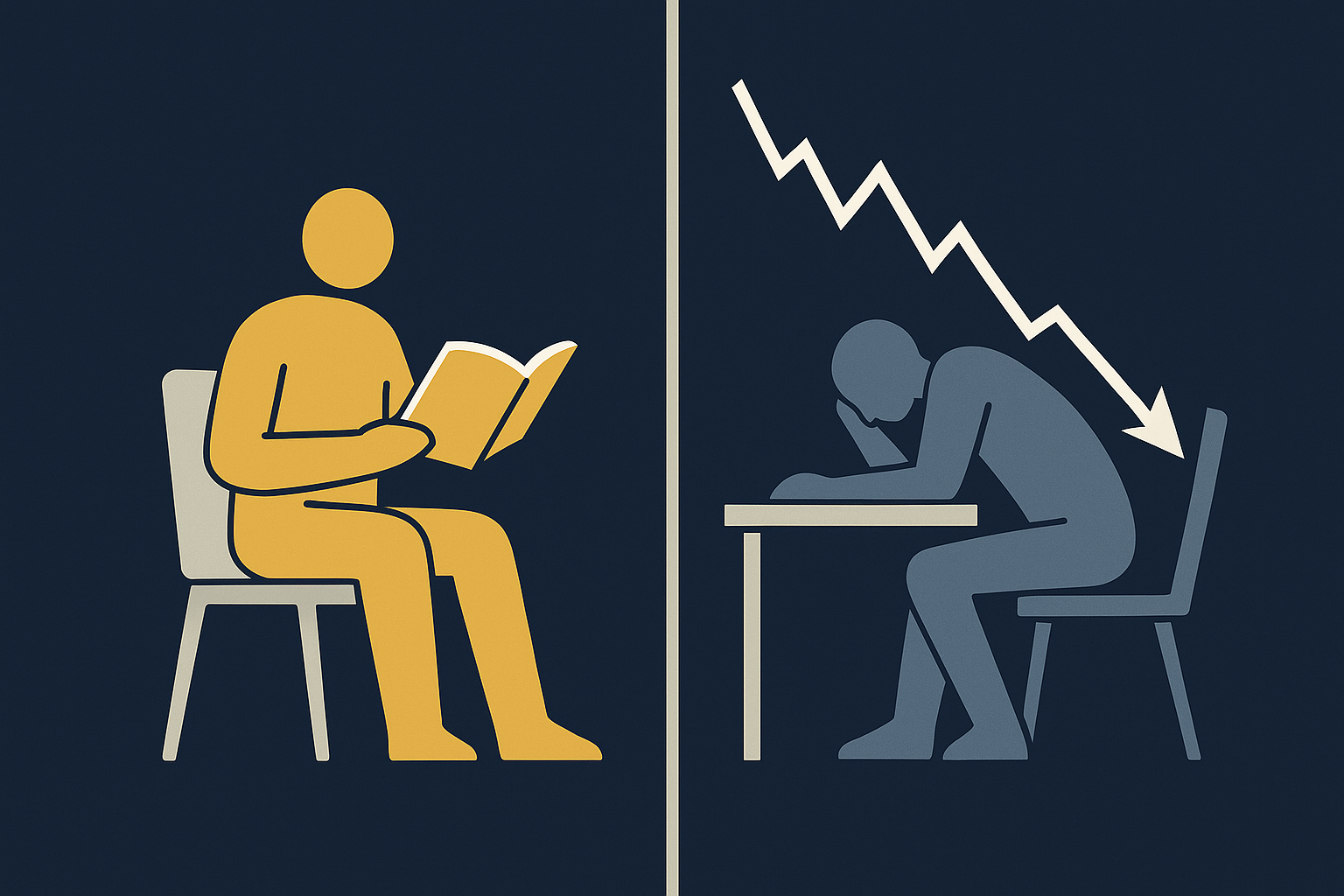
Every book on this list is read in a calm room. No position open, no money moving, nothing at stake. In that state the advice is obvious and you agree with all of it.
Then a real trade goes against you. Your position is down, the loss is now a number attached to your account, and the part of your brain that read the book is competing with a much older and faster part that wants the discomfort to stop. Knowing about loss aversion does not switch loss aversion off. Kahneman spent his career studying these biases and reported that he was no better at avoiding them than anyone else.
This is why “be more disciplined” fails as a plan. It is not a plan. It is a description of the outcome you want, restated as an instruction.
The gap is a design problem, not a character problem. If your process requires a judgement call at the moment of maximum stress, it will eventually get that call wrong, no matter how much you have read. Design the judgement call out and the failure mode goes with it.
What actually fixes emotional trading?
A tested, written, rules-based system that makes the decision before the money is at stake.
Here is the practical difference. A discretionary trader in a drawdown has to decide, today, whether the strategy is broken or whether this is normal. That decision is made under stress, with recent losses weighted far too heavily, and it is where most traders abandon a perfectly good approach at exactly the wrong moment.
A systematic trader in a drawdown has already answered that question. They know from their backtest what the historical maximum drawdown looked like, how long the worst recovery took, and how many consecutive losses the system has produced before. The current drawdown is either inside that range, in which case there is nothing to decide, or outside it, in which case a pre-written rule tells them what to do.
The emotional load is not managed. It is largely removed, because the decision was made months earlier by someone calm.
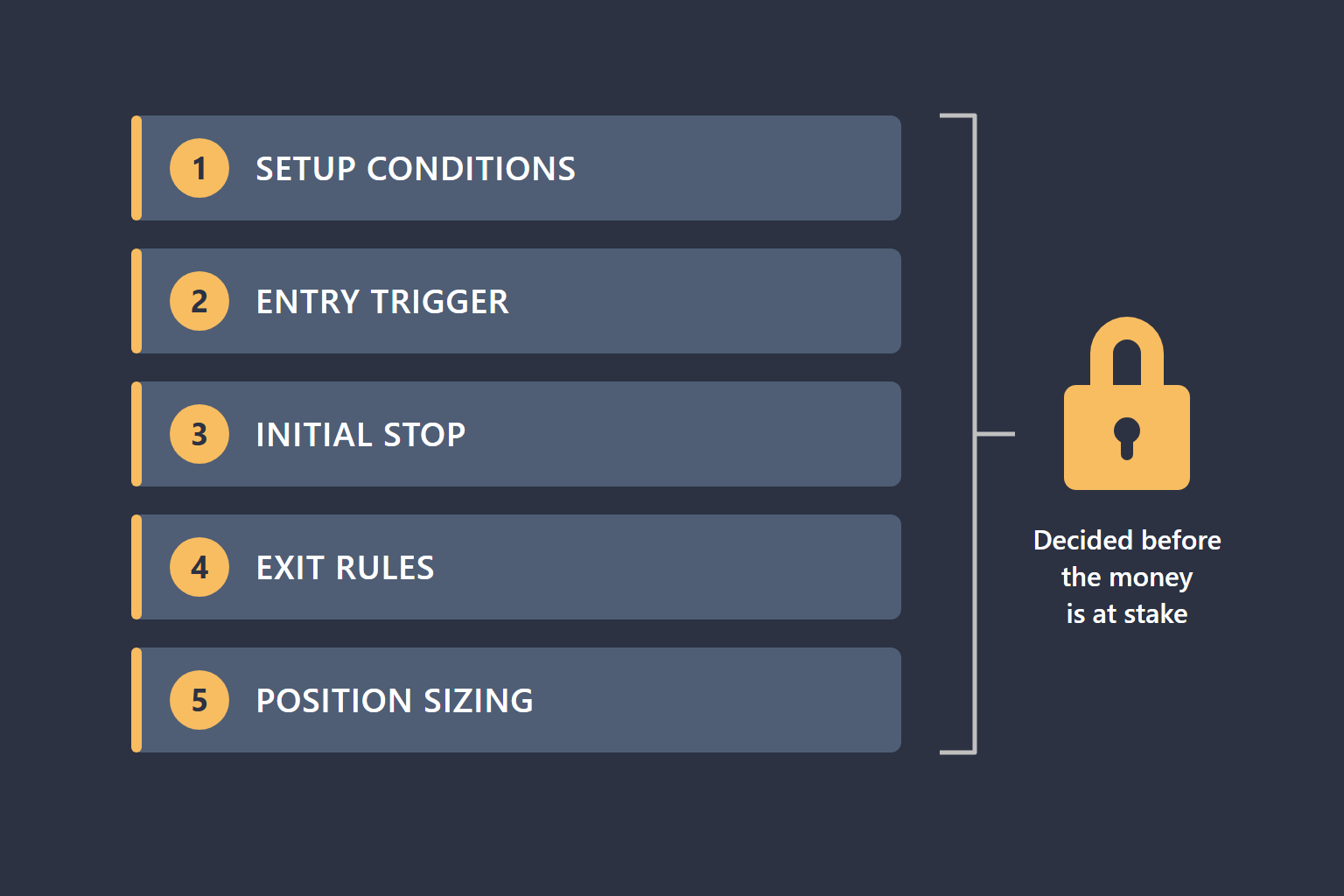
That is what a complete system does, and it needs all five parts to work:
- Setup conditions – what must be true before a trade is even considered
- Entry trigger – the exact condition that puts you in
- Initial stop – where you are wrong, defined before you enter
- Exit rules – profit target, trailing stop, or time-based exit, decided in advance
- Position sizing – how much you risk, calculated from the distance to your stop, not from a hunch about conviction
Write the rules down. Then write down the answers to the awkward questions: how do you prioritise two buy signals on the same day, how many positions do you hold at once, what happens if the broad market falls apart. Every gap where you would have to improvise is a gap where your psychology gets a vote. Our guide to building a trading plan covers how to close those gaps properly.
Then test it. Not because the numbers are the point, but because confidence built on evidence survives a losing streak and confidence built on hope does not.
How should a systematic trader read a psychology book?
Read them to reinforce why the system must be followed, not to find a substitute for having one.

That reframe changes what you take from every book on this list. You are no longer reading for a technique to deploy mid-trade. You are reading to strengthen your commitment to a process you have already tested, so that when the drawdown arrives you understand what is happening to you and why the rules exist.
Three practical suggestions:
Build the system first. A psychology book read before you have a tested system gives you nothing to be disciplined about. Read it after and every chapter has something concrete to attach to.
Do not read them once. Highlight them. Re-read them during drawdowns specifically, which is when the material is genuinely useful and when you are most likely to need it. A book that felt obvious in a calm month reads very differently in month four of a flat equity curve.
Change what you measure. Stop asking “did I make money today?” and start asking “did I follow my system today?” You control the second question completely. You control the first not at all. That single change in scorekeeping does more for a trader’s psychology than any book, because it stops rewarding you for undisciplined trades that happened to work.
If you want the wider reading list beyond psychology, we maintain a ranked list of the best trading books of all time covering systems, backtesting and risk alongside mindset.
Which trading psychology book should you read first?
Start with Way of the Turtle, because it shows psychology and system design working together rather than treating the mind as a separate project.
A sensible order:
- Way of the Turtle – see how the two halves fit
- Trade Your Way (Van Tharp) – get expectancy and position sizing straight
- Trading in the Zone – install the probability mindset
- Market Wizards – stop hunting for the one right strategy
- Fooled by Randomness – learn to distrust a hot streak
- Everything else, as the specific problem arises
If you are in a drawdown right now, skip to Trading in the Zone and re-read your own backtest results at the same time. The combination works better than either alone.
Frequently asked questions about trading psychology books
Do trading psychology books actually work?
They work as diagnosis and they fail as treatment. A good psychology book will explain accurately why you moved your stop or skipped a valid signal. What it cannot do is prevent it happening again, because it asks you to override an emotional reaction in real time. Removing the discretionary decision through a tested rules-based system is far more reliable than trying to win that fight repeatedly.
What is the best trading psychology book for beginners?
Way of the Turtle by Curtis Faith. It is readable, it is honest about failure, and it shows psychology in the context of an actual mechanical system rather than in isolation. A beginner who reads only mindset books tends to conclude that trading is mostly mental, which leads to years of work on the wrong problem.
Is Trading in the Zone worth reading?
Yes. Mark Douglas’s core idea, that you should think in probabilities across a large sample rather than trying to predict individual outcomes, is the correct mental model for systematic trading and the book explains it better than anything else. Read it for the mindset, then get your probabilities from a backtest rather than from acceptance alone.
How many trading psychology books should I read?
Two or three, properly, beats fifteen skimmed. I have read over 150 trading books and fewer than ten genuinely changed how I trade. Re-reading a good book during a drawdown is worth more than adding a new title to the pile, and time spent building and testing an actual system beats both.
Can psychology books replace a trading system?
No, and treating them as a replacement is the most common and most expensive mistake in this category. Psychology work makes a good system easier to follow. It cannot manufacture an edge, and no amount of emotional control will make an untested strategy profitable.
Why do most traders still fail after reading these books?
Because they read for a cure rather than an explanation, and they read before they had a system. Knowledge of a bias does not neutralise the bias. The traders who improve are the ones who use the books to understand why rules matter, then go and build rules worth following.
The shortcut nobody sells you
If you take one thing from this article, take this: the discipline problem you are trying to read your way out of is usually a system problem wearing a psychology costume.
Traders who describe themselves as undisciplined are almost always traders whose rules are incomplete. There is a gap somewhere in the process, they have to improvise to fill it, and improvising under pressure produces the behaviour they then blame on their mindset. Close the gap and the symptom goes.
Read the books. Several of them are excellent and the reading list above will not waste your time. Just do not expect them to do the job a tested system does.
The Trader Success System is built on exactly this principle: give an analytical person complete, backtested, rules-based systems and the confidence that comes from evidence, and the psychology problem shrinks to something manageable. It is a structured path through system design, backtesting, position sizing and portfolio construction, built for people who have full-time jobs and want their trading to take 10 to 30 minutes a day.
If you are not ready for that yet, start free. The Trader Acceleration Bundle includes the Trading Confidence Builder mini-course and a fully coded mean reversion system you can examine and test yourself, which will teach you more about the psychology of following rules than another book will.
Remember – You are only one trading system away!