What Are Trading Goals?
Trading goals are written statements that define what you want your trading to deliver – your target annual return, the maximum drawdown you will tolerate, the time per day you will commit, and the lifestyle the system has to fit. Without them, every system decision becomes guesswork. With them, you have a clear pass-or-fail benchmark for every system you build, every dollar you risk, and every change you consider.
Most traders never write their goals down. That is why most traders cannot answer the single most important question in trading: is my system good enough?
This article shows you how to set trading goals that survive contact with the market – probabilistic, multi-dimensional, and matched to the life you actually want to live.
Key Takeaways
- Trading goals must cover return, drawdown, time, personality and lifestyle – not just CAGR.
- Single-number targets like “25% CAGR” are a trap. Use probabilistic goals such as “90% probability of 18%+ CAGR”.
- Most “discipline failures” are actually lifestyle mismatches in disguise.
- Define your catastrophic-loss floor (worst single-trade loss) before you start trading.
- Write your goals into the front of your trading plan and review them quarterly.
Your Trading Goals Are Closer Than You Think
I took a photo the day before we set off to climb Mount Kilimanjaro. The summit looked so far away I genuinely thought I would never reach it. Six days later, after putting one foot in front of the other, I stepped onto the summit.

That photo reminds me of when I started stock trading with just $7,500. Financial independence seemed a long way off. But I started. I learned how to build a trading system, I learned proper risk control, and I created my own trading plan. Then I executed it and followed my system consistently.
I am glad I did. If I had looked at that first trading book and said “this is going to take me too long to figure out”, life would look very different now.
Your trading goals are no different. Start. Learn what you need to learn. Commit to the process. Before you know it, you will hit the summit too.
But here is the part most traders miss, and the reason they wander for years without ever arriving:
If you cannot describe the summit, you cannot tell when you are getting closer to it.
That is what this article is about. Defining your trading goals so precisely that every system decision you make from this day forward has a clear pass-or-fail answer.
Why Do Trading Goals Matter?
Most traders fail because they try to use someone else’s system, take tips, read trading newsletters, or rely on broker recommendations. These methods are all flawed because they do not take into account YOUR trading goals.
Your goals are as personal as you are.
More than most disciplines, you need to be 100% clear on your objectives to be successful in trading. Without clear goals, you will not succeed – PERIOD!
Writing my specific trading goals gave me dramatic and unexpected benefits which I will tell you about below.
Setting written goals puts you at a significant advantage over almost every other trader in the market.
What Your Trading Goals Need To Cover
Your trading goals should consist of a precise written statement about each of the following:
- Your ideal lifestyle (that you want your trading to support)
- Amount of time you will spend on your trading each day
- Annual percentage return
- Maximum drawdown
- Maximum monthly drawdown
- Maximum length of drawdown
- Worst case drawdown
Without these, it is impossible to know when your trading system is good enough. You will also have no way to tell if your live trading results are meeting your objectives once you start.
That sounds like a minor point, but it is not. Trading through a 15-20% drawdown will be very hard if you never established your maximum drawdown tolerance and never designed your rules to deliver on it. On the other hand, if your goals say you want to avoid drawdowns of 40% or more, then a 15-20% drawdown becomes a non-event.
Knowing how much to risk on each trade is impossible if you have not established your profit objective and your drawdown tolerance. Changing the amount you risk per trade by only 0.25-0.5% can make a dramatic difference to the shape of your equity curve, your rate of return and the size of your maximum drawdown. (For more on this, see position sizing.)
Without written trading goals, it is impossible to determine how much to risk per trade.
How Written Goals Changed My Trading Results
Before writing my trading goals, I spent countless hours tinkering and “optimising” trading systems.
With no clear outcome to work towards, there was no way of knowing when to stop, nor what I was actually optimising for. It was hard to gain confidence in new systems, and progress on diversification was painfully slow.
Once I documented my goals for my overall trading program and for each new trading system, the development process accelerated, objective functions became clear, and the system parameters fell into place much more easily. I also ended up building more profitable trading systems with smoother equity curves.
If you have not already done it, write down your trading goals in as much detail as you can. Do this before continuing on with any system development work.
Trade Your Personality, Lifestyle, And Objectives
Here is something most trading courses skip entirely. Even the perfect set of return and drawdown numbers will not save you if your trading method does not fit you as a person.
If you are going to be active in the market, your approach has to match three things: your personality, your objectives, and your lifestyle.
If you are hyperactive and crave action, you cannot buy and hold for ten years. You will be bored, you will sabotage the system, and you will quit. The reverse is just as true. If you want a calm life with 20 minutes of trading per day, you cannot run a strategy that demands you watch the screen during business hours.
The Three Requirements For Freedom Through Trading
In 2019 as part of our family global travel adventure, we spent time cruising around the island of Kauai on a boat, snorkelling, watching dolphins and sea turtles, in the middle of the week, with no worry about money, work, or annual leave. That is what freedom looks like to me. I did not want to worry about the markets during the day while I was on awesome adventures with my family. That is why I trade systematically using end of day trading systems.
A lot of people get into trading to achieve that kind of freedom. And yet most traders are trading in a way that makes freedom impossible. There are three things you need to actually get there:
- A profitable method. You have to be able to make money.
- Confidence in your system. You need to be able to follow it without second-guessing.
- A trading plan designed to fit the life you want. This is the one most people miss.
If you want to sit in front of nine monitors all day staring at tick charts and making high-stress decisions, fine – if that is genuinely what you want. But for me, that is not freedom, and that is not why I got into trading.
So I designed my systems with those objectives in mind. When I first built them 25+ years ago, my main constraint was time. I was working long hours and travelling. The only way I could trade was 20-30 minutes a day, placing orders at the open and walking away.
That choice turned out better than I expected. In 2012, I was making more money trading 20-30 minutes a day than I was earning at my 14-hour-a-day corporate job. So I left. And because my trading was already giving me the freedom I now had time to enjoy, I never felt the need to change my style.
Meanwhile, I see traders running short-term systems that demand they monitor positions through the day, while complaining they have no time and no freedom. The mismatch is the problem, not the markets.
Objectives In Terms Of Time, Return And Risk
Your objectives have to cover three dimensions, not one:
- Time. “I want to spend 20 minutes a day on this so I have the rest of my day free.” If that is your objective, you cannot run a strategy that requires intraday monitoring.
- Return. What annual percentage return do you actually need, given your account size and your goals?
- Risk. What drawdown can you genuinely live through without quitting?
If any one of these does not match, the system will eventually break – not because the rules failed, but because you will stop following them.
This is why I do not believe in blindly copying anyone else’s system. The right trading system for me will not be the right system for you. The right system is the one designed to fit your personality, your time, and your goals. (If you want to know your own profile, the trader personality test is a good place to start.)
Absolute Objectives Are A Trap
Now here is where most traders, even the disciplined ones, still get it wrong.
They set objectives like: “I want 25% CAGR with a 15% max drawdown.”
It sounds rigorous. But it is actually close to useless – because trading deals in probabilities, and that objective is stated as a certainty.
Here is the problem. You run a backtest, you get one equity curve, one CAGR, one max drawdown. Then you anchor your expectations to those exact numbers. But that single backtest is just one path the market happened to take. Reorder the trades, shift the entries by a day, change which signals fire first, and you get a meaningfully different result from the same strategy.
The headline numbers from a single backtest are not what you should expect. They are one sample from a distribution of possible outcomes. If you set your objectives against that single sample, you are setting them against an accident of sequencing.
The difference between the two approaches is stark:
| Single-Number Objective | Probabilistic Objective |
|---|---|
| “25% CAGR with 15% max drawdown” | “90% probability of >18% CAGR; <5% probability of >25% drawdown” |
| Based on one backtest path | Based on thousands of resampled paths |
| Live deviation triggers panic | Live deviation checked against modelled distribution |
| Optimises for noise | Ignores noise within the margin of randomness |
| Has no answer for “is this good enough?” | Has explicit pass-or-fail criteria |
| Encourages quitting at the worst moment | Builds the confidence to keep trading through normal bad runs |
There is a much better way.
Monte Carlo: Setting Objectives In The Real World
Monte Carlo analysis takes your strategy’s trades (or daily equity changes) and resamples and reorders them thousands of times. Instead of one equity curve, you get a distribution of outcomes – a clear picture of the good paths, the bad paths, and everything in between that the same set of rules can produce.
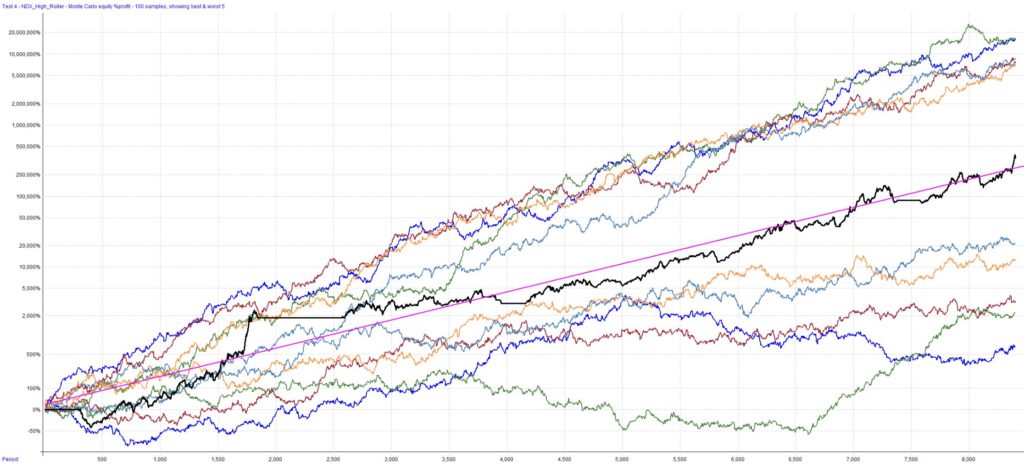
That changes what an objective even is. Now you can state objectives the way reality actually works:
- “90% probability of exceeding 18% CAGR”
- “Less than 5% probability of a drawdown worse than 25%”
- “75% probability the return lands between X and Y”
The benefit shows up in three ways.
First, you stop abandoning good systems. When you hit a 22% drawdown live, you do not panic. You check whether that outcome sits inside your modelled distribution. If it does, you keep trading – the system is behaving exactly as expected. If it does not, that is your genuine signal that something is broken. Most traders quit perfectly good systems at the worst possible moment because they never knew what “normal bad” looked like.
Second, you allocate capital with confidence. A distribution of drawdowns tells you how much you can size up before the probable worst case exceeds what you can stomach. A single backtest cannot.
Third, you stop chasing noise. When you can see how wide the outcome distribution is, you realise that half a percent of backtested CAGR is well within the margin of randomness – and you stop wasting weeks optimising for it.
Probabilistic objectives turn live performance from an emotional guessing game into a pass-or-fail check. That is a far stronger position to trade from.
Want to define your own probabilistic, multi-dimensional trading objectives in under 10 minutes?
Why CAGR And Drawdown Targets Are Not Enough
Even probabilistic CAGR and drawdown objectives are incomplete. CAGR and max drawdown are two numbers describing something that has many dimensions – and traders who optimise only for those two routinely build portfolios they cannot actually live with.
This is where most trading advice is just plain wrong. The standard story is that traders fail because of discipline. The prescribed fix is always the same: try harder, be more disciplined, white-knuckle it, stop messing around.
But a lot of what gets diagnosed as a discipline problem is actually a lifestyle or personality mismatch. And no amount of willpower fixes a mismatch.
To be clear: not every lapse is a mismatch. Sometimes you revenge trade, override a signal out of boredom, or skip your journal because you genuinely could not be bothered. That is on you. But far more failures are structural than traders are willing to admit, and the structural ones are the ones you can actually fix by design.
Consider what really happens:
- A trader who does not have much time following a system that fires 30 signals a week will eventually have trades slip through the cracks. Not because the trader is lazy, but because the workload does not fit the hours available. That is not lack of discipline, it is a frequency mismatch.
- A trader with a day job, running a system that requires them to check positions at the open, will inevitably miss executions. Calling that a discipline failure is like blaming someone for not answering the phone while they are in a meeting with their boss.
- A system that sits underwater for 18 months will erode the attention and record keeping of even a conscientious trader, because humans disengage from things that feel like they are failing. The slipping standards are a symptom of the time-in-drawdown, not a character flaw.
- A high-position-count portfolio demands a tolerance for monitoring complexity that some personalities simply do not have. Force it on the wrong person and you get errors, missed adjustments, and eventually avoidance.
Build a system – and even more to the point, a portfolio of trading systems – that fits the trader, and the “discipline problems” quietly start to disappear. There is nothing to push through. The record keeping gets done because it is manageable. Mistakes stop slipping through because the workload matches the attention available. Good behaviour stops being a feat of willpower and becomes the path of least resistance.
So your objectives need more dimensions than return and drawdown:
- Simultaneous positions – how many open trades can you realistically manage and still pay attention to each one?
- Trading frequency – how many signals per week genuinely fit your available hours, not your fantasy of them?
- Time between equity highs – how long can you stay engaged and attentive while underwater before your standards slip?
- Time-of-day demands – when do you actually need to be available to monitor signals and executions, and does that line up with the rest of your life?
A system that scores beautifully on CAGR but fails the lifestyle test is not a system with a disciplined trader waiting to emerge. It is a system you will eventually abandon – and you will wrongly blame yourself when you do. Define these constraints before you build, and you stop setting yourself up to fail.
For the specific CAGR and drawdown targets that fit a realistic stock portfolio, see how to set achievable CAGR and drawdown targets.
What Is A Catastrophic-Loss Objective?
Finally, your objectives need a downside floor. Not the modelled drawdown – the genuine worst case.
What happens when a stock gaps to zero on fraud, or gaps up 200% against your short? What is the maximum single-trade loss you are prepared to endure, and does your position sizing actually respect that limit?
Similarly, we must also ask what happens to our portfolio if the market crashes. If the market gapped down 20% on one day due to some extreme unexpected event, how much of a drop in your account would you be comfortable with?
Most traders never write these numbers down, which means they discover it the hard way.
A catastrophic-loss objective is a hard constraint that sizing and system design must obey, full stop. Write it down with the rest of your goals.
Establish Your Reason To Succeed: Your Ideal Life
Trading goals are only one piece of setting objectives for your life. The numbers matter, but if you have no idea how trading fits into the rest of what you want, you will struggle to find the motivation and discipline when the work gets hard.
Jim Rohn said that if your “why” is big enough then the “how” does not matter. When your reasons for succeeding are big enough, nothing can stand in your way – you will find a way.
Building a profitable trading business is hard. If you have a big enough reason to succeed, you will get there anyway.
Once you succeed in the trading systems business, the rewards are very significant.
A useful exercise is to define what your ultimate life looks like in as much detail as possible. Capture everything you want to do once time and money are no longer a problem. Whether you call this a dream board, a dreams list, or your ideal lifestyle does not matter (I call it my ‘Dream Life Statement’). The intent is the same:
Create a detailed picture of your ideal life to move you to take action.
Do it in one of three ways depending on your preference:
- Assemble a dream board with pictures of everything you want in your life.
- Create a dreams list of about 100 things you want to do.
- Write a document that describes in rich detail what your future dream life looks like.
The trick is not to hold back or limit yourself to what feels “reasonable” based on your past. You are trying to create a compelling future that drives you to take the action required to become a successful systematic trader.
Take 30 minutes now to do it. Identifying the dream is the first step to achieving it.
Build Your Goals Into Your Trading Plan
The start of your trading plan should establish your reasons to succeed, so that those reasons drive every other rule that follows.
Once you have a first draft of your ideal life, drop it into the front of your trading plan. Review your plan often, and you will remind yourself of why you are doing this every time.
If you do not have a trading plan yet, start one as a first priority. Your ideal life is the first page.
Warning: Your Trading Objectives May Not Be Conscious
All behaviour is driven by objectives. The problem most people have is that their objectives are not conscious. If you are not aware of them, you cannot tell what you are actually working towards.
If you have no written trading goals, you are in real danger. You are being driven by subconscious objectives, and those almost never line up with profitable trading. Read enough trading psychology and you will see the usual suspects:
- Desire to be right
- Desire for excitement
- Social acceptance
- Avoidance of pain and discomfort
Each one sabotages trading in a predictable way:
- Desire to be right. Causes you to cut winners early and hold onto losses, hoping they will come back. Your average win shrinks. Your average loss grows.
- Desire for excitement. Causes you to overtrade, take poor setups just to have something to do, and obsessively monitor positions. Time wasted, stress up, mistakes up.
- Social acceptance. Causes you to share positions and performance openly, get attached to trades, take tips that undermine your system, and stress over what others think.
- Avoidance of pain. Causes you to skip the small loss now, which usually turns it into a much bigger loss later.
Write your goals down. Revisit them regularly. That is how you keep the conscious objectives in charge and the subconscious ones out of the driver’s seat.
What Changes When You Have Clear Trading Objectives?
Once probabilistic, multi-dimensional objectives like I have described are in place, something shifts. You now have clear pass-or-fail criteria for every decision:
- Is this system good enough? Does it meet the objectives? Yes or no.
- How much capital should I allocate? Whatever size keeps you inside your drawdown and catastrophic-loss limits.
- What should I work on next? Whichever dimension of your portfolio’s performance is currently failing.
That is the real payoff. Clear objectives kill analysis paralysis. They end the endless optimisation loops where you chase another half-percent of CAGR with no idea whether it matters. They give you permission to stop when a system is good enough – which is something most traders never let themselves do.
You do not need a better system. You need a benchmark.
Frequently Asked Questions About Trading Goals
What is the goal of trading?
The goal of trading is to grow your wealth by consistently executing a well-defined plan that aligns with your financial objectives, risk tolerance, and lifestyle. It is not just about making money on individual trades. It is about building a sustainable process that generates profits over time while managing risk.
Key goals include capital growth, risk management, consistency, adherence to a plan, emotional discipline, and the freedom and flexibility that systematic trading can produce.
What are realistic financial goals for trading?
Your financial goals for trading should be specific, measurable, and aligned with your personal objectives:
- Annual return target. Define the percentage return you aim to achieve each year. Disciplined traders with diversified systems might target 20-30% annually, though this depends on your strategy and risk tolerance.
- Drawdown limits. Set clear boundaries for the maximum drawdown you will tolerate, including overall, monthly, and worst-case scenarios.
- Account growth. Focus on growing your account steadily. Reinvest profits. If you can, add savings to accelerate growth.
- Living expenses. If your goal is to trade for a living, calculate the income you need, then work backward to the account size required to generate it. The trading for a living calculator handles the maths.
- Long-term independence. For many, the ultimate goal is having enough capital to support your ideal lifestyle without relying on traditional income.
Write these down and put them at the front of your trading plan.
What is a realistic CAGR target?
For a well-diversified portfolio of long-only stock systems, a MAR ratio (CAGR divided by max drawdown) of around 1.0 is a respectable goal. So if your maximum acceptable drawdown is 20%, your CAGR target should be around 20%. If your maximum acceptable drawdown is 30%, then 30% CAGR is a reasonable target.
Set the drawdown first, then derive the CAGR. Full methodology in how to set achievable CAGR and drawdown targets.
How do I know if my trading system is good enough?
You cannot answer that question without defined objectives. “Good enough” is meaningless without a benchmark. Define probabilistic objectives (return distribution, drawdown distribution, time-in-drawdown, catastrophic-loss floor, position count, frequency, and time-of-day demands), then check whether your system’s modelled distribution meets each one. Pass or fail. That is how you stop tinkering.
Should I copy someone else's trading system?
Ideally No. Copying someone else’s system means inheriting their objectives, their personality, their lifestyle, and their tolerance for drawdown. None of those will match yours. You will eventually abandon a system that does not fit you – and the better the system, the more painful the abandonment. Build, or learn to build, your own systems around your own objectives.
How often should I review my trading goals?
At least quarterly. Read them when you review your trading plan, when you finish a new system, when you hit a new drawdown, and when something in your life changes (new job, kids, retirement, inheritance). Goals are not set once and forgotten. They drive every system decision you make, so they need to stay current.
What if my trading goals conflict with my lifestyle?
They probably will, at first. That is the point of writing them down. If your goal is 30% CAGR but you only have 15 minutes a day, something has to give: lower the return target, find a less time-intensive style, or carve out more time. The conflict was always there. Writing the goals down just makes it visible.
What is the most common goal-setting mistake traders make?
Setting a single-number target like “25% CAGR, 15% max drawdown” from a single backtest. Reality is a distribution, not a number. The minute live results drift from those exact numbers, the trader panics or quits. Probabilistic objectives (“90% probability of exceeding 18% CAGR”) survive contact with reality. Single-number objectives do not.
What are some examples of good trading goals?
A good set of trading goals is specific, written, and covers multiple dimensions. Here is an example for a part-time systematic stock trader:
- Return: 90% probability of exceeding 18% CAGR over rolling 3-year windows
- Drawdown: Less than 5% probability of a drawdown deeper than 25%
- Time-in-drawdown: Less than 18 months underwater before a new equity high
- Catastrophic loss: No single trade can lose more than 2% of total portfolio equity
- Workload: No more than 30 minutes per day, run end-of-day, never during market hours
- Position count: Maximum 20 simultaneous open positions across all systems
- Lifestyle: System must run unattended for up to 4 weeks while travelling
Notice that the example covers far more than CAGR and max drawdown. Most failures happen on the dimensions traders never write down.
How do I set trading goals as a beginner?
Start with lifestyle and time, then layer the financial targets on top. Most beginners do this backwards – they pick a return target first, then discover their system needs hours a day they do not have. Work through it in this order:
- Lifestyle. How much time per day, which time of day, and how much screen attention can you genuinely commit?
- Drawdown tolerance. What is the largest drawdown you could sit through without quitting? Be honest, not aspirational.
- Return target. Derive this from your drawdown tolerance using a MAR ratio of around 1.0 (so 20% drawdown tolerance = 20% CAGR target).
- Catastrophic floor. Set a hard ceiling on the worst single-trade loss your position sizing will ever allow.
- Write it down. Put all five at the front of your trading plan and review quarterly.
This stops you from copying someone else’s targets and inheriting goals that do not fit your life.
Are SMART goals useful for traders?
The SMART framework (Specific, Measurable, Achievable, Relevant, Time-bound) is useful for the structure of trading goals, but it is incomplete for traders. SMART goals are usually stated as single-number targets – “make 25% this year” – which is exactly the trap probabilistic objectives are designed to avoid.
A better framing for traders is SMART + Probabilistic + Multi-dimensional:
- Specific to your system, not generic
- Measurable as probabilities and distributions, not single numbers
- Achievable based on what your modelled distribution actually shows
- Relevant to your real lifestyle, not your fantasy of it
- Time-bound with explicit time-in-drawdown and review cadence
Add probability and multi-dimensionality on top of SMART and you have a framework that survives the markets, not just a goal-setting workshop.
Build Your Crystal Clear Trading Objectives In Minutes
My Trading Objectives Analyzer walks you through defining probabilistic, multi-dimensional objectives – return probabilities, drawdown tolerances, position and frequency limits, time-in-drawdown, and your catastrophic-loss floor – so every future system decision has a clear pass-or-fail answer.
Do you want clear, holistic trading objectives documented in under 10 minutes?
Related Reading
- How to Set Achievable CAGR and Drawdown Targets For Your Stock Portfolio
- Drawdown In Trading: Manage Risk and Stay Profitable
- Your Trading Plan: The Essential Blueprint For Successful Trading
- Trading System Development: Your Step-By-Step Guide
- Position Sizing
- Backtesting
- Trading Psychology
- Trader Personality Test
- Trading For A Living Calculator