“It’s easy to stay motivated when you have momentum.”
This quote is so true, isn’t it? When trades are going well, profits are rolling in, and your equity curve is shooting upwards, it’s almost effortless to stay committed and focused. It’s easy to push forward, to feel that energy and drive when you see tangible results. You feel invincible, like you’re riding a wave of success that will never end. But what happens when the wave crashes? What do you do when that momentum grinds to a halt, and your trading account starts moving sideways or, even worse, starts shrinking?
Welcome to the Valley of Stagnation. It’s a place where every trader, regardless of experience or expertise, finds themselves at some point. It’s that frustrating period where you feel like you’re doing everything right, following your rules meticulously, but the results just aren’t there. Your systems seem to have stopped working, the market feels hostile, and every trade seems to be a battle. If you’ve been trading for any length of time, you know exactly what I’m talking about.
Understanding the Valley of Stagnation
The Valley of Stagnation is more than just a metaphor; it’s a reality that every trader must face. It’s a period of perceived stagnation, where the results don’t seem to match your efforts. You may be grinding away, day in and day out, sticking to your trading plan, following your systems, but it feels like you’re going nowhere.
This is the ultimate test. It’s where most traders throw in the towel, believing that they’ve “lost their edge” or that the market is simply against them. The problem isn’t the market; the problem is the mindset.
You see, the Valley of Stagnation is a psychological challenge more than anything else. It tests your resilience, your patience, and your belief in your system. It’s easy to follow your system when it’s working, but the real test of a trader is how you respond when it feels like nothing is working. This is where true mastery in systematic trading is forged.
Embrace the Cyclicality of Trading
Like many things in life, trading has its cycles. In Ancient Indian traditions, there’s a concept called the Wheel of Time, or “Kalachakra,” which posits that time goes through a natural cycle of Creation, Destruction, and Rebirth. Similarly, in trading, every period of prosperity is followed by a period of stagnation or drawdown, and this, in turn, is followed by another period of growth.
The Valley of Stagnation is not a permanent state; it’s just one phase in the trading cycle. You might find yourself there for a few days, weeks, or even months, but it will pass. What’s crucial is how you handle yourself during this time.
1. Ground Yourself in the Facts
Nothing bad ever comes from diligent, focused effort. Even if you don’t achieve the exact results you’re aiming for, you will learn, improve, and grow as a trader. This growth may not be immediately apparent in your equity curve, but it’s happening under the surface. As long as you continue to follow your systems and make data-driven decisions, you are still on the path to long-term success.
2. Choose Your Beliefs Wisely
Confirmation bias is a powerful thing. If you believe that you are a terrible trader, you will find plenty of evidence to support that belief, especially during a drawdown. Conversely, if you believe that you are a competent, disciplined trader who is simply going through a rough patch, you will find evidence for that too. Your beliefs shape your reality. Choose them wisely.
3. Be Prepared for the Rebirth
Just as the wheel turns from creation to destruction and back to creation again, so too will your trading performance. The Valley of Stagnation will be followed by a resurgence, a rebirth in your trading results. The key is to be prepared for it. Don’t abandon your systems, don’t stop trading, and don’t lose faith in your process. When the market turns, and it always does, you want to be ready to capitalize on the opportunities.
Why Systematic Traders Thrive in the Valley
Systematic traders are better equipped to handle the Valley of Stagnation than discretionary traders for several reasons:
1. Rule-Based Decision Making
Systematic trading takes the emotion out of trading decisions. When you follow a system, you don’t have to worry about whether you “feel” like taking a trade or not. Your decisions are based on pre-defined rules and algorithms that you have tested and validated. This means that even during periods of drawdown, you know that you’re doing the right thing by sticking to your system.
2. Diversification Across Systems and Markets
One of the key principles I teach in the Trader Success System is diversification. By trading multiple systems across different markets and timeframes, you reduce the likelihood that all your systems will be in a drawdown at the same time. This diversification helps smooth out your equity curve and gives you more consistent returns over time, even when some of your systems are underperforming.
3. Continuous Improvement and Monitoring
A systematic trader continuously monitors and improves their systems. This doesn’t mean over-optimizing or changing systems at the first sign of trouble, but rather keeping an eye on the performance metrics to ensure that the system is still robust. If you identify genuine deterioration in a system’s performance, you can take measured steps to improve it or replace it with another system. This ongoing refinement process ensures that you’re always using the best tools available to navigate the market.
My Personal Journey Through the Valley
Believe me, I’ve been through the Valley of Stagnation more times than I can count. I’ve experienced periods where every trade seemed to go wrong, where I doubted myself and my systems, and where I wondered if I had lost my edge. But looking back, I realize that those were the times that defined me as a trader.
One particularly tough period was early in my trading career. I had just developed a new trading system, and after a few months of incredible returns, the system hit a losing streak. I was devastated. I started questioning everything. Maybe I had just been lucky. Maybe the system was flawed. But I resisted the urge to tinker with the system or abandon it altogether. Instead, I went back to my backtests, re-checked my parameters, and reaffirmed my confidence in the system.
Eventually, the market conditions changed, and the system started performing well again. That experience taught me a valuable lesson: you must have faith in your process and the courage to stick with your systems even when it feels like they’ve stopped working.

Strategies to Survive and Thrive in the Valley
So, how do you get through the Valley of Stagnation without throwing in the towel? Here are a few strategies that have worked for me and many of my students:
1. Focus on Process, Not Results
During periods of stagnation, it’s easy to become obsessed with your trading results. You check your account balance every five minutes, you second-guess your trades, and you start to feel overwhelmed. Instead, shift your focus to the process. Are you following your trading plan? Are you executing your trades flawlessly? Are you managing your risk appropriately? If the answer is yes, then you’re doing everything right, even if the results aren’t there yet.
2. Revisit Your Trading Journal
One of the most powerful tools in your arsenal is your trading journal. Go back and look at your past trades, both winners and losers. Look for patterns, mistakes, and areas for improvement. Often, just the act of reviewing your past trades can provide valuable insights and remind you of the progress you’ve made.
3. Engage with the Community
Trading can be a lonely pursuit, especially during tough times. This is why being part of a supportive trading community, like the one we have in the Trader Success System, is so important. Share your struggles, ask for advice, and lean on your fellow traders for support. Sometimes, just knowing that others are going through the same challenges can be a huge relief.
4. Stick to Your Risk Management
During drawdowns, the temptation to “make it all back” with one big trade can be overwhelming. Resist that urge. Stick to your risk management rules religiously. The last thing you want is to blow up your account trying to recover from a drawdown. Remember, slow and steady wins the race.
5. Celebrate Small Wins
In the Valley of Stagnation, it’s important to celebrate even the smallest of wins. Did you follow your trading plan perfectly this week? Did you avoid a revenge trade? Did you stay disciplined with your stop-losses? Celebrate these victories, no matter how small they seem. They are proof that you are growing as a trader.
The Valley is a Part of the Journey
Ultimately, the Valley of Stagnation is a necessary part of the trading journey. It’s a rite of passage that every trader must go through. It’s not a sign that you’re a bad trader or that your systems are broken. It’s simply the market’s way of testing your resolve, your discipline, and your faith in your process.
So the next time you find yourself in the Valley, remember these truths: Nothing bad ever came from diligent, focused effort. Choose your beliefs wisely. And always believe that this period of stagnation is followed by a brilliant climb to a new summit.
Remember – You’re only one trading system away!
Adrian
Founder – Enlightened Stock Trading
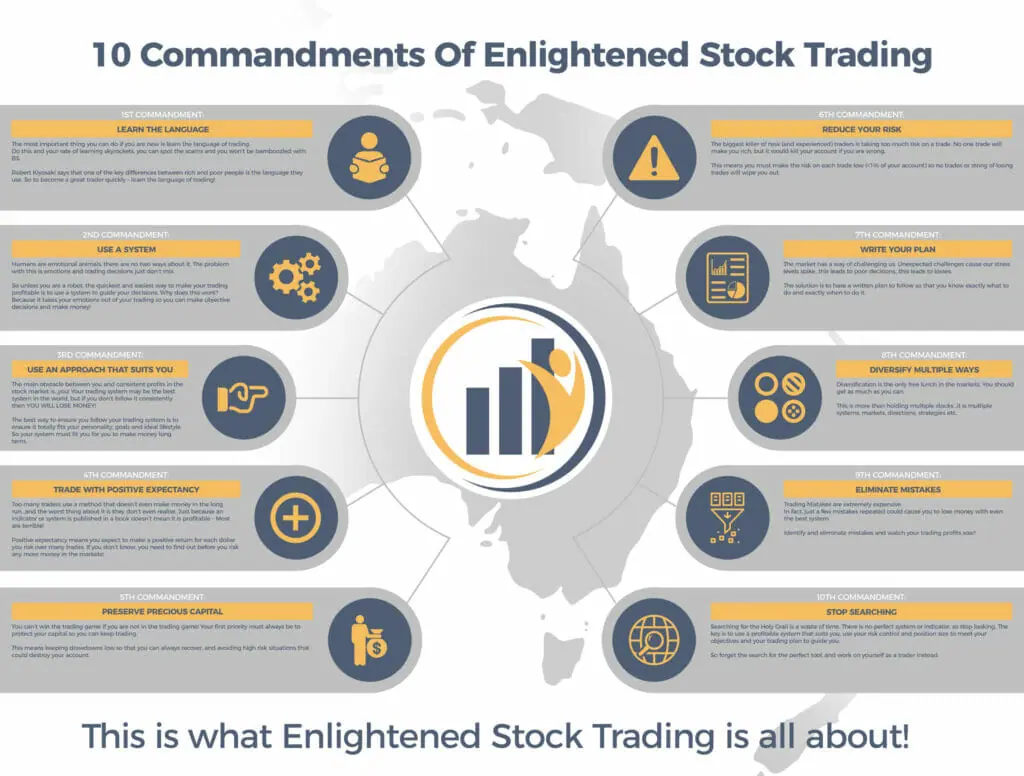
Learn The 10 Commandments For Profitable Trading
Discover the 10 most important lessons from 18 years of profitable trading & reading over 150 trading books.
Get your FREE Report & 10 Training Videos NOW!