
I have used trend following stocks as a trading strategy for over 18 years and have made substantial and consistent profits during this time.
Trend following is a fantastic trading strategy because it is simple, doesn’t require much time to execute and it has a long and consistent performance record. The return for effort is exceptionally high and it is possible to manage this sort of trading system while you still have a day job – or when you want to travel and spend a lot of your time focused on other passions like your family and friends!
When teaching trend following, one of the interesting questions that comes up is “Why does trend following stocks actually work?” closely followed by “If this method makes money consistently, can be taught and isn’t rocket science, why is there money still left on the table?”
These are great questions and in the rest of this post I cover 8 important reasons why trend following stocks works, and should continue to work in the future. After which, we’ll showcase some of the best trend following success stories that have emerged in the modern era.

Trend following in stocks really works
Trend Following Stocks – It Is Simple, Not Easy
Trend following stocks is a simple trading strategy. A great trend following system does not have many rules, and these rules can be very simple. This means you don’t have to be a rocket scientist to create your own trend following trading system. Given its simplicity and profitability you would think that everyone would be doing it and the profits would disappear.
BUT (and it is a BIG but)…
Trend following stocks is not emotionally easy…but it works!
Most investors are not willing to remove themselves from their trading decisions and trust a trading system, particularly a long term system that loses on 70% of its trades (even if it does make bucket loads of money overall). Many factors play a part in this, but let’s just say arrogance, insecurity, impatience and the need to be right all play a part.
Impatience is one of the biggest reasons. So many people are just not willing to wait patiently and DO NOTHING while a trend moves their position in the right direction. Because of this impatience many people just can’t follow a trend following system.
I would say the second biggest reason is that our education system teaches us that you have to be RIGHT… At school you want to get 100% in a test, you FAIL if you get below 50% on a test. BUT trend following requires that you get into a lot of potential trends and quickly get out at a small loss if you are wrong. This means that trend followers have lots of small losses, and are wrong a lot. Most people (because of our education system) don’t like to be wrong. When I tell people that I am wrong on 70-80% of my trades they look at me in horror – the look on their faces says “how could you be so stupid! You must be the dumbest trader on earth” but when I tell them that I make 10 times more on my winning trades than I lose on my losing trades they get confused and stop asking questions.
Trading math is something that needs to be learned. Expected profit per trade is important, winning percentage of trades is not. But most people would emotionally be more comfortable with a high winning percentage even if they lost money overall – at least they can say they are right a lot and their small number of large losing trades are “just unlucky”. They blame someone else like the market or their broker for those and just focus on their high winning percentage. They delude themselves that they will make money this way.
Trend following stocks works because it is emotionally difficult – most people do not have enough resilience to do it consistently
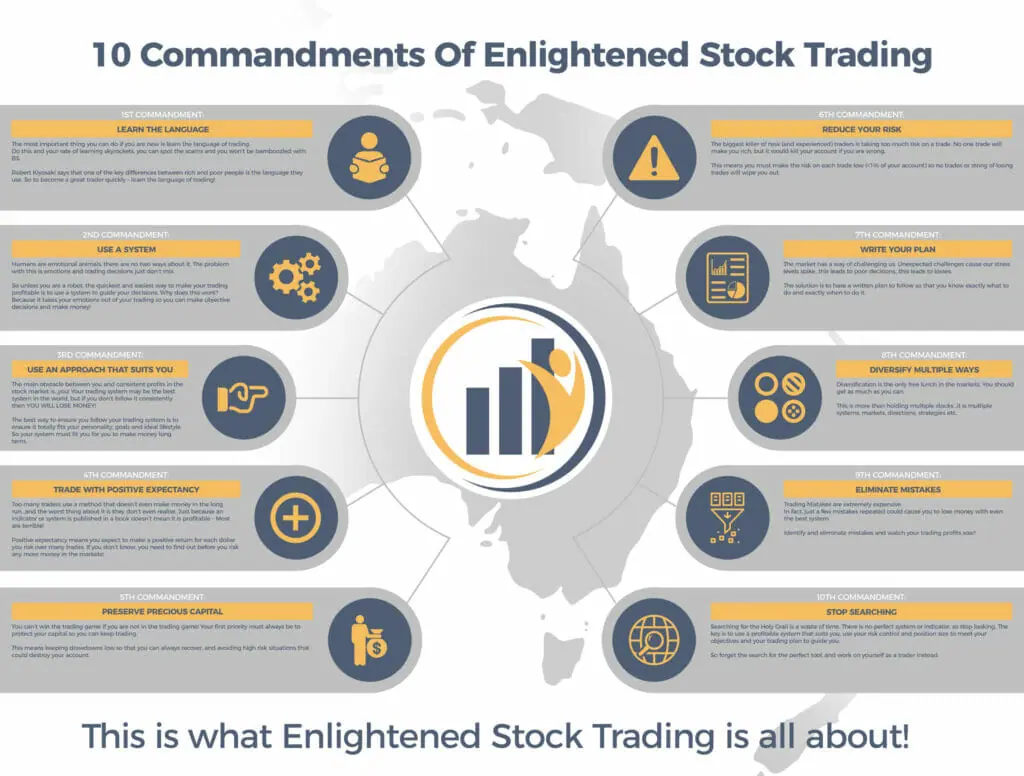
Learn The 10 Commandments For Profitable Trading
Discover the 10 most important lessons from 18 years of profitable trading & reading over 150 trading books.
Get your FREE Report & 10 Training Videos NOW!
Emotional Control
Systematic trading, such as what you use when trend following stocks, removes the human emotion from all areas of your trading. It simply allows the systematic trader to identify when a price move is in place and capture it. Removing human emotion from market decisions really is the key to trading profits.

We know trends do actually occur – a glance at pretty much any chart will show that. So when our trend following system finds one and gets into it then we profit from both the change in the fundamental conditions, the change in the investor sentiment and the change due to the influence of company management as discussed below.
When a trend is reversed the trend following system gets you out (unemotionally) and you capture your profit. The emotional unsystematic investors and the buy and hold investors lose money because they hope prices will go back to previous highs… The trend follower is already out and has their profit!
Mutual Funds Must Stay Invested
Mutual funds can’t trend follow because they have to be fully invested. They also typically have a mandate (such as a certain sector) and they have to have a portfolio close to the relevant index else they have too much risk of underperforming the index and their peers if they get it wrong.
Trend following systems have a massive advantage over mutual funds because they can exit stocks that are moving in the wrong direction and hold only stocks that are going in the right direction. Funds just can’t do this. Also you never see a mutual fund go 100% to cash because they are not allowed to. But if you are a trend follower and there are no trends then you just hold cash! (Or if you are more advanced then you will have other trading strategies to focus on while there are no trends) So if you are a long only trend follower in stocks and there is a bear market then you will probably just end up holding cash while all the mutual fund managers lose money hand over fist as the bear market progresses.
This means long only stock trend following equity curves can be much better than that of a mutual fund if you have a good trading system. Just look at this example of my own trend following equity curve overplayed against the ASX200 stock index. A buy and hold index fund investor would have gone nowhere and experienced very large drawdowns during this period, but my own stock trend following portfolio had very strong returns with little drawdown.

Trend Following Stocks works extremely well compared to buy and hold in the index
There is obviously no guarantee that these results will continue in the future, nor am I suggesting that you will achieve the same returns. But when a stock is trending down, trend followers will not hold onto it – this is a distinct advantage over investing with a mutual fund manager who has to track their portfolio very close to the market index or compared to investing in an index fund which is a very passive strategy.
Breath & Flexibility
When trend following stocks, you can cover far more stocks than a mutual fund – without the army of analysts. If I scan all the stocks in Australia, Hong Kong and the US for trends then I can identify far more trend opportunities that an Australian mutual fund could ever find. I can buy anything that fits my criteria but a fund can only buy what fits their mandate.
Even if you just trade the fully paid ordinary stocks in Australia, that is over 1900 different stocks. If you include other international stock markets which can be traded through through your interactive brokers trading account then you have thousands of potential trading candidates…there will be a stock trend somewhere most of the time!
Market (In)Efficiency
Regardless of what the academics say, the markets are not efficient. I prefer to think about them as being semi efficient. This means that when new information comes to light, it often takes quite a bit of time for all market participants to become aware of the changed situation… And even more time for all participants to figure out the implications of the changed situation.
Assuming the new fundamental change is positive, as some participants start to become aware they buy and the price moves up. As more participants become aware there is more buying and the price continues to move up until everyone who wants to buy is in the position. This progressive buying creates a fundamentally driven trend which can be quite long depending on how well analysed the stock is.
If the markets were fully efficient this move would be a step change (like it often is in the case of a take over announcement – these generally cause a step change because the implication on company value is pretty obvious to all investors). The challenge in non-takeover situations is that no one really knows exactly what a company announcement is worth (despite what the analysts say, it is just an estimate). So this means prices trend as the market figures out what the new share price should be.
Stock Fundamentals Trend Too
Often the underlying driver of a trend is also trending too, so as the fundamental driver gets better, so too does the stock continue trending. This means that when your strategy is trend following stocks, you continue to benefit as the fundamentals move in your favour.
The most obvious example is interest rates – once interest rates start moving in a particular direction, they tend to continue moving in that direction for quite some time.

Stock fundamentals also trend. For example, Interest rate trends in the 13 week T Bill are very clear over the past 20 years.
Interest rates don’t go straight to the end point because the market gradually adjusts to a new equilibrium level (by which time something else will have changed anyway, so they just keep shifting). Because interest rates shift gradually the cost of debt to companies also shifts gradually, so their earnings shift gradually, so valuations shift gradually, so prices trend gradually.
But there are always many fundamental shifts going on at any one time – when several of these line up in the same direction you get very big trends. This is why stocks can have mega trends and end up increasing in price by 10 times or more!
This convergence of multiple trends in fundamental drivers is one of the most exciting things about trend following in stocks. Catching just one of these can mean high double digit returns for entire portfolio for the year.
Corporate Improvement
Even if all external fundamental conditions are constant (highly unlikely), company management can gradually improve the profitability of the business. This can be through efficiency improvement, new product development, pricing sophistication, better marketing, training and development, cost reduction and many other factors.

Management typically makes these changes gradually, so profits improve gradually, so valuations improve gradually, so prices trend gradually. A great management team will be improving multiple parts of the business simultaneously, so these compound on each other creating strong trends in share price.
But how do you determine which management teams are doing this?
Well that is the great thing about trend following stocks – you don’t have to. All you do is identify the stock that are trending up in price. If the management team is good and the underlying fundamental conditions are attractive then chances are you will be holding that company because the price will start going up.
Investor Sentiment
This is a really huge driver of why trend following stocks works so well…one huge reason we can beat the market is that investor confidence/excitement changes over time on two levels. The first is the overall market, the second is the individual stock.

We all know that investor sentiment changes and moves in cycles. Sentiment can be measured by the price earnings multiple (PE = Share price / Earnings per share). When investors are confident of the future they are willing to pay more for each dollar of earnings, so the share price goes up and the PE multiple goes up.
This is because humans are emotional creatures. When people are scared PE multiples contract, when people are confident and excited PE multiples expand. Thus even if fundamental conditions are stable (highly unlikely), stocks can trend because investor sentiment improves or deteriorates. This means that stocks can trend just because people collectively are getting more confident, even if there is no actual change. Shifts in market sentiment can cause PE multiples to go from single digits to very high double digits. This shift causes very big market or sector wide trends – like in the massive bull market leading up to 2000 when Price Earnings Multiples for the overall US Stockmarket went from single digits in the 1980’s all the way up to over 40 before the tech bubble burst.
Investor sentiment also applies to individual stocks. Say for example a company starts off with a boring story, no growth and no investor interest. It will have a low PE multiple. Then something fundamentally changes, new dynamic management gets put in place and good things start to happen.
Investors get progressively more and more excited as things go right. Because things go right investors (who are typically not that bright and project things linearly) expect things to keep going right. Because they expect things to keep going right they are willing to pay higher and higher PE multiples. As the price goes up more people notice that something is happening and out of greed (to make money) and fear (of missing out on the trend), these new investors bid the stock up higher and higher to get in.
Thus the PE multiple on the individual stock can move dramatically as investor sentiment about the stock keeps changing. This means that one stock can trend dramatically just because of changing investor excitement about the stocks story! Trend following stocks allows you to capture a large chunk of the huge price moves that happen when investor sentiment shifts like this.
Trend Following Success Stories
Trend following has proven to be an effective system over the years, even in different market conditions, such as a pandemic-ridden market (COVID Panic 2020), Tech Boom (1990’s), Tech Bubble Burst (2000’s), Global Financial Crisis (2008) and the bull market from 2009 – 2020. If you need more evidence that trend following is the key to sustainable stock trading success, then you’ll want to hear these stories.
Let’s take a look at a few different case studies to see this strategy in action:
Richard Dennis

When Richard Dennis met fellow trader, William Eckhardt, he claimed that traders could be easily grown just like turtles in a farm he saw in Singapore, hence, the origin of the name. To prove his point, he recruited 13 “turtles” (or trainees) out of a The Wall Street Journal ad.
Dennis focused on consistency and training to hone the skills of his team of would-be traders. He emphasized mechanical trading over emotional trading while downplaying the importance of following financial reports. He was keen to prove a point by giving each student $1 million in their accounts to use for trading.
He came up with six turtle trading rules to give structure to his method. In the beginning, the group achieved mixed results. But the key to their eventual and sustained success was trend following, giving birth to the saying, “The trend is your friend.” The turtle traders went on to collectively make hundreds of millions of dollars of profits with trend trading techniques in the decades that followed the turtle experiment.
By following growth trends or value stocks, traders can, in fact, profit from the next bullish or bearish market. So, if you’re new to trading, trend following is key to be on par with the experts.
Dunn Capital

Bill Dunn of Dunn Capital is a lifelong trend follower who notably exploited the Japanese Yen and earned massive profits in 1995. He follows a 100% mechanical approach with the philosophy that big gains can make up for small losses. He’s a strong advocate for long-term holding, which involves being strictly data-driven, eliminating all subjectivity and emotion.
Dunn notoriously still profits regardless of market downturns with his unique trend following strategy of “riding it out.” He believes in staying steadfast for the long haul and recovering the next time bullish trends appear, which always happens if you are patient and know where to look. This is evident from his losing years of 27% in 1976 and 32% in 1981, which were followed by multi-year gains of 500% and 300% respectively. Stick with your guns and believe in the trends, folks.
Ed Seykota

Ed Seykota is a self-taught trader. He has an outstanding money management track record with returns of roughly 60% net of fees within his thirty-year career. His unique method revolves around continual self-examination and commitment to studying the psychological components of trading while helping others achieve their potential.
During his years as a trend follower, he grew $5,000 to $15 million in a 12-year period using a test account–which happens to be owned by one of his clients. He ultimately used this knowledge to create and develop the first commercial computerized trading system that manages his clients’ money. The guy was a pioneer indeed.
John Henry

Whether you’re a new or seasoned trader, it has probably crossed your mind that actual market prices are close to impossible to predict. John W. Henry thinks the same. But even though he had this philosophy, he invested heavily in trend following because that’s the most reasonable and closest way to forecast future markets.
Henry followed a purely mechanical approach and relied on market prices to make sound investment decisions. He focused on the long game and stressed that you would only reap the rewards over the course of decades. This means sitting through the volatility, not acting on desires to make moves during adverse market conditions, and sticking with your plan. Circling back: Patience is the key.
John Henry

Nicolas Darvas was a self-taught investor, author, and dancer. He is best known for making $2 million using trend following methods (which was an obscene amount in the 1950s). Back then, his ways seemed unorthodox to many, because instead of studying the fundamentals, he judged public enthusiasm instead. This method reportedly works best in volatile markets.
Interestingly enough, he picked up this skill from his experience as a dancer, where he learned to tune into the feelings of his audience. Darvas consistently ignored tips, financial stories, and brokers’ letters and relied on his instincts. He mainly watched out for price and volume, which was the heart of his trend following strategy.
Dinesh Desai

Dinesh Desai was regarded as one of the best trend followers in the 80s before his retirement. He ran a California-based company called Desai & Co. At the peak of his career, he had $250 million under management, averaging 80% returns annually–with some years even going over 100%.
His top three funds in 1987 were reported to be the following:
- Tudor Futures Fund, Tudor Investment Corp., New York, (+201.1%)
- North American Commodity Fund I, Desai & Co., Mountain View, Calif. (+150.6%)
- Palo Alto Futures Fund, Desai & Co. (+140.3%)
If this doesn’t inspire you to take trend following seriously, then I don’t know what else will.
More Articles About Trend Following
14 Global Stock Markets Tested for Trend Trading
5 Steps to capture the next big stock market move with trend following
Can Trend Trading Make a Lot of Money?
How long do you need to hold trades for long term trend following systems?
Can I capture more profits in a trend using Parabolic SAR as an exit?
Should I go live with a long-only stock trading system when a market correction is expected?
Is it possible to take a system that I use in this market and apply it in another market?
Should you trade with a stocks 52 week highs or lows?
Trading Books: ‘Following The Trend: Diversified Managed Futures Trading’ by Andreas F. Clenow
So What Should I Do Now?
As you have seen, there are many reasons why trend following stocks has worked in the past, and plenty of evidence to suggest that this will continue to work in the future. If you have been dissatisfied with buy and hold or mutual fund investing, maybe it is time for you to learn how to profit using your own stock trend following system.
The best way to learn how to do this and build total confidence in your trend trading strategy is to join The Trader Success System. In the Trader Success System you will get immediate access to over 18 different trading systems (Including several phenomenal trend trading systems for different markets) AND learn how to backtest and build confidence in those systems for yourself. Click here to learn more about The Trader Success System.
Frequently Asked Questions about Trend Following Stocks
What is trend-following in the stock market?
Trend-following in the stock market is a strategy that capitalizes on sustained price movements in a particular direction. It’s all about identifying and riding these trends until they show signs of reversing. Here’s a quick breakdown:
- Simplicity: Trend-following systems are straightforward, often with a few simple rules. This makes them accessible without needing to be a rocket scientist .
- Emotional Control: By relying on systematic rules, trend-following removes emotional decision-making, which is crucial for consistent trading profits .
- Risk Management: The strategy involves cutting losses quickly and letting winners run, which helps in managing risks effectively .
- Market Adaptability: Trend-following works across different market conditions, allowing traders to profit from both bullish and bearish trends .
- Patience and Discipline: It requires patience to wait for trends to develop and discipline to stick with the system, even during periods of drawdown .
This approach is particularly appealing because it doesn’t require constant market monitoring, making it suitable for traders who have other commitments .
Does trend-following work on individual stocks?
Absolutely, trend-following can work effectively on individual stocks. Here’s why:
- Simplicity and Profitability: Trend-following is a straightforward strategy that doesn’t require complex rules. It allows traders to capitalize on significant price movements in individual stocks without needing to be a rocket scientist .
- Emotional Control: By using a systematic approach, trend-following removes emotional decision-making, which is crucial for consistent trading profits. This helps traders stay disciplined and stick to their strategy .
- Market Adaptability: The strategy works across different market conditions, allowing traders to profit from both bullish and bearish trends. This adaptability is key to its success on individual stocks .
- Risk Management: Trend-following involves cutting losses quickly and letting winners run, which helps in managing risks effectively. This is particularly important when trading individual stocks, as it helps preserve capital and maximize returns .
- Historical Success: There are numerous examples of successful trend-following on individual stocks, such as Incitec (IPL:ASX), Cochlear (COH:ASX), and Jb Hifi (JBH:ASX), which have shown significant trends over time .
By focusing on these principles, traders can effectively apply trend-following to individual stocks and potentially achieve substantial returns .
How do you identify trending stocks?
Identifying trending stocks involves a few key techniques and indicators that help you spot when a stock is on the move. Here’s how you can do it:
- Price Movement: Look for stocks with sustained price movements in one direction. This is the essence of trend-following—jumping into stocks that are moving up and holding them while they continue to rise .
- Volatility Indicators: Use tools like the Average True Range (ATR) to assess volatility. Stocks with low volatility that start to trend can be good candidates for trend-following. Typically, a stock with an ATR less than 5 or 6% of its closing price is considered to be trending well .
- Moving Averages: Monitor moving average crossovers. If a stock’s price is consistently above its moving average, it indicates a strong trend. Conversely, frequent crossovers suggest a lack of a strong trend .
- Bollinger Bands: In a strong trending market, the price often crosses above the upper Bollinger Band. If it doesn’t, it might not be a strong trend, and you might consider exiting the trade .
- ADX Indicator: Although not my favorite, the Average Directional Index (ADX) is often used to measure trend strength. A reading above 20 is typically considered a strong trend, though I haven’t found it particularly useful .
By using these techniques, you can identify stocks that are trending and potentially capitalize on their movements .
How can I follow stock market trends effectively?
Following stock market trends effectively involves a systematic approach and the use of specific tools and strategies. Here’s how you can do it:
- Use Moving Averages: Track moving averages like the 50-day and 200-day to identify trends. If a stock’s price is above these averages, it’s generally considered to be in an uptrend .
- Monitor Volatility with ATR: The Average True Range (ATR) helps you gauge volatility. Entering trades when volatility is low can increase your chances of success, as it reduces the likelihood of your stop loss being hit .
- Bollinger Bands: These can help you understand the relationship between price and volatility. When the price hits the upper band, it indicates a strong upward trend, while hitting the lower band suggests a downward trend .
- Diversify Your Systems: Employ a mix of systems that profit from different market conditions—trend-following for uptrends, mean reversion for sideways markets, and short-selling for downtrends. This diversification helps you stay profitable across various market scenarios .
- Backtesting: Test your systems over historical data to ensure they are robust and profitable. This builds confidence and discipline, crucial for sticking to your strategy .
By using these techniques, you can effectively follow and capitalize on stock market trends.
What are examples of trend-following strategies in stocks?
Trend-following strategies in stocks are designed to capitalize on sustained price movements. Here are a few examples:
- Moving Average Crossover: This is a classic trend-following strategy where you use two moving averages, such as the 50-day and 200-day. A buy signal is generated when the shorter moving average crosses above the longer one, known as a “golden cross.” Conversely, a sell signal occurs when the shorter moving average crosses below the longer one, called a “death cross” .
- Breakout Strategy: This involves buying a stock when its price breaks above a resistance level or its highest close in a certain period, like 200 days. You hold the stock as long as it continues to rise, and sell when it falls a certain percentage from its peak, using a trailing stop .
- Bollinger Bands: In this strategy, you might enter a trade when the stock price moves above the upper Bollinger Band, indicating a strong upward trend. You exit when the price crosses below the moving average or the lower band .
- ATR Volatility Breakout: This uses the Average True Range (ATR) to identify volatility breakouts. You enter a trade when the price moves a certain multiple of the ATR above a recent high, and exit when it falls below a moving average or a set percentage .
These strategies focus on capturing the middle of a trend, allowing you to ride the wave of price movements while managing risk effectively.
What time frames are best for trend-following stocks?
When it comes to trend-following in stocks, the best timeframes can vary depending on your trading goals and lifestyle. Here’s a breakdown:
- Daily Timeframe: This is a popular choice for trend-following because it offers a good balance between signal reliability and manageable drawdowns. Daily charts provide a strong signal-to-noise ratio, making it easier to identify trends without getting caught up in market noise. Plus, systems developed on daily charts tend to be robust and can last for many years due to the availability of extensive historical data .
- Weekly Timeframe: Trading on a weekly timeframe can be less stressful and requires less frequent monitoring. It’s ideal for capturing larger macro trends and involves lower activity, making it suitable for those with limited time. Weekly systems can be run with minimal effort, often requiring just 20 minutes a week, and they can capture significant price moves .
- Intraday Timeframe: While not typically recommended for trend-following due to the higher noise levels, intraday trading can be used to complement other strategies. It allows for efficient capital deployment by closing positions at the end of the day, freeing up cash for other systems .
Ultimately, the best timeframe depends on your personal preferences and trading objectives. Diversifying across multiple timeframes can help smooth your equity curve and reduce risks
Is trend-following suitable for swing trading?
Trend-following and swing trading are distinct strategies, each with its own approach and objectives. While trend-following focuses on capturing long-term price movements by holding positions for extended periods, swing trading aims to profit from shorter-term price swings within a trend.
- Trend-Following: This strategy involves identifying and riding significant trends over weeks, months, or even years. It’s about capturing the bulk of a trend’s movement, requiring patience and a willingness to endure periods of drawdown. Trend-following is less about frequent trading and more about letting profits run while cutting losses quickly .
- Swing Trading: In contrast, swing trading is more active, seeking to capitalize on short-term price fluctuations within a broader trend. Swing traders typically hold positions for a few days to a few weeks, aiming to profit from the “swings” or oscillations in price. This approach involves more frequent trading and often uses technical analysis to identify entry and exit points .
While trend-following isn’t typically used for swing trading due to its longer-term focus, elements of trend-following can inform swing trading strategies. For instance, identifying the overall trend direction can help swing traders align their trades with the prevailing market trend, increasing the likelihood of success .
What are the risks of trend-following strategies?
Trend-following strategies, while potentially profitable, come with their own set of risks and challenges:
- Frequent Small Losses: Trend-following often involves a series of small losses before capturing a big win. This can be psychologically challenging, as it requires enduring multiple losing trades, which can be discouraging if you’re not prepared for it .
- Drawdowns: These strategies can experience significant drawdowns, where the value of your portfolio decreases from its peak. This is a natural part of trend-following, but it requires emotional discipline to stick with the strategy through tough times .
- Late Entries and Exits: Trend-following systems typically enter and exit trades based on predefined rules, which can lead to entering a trend late or exiting after a significant portion of the trend has already occurred. This can result in missed opportunities or reduced profits .
- Market Conditions: The effectiveness of trend-following can vary with market conditions. In certain environments, such as when trends are not well-defined or during high volatility, these strategies might underperform .
- Psychological Pressure: The emotional toll of seeing frequent small losses and enduring drawdowns can lead traders to abandon their strategies prematurely, even if the system is fundamentally sound .
Understanding these risks and having a robust plan to manage them is crucial for success in trend-following.
How do you use moving averages in trend-following?
Moving averages are a fundamental tool in trend-following strategies, and here’s how you can use them effectively:
- Trend Filter: Use the 200-day moving average as a trend filter. If a stock is above this average, it’s generally in an uptrend, and if it’s below, it’s in a downtrend. This helps you decide whether to go long or short on a stock .
- Entry and Exit Signals: You can use moving averages for entry and exit signals. A common method is the moving average crossover, where a shorter-term moving average (like the 50-day) crosses above a longer-term moving average (like the 200-day) to signal a buy. Conversely, a crossover below signals a sell .
- Lagging Indicator: Be aware that moving averages are lagging indicators. They confirm trends after they have started, which means you might enter or exit trades later than ideal. However, they help you stay in trends longer, capturing significant moves .
- Backtesting: It’s crucial to backtest your moving average strategies to ensure they work well with your chosen stocks and market conditions. This helps you refine your approach and improve your trading results .
By incorporating these techniques, you can enhance your trend-following strategy using moving averages.
Can trend-following strategies help make $200 or $1000 per day?
Trend-following strategies can indeed be profitable, but making a consistent $200 or $1000 per day is not guaranteed and depends on several factors:
- Account Size: The size of your trading account plays a significant role. Larger accounts have more capital to deploy, which can lead to higher absolute profits. For instance, if you’re aiming for a 1% daily return, a $10,000 account would yield $100, while a $100,000 account would yield $1,000 .
- Market Conditions: Trend-following works best in trending markets. If the market is choppy or range-bound, it might be challenging to achieve consistent daily profits. Trends can last for weeks or months, but they don’t occur every day .
- Risk Management: Proper risk management is crucial. You need to balance the potential for profit with the risk of loss. Without effective risk management, you might face significant drawdowns that can wipe out your gains .
- Strategy and Discipline: The effectiveness of your trend-following strategy and your discipline in executing it are critical. Consistency in following your rules, even during drawdowns, is essential for long-term success .
While trend-following can generate healthy returns over time, expecting consistent daily profits can be unrealistic due to market variability. It’s more about capturing significant trends over time rather than daily targets .
What is the 2% rule in swing trading and how does it relate to trend-following?
The 2% rule in trading is a risk management guideline suggesting that you should not risk more than 2% of your trading account on a single trade. This rule is designed to protect your capital from significant losses, especially during losing streaks. However, in the context of trend-following, this rule might be considered a bit aggressive.
- Trend-Following Context: In trend-following, you’re often dealing with a series of small losses before hitting a big winner. Given this, risking 2% per trade can lead to substantial drawdowns if you encounter a string of losing trades. Trend-followers typically risk much less, often around 0.5% to 1% per trade, to ensure they can withstand multiple losses without significant damage to their account .
- Swing Trading Context: For swing trading, the 2% rule can be more applicable because swing traders aim to capture shorter-term price movements and might have a higher win rate. However, even in swing trading, it’s crucial to adjust your risk based on your system’s characteristics and your personal risk tolerance .
Ultimately, both strategies benefit from robust risk management, and it’s essential to tailor the risk per trade to suit the specific strategy and market conditions you’re working with .
How do I build a trend-following system for stocks?
Building a trend-following system for stocks involves several key steps to ensure it’s robust and effective:
- Define Your Rules: Start by setting clear entry and exit rules. A common approach is using moving averages. For instance, you might enter a trade when the stock’s price is above both the 50-day and 200-day moving averages, indicating an uptrend .
- Risk Management: Implement strict risk management rules. Consider risking a small percentage of your capital per trade, such as 0.5% to 1%, to protect against drawdowns. This helps you stay in the game even if you encounter a series of losing trades .
- Diversification: Diversify your portfolio across different stocks and sectors. This reduces the impact of any single trade going against you. Even if one stock becomes a large part of your portfolio due to a strong trend, diversification helps mitigate risk .
- Backtesting: Test your system on historical data to see how it would have performed in the past. This helps you refine your strategy and understand its strengths and weaknesses. Use software like Amibroker to run these tests and analyze the results .
- Emotional Discipline: Stick to your system’s rules, even during drawdowns. Trend-following requires patience and discipline, as profits often come from a few significant trades while enduring many small losses .
By following these steps, you can develop a trend-following system tailored to your trading style and risk tolerance.
What indicators work well with trend-following strategies?
When it comes to trend-following strategies, several indicators can be quite effective in helping you identify and ride trends:
- Moving Averages: These are fundamental in trend-following. A common approach is using the 50-day and 200-day moving averages. When the price is above these averages, it indicates an uptrend, and when below, a downtrend .
- MACD (Moving Average Convergence Divergence): This indicator helps measure both trend and momentum. A crossover of the MACD above the signal line suggests an uptrend, while a crossover below indicates a downtrend .
- ATR (Average True Range): This is used to measure market volatility. It can help set stop-loss levels and determine the strength of a trend. A higher ATR suggests more volatility, which can be indicative of a strong trend .
- RSI (Relative Strength Index): While primarily used to identify overbought or oversold conditions, RSI can also confirm trend strength. An RSI above 70 might indicate a strong uptrend, while below 30 could suggest a strong downtrend .
These indicators, when used together, can provide a comprehensive view of market trends, helping you make informed trading decisions.
Can you trend-follow with ETFs as well as individual stocks?
Absolutely, you can trend-follow with ETFs as well as individual stocks, though there are some nuances to consider.
- ETFs: They offer a diversified approach since they represent a basket of stocks or other assets. This can lead to lower volatility compared to individual stocks. However, because ETFs are averages of multiple instruments, the performance might not be as high as with individual stocks, especially in trend-following systems where outliers can significantly boost returns .
- Individual Stocks: These can provide higher returns in trend-following strategies due to the potential for large price movements in single stocks. The downside is that they can also be more volatile, which means higher risk .
- Backtesting Considerations: When backtesting a trend-following system on ETFs, you might find fewer trades due to the longer duration of trends and the nature of ETFs. This means you might not get as many data points as you would with individual stocks, which could impact the robustness of your backtest results .
In essence, both ETFs and individual stocks can be used for trend-following, but the choice depends on your risk tolerance and the specific goals of your trading strategy.
How much do I need to invest to generate $1000 per month using trend-following?
Generating $1,000 per month using trend-following depends on several factors, including your trading strategy’s performance, risk tolerance, and market conditions. Here’s a rough guide to get you started:
- Expected Return: Trend-following systems can vary widely in their returns. Let’s say your system averages a 20% annual return, which is a reasonable expectation for a well-developed strategy .
- Capital Requirement: To generate $12,000 annually ($1,000 per month), you’d need a portfolio size that aligns with your expected return. With a 20% return, you’d need around $60,000 in capital ($12,000 / 0.20) .
- Risk Management: It’s crucial to manage your risk effectively. This means not risking too much of your capital on any single trade, which can help protect your portfolio during drawdowns .
- Diversification: Consider diversifying across multiple systems or markets to smooth out returns and reduce risk. This might require additional capital, but it can enhance the stability of your income .
Keep in mind, these are rough estimates, and actual results can vary. It’s essential to backtest your strategy thoroughly and adjust your capital allocation based on your specific system’s performance and risk profile.
Is trend-following a long-term or short-term trading strategy?
Trend-following is generally considered a long-term trading strategy. It involves identifying and capitalizing on sustained price movements over time. The beauty of trend-following is that it doesn’t require constant monitoring of the markets, making it suitable for those who prefer a more hands-off approach .
- Long-Term Focus: Trend-following systems typically aim to capture large price movements, which can take weeks, months, or even years to fully develop. This long-term focus allows traders to benefit from significant trends without the need for frequent trading decisions .
- Systematic Approach: The strategy relies on mechanical rules, which means you don’t need to make subjective decisions based on news or market noise. This can help reduce emotional trading and improve consistency .
- Time Efficiency: With trend-following, you can manage your trades with just 30-60 minutes per day, regardless of your account size. This makes it an attractive option for those looking to balance trading with other commitments .
If you’re exploring trend-following, it’s important to have patience and trust in your system, as trends can take time to develop.
What is the success rate of trend-following systems?
The success rate of trend-following systems can vary, but it’s important to understand that the win rate isn’t the most crucial factor. In fact, trend-following systems often have a relatively low win rate, sometimes around 30% to 50% . This might seem counterintuitive, but the key to their success lies in the size of the wins compared to the losses.
- Big Wins, Small Losses: Trend-following systems aim to capture large price movements, which means that when they win, the returns can be substantial. These big wins can more than offset the smaller, more frequent losses .
- Expectancy: The profitability of a trend-following system is determined by its expectancy, which is the average profit per trade. This takes into account both the win rate and the size of wins and losses. A system can be highly profitable even with a low win rate if the winners are significantly larger than the losers .
So, while the success rate in terms of winning trades might not be high, the overall profitability can be very attractive if the system is designed to capitalize on large trends.
Can trend-following be automated using trading algorithms?
Absolutely, trend-following can be automated using trading algorithms, and it’s a bloody good thing too! Automation offers several advantages:
- Consistency: Automated systems execute trades based on predefined rules, eliminating emotional decision-making and ensuring consistent application of your strategy .
- Time Efficiency: Once set up, these systems can run with minimal intervention, freeing up your time for other activities. You can manage your trades with just 30-60 minutes per day, regardless of your account size .
- Diversification: Automation allows you to manage multiple systems or markets simultaneously, which can enhance diversification and potentially improve your overall returns .
- Reduced Errors: By automating your trading, you minimize the risk of human error, such as incorrect order entry or missed trades due to distractions .
If you’re considering automating your trend-following strategy, it’s crucial to backtest your system thoroughly to ensure its robustness and profitability.
Learn The 10 Commandments For Profitable Trading
Discover the 10 most important lessons from 18 years of profitable trading & reading over 150 trading books.
Get your FREE Report & 10 Training Videos NOW!



Hello, your systems look promising. But there so many out there offering what they call good systyems, Would it be possible to see some of the results of the system, for instance on SPY? Thanks!
Kind regards Harald
Hi Harald,
Thanks for your question – you are right, there are a lot claiming to be good systems that are really just curve-fit garbage. The systems that some in The Trader Success System have been backtested and designed using the same principles I teach in The Trader Success System. All have been developed using an ‘In-Sample’ dataset and then as a final development step validated on an ‘Out Of Sample’ dataset. The systems are all robust over a wide range of parameter values, have a stable edge over time and profits are not driven by outlier trades – they are solid and reliable and I trade many of them with my own money. If you would like to see the performance of the trading system the return and drawdown statistics are shown on this page: https://go.enlightenedstocktrading.com/about-the-trader-success-system
Please let me know if you have any more questions after seeing that page.
Thanks again for your comment!
Adrian
Trend following works but not on ASX IMO
Hi Johnny,
Thanks for your comment. Trend following absolutely works on ASX stocks – I have been doing it for decades. It certainly works best on smaller capitalization stocks so it will depend on which segment of the market you are backtesting and what rules you are using. If you share what you have tried I can give you some pointers, however don’t give up on ASX trend following because it has been very profitable for me.
Adrian