Money Is Just an Idea
Money – whether it’s the crisp note in your wallet, digits on a screen, or a growing pile in an investment account – is fundamentally just an idea. And that idea is crafted, moulded, and defined by words. To some, this concept may seem a bit abstract, but think about it: money doesn’t exist as anything more than a representation of value we all agree upon. And what fuels that value? The words we use, the beliefs we hold, and the ideas that shape our understanding of wealth.
Now, don’t worry, I’m not about to lead you down a rabbit hole of philosophy. This isn’t about turning our finances into a poetry reading, but there’s a fundamental truth here that can reshape how you approach your trading, your finances, and even your life. If you’re ready to see money differently—and perhaps unlock a more profitable, fulfilling approach to trading—then let’s dive in.
The Power of Beliefs: Words as Tools for Wealth
Most people look at wealth and think of it as something “out there”—something you earn or accumulate through hard work, luck, or even a bit of market savvy. But here’s the thing: wealth starts as an idea. It’s a concept shaped by our beliefs and the words we use every day.
Consider this: how do you talk to yourself about money? Words like “risk,” “scarcity,” or “struggle” might pop up, especially if you’ve faced trading losses or setbacks. But what if you swapped those words with “opportunity,” “abundance,” or “growth”? The impact may feel subtle, but over time, this shift will colour every decision you make. Imagine you’re driven, analytical, and meticulous in your approach. You love certainty, crave clarity, and maybe even struggle with the market noise. For you, understanding that words matter could be the missing piece that brings it all together.
The mind takes words seriously. That’s why you should treat your self-talk about money like a sacred ritual. Reinforce your belief in abundance, opportunity, and growth every day. These words can act as quiet but powerful reminders that trading is about calculated moves, not gambling. When you shift your language, your perspective follows, and so do your results.
How Ideas Shape Financial Success
Think of every successful business or trading breakthrough. Before the results, before the profits, there was an idea. Every investment you make starts as an idea, doesn’t it? You research, analyze, and predict with a specific outcome in mind. And the success of that outcome often comes down to your conviction, the clarity of the idea, and the words you use to define it.
Now, let’s get real here: how many times have you doubted yourself, thinking, “Is this the right trade?” “Will I ever be able to quit my day job?” These questions—these words—are like little mental anchors, holding back your potential. Shifting these doubts to affirmations of possibility—“This trade aligns with my strategy,” or “This decision is part of my long-term vision”—can subtly yet profoundly affect your mindset. This isn’t just “positive thinking”; it’s a form of mental alignment that reinforces your strategic approach.
Back in my early days of trading, I didn’t fully grasp this. I approached the markets with a mix of excitement and trepidation, but I realized that every profitable trade began with clear ideas and words of conviction. Over time, I learned to harness the power of clarity—of defined goals and the language to support them. If you can define what you’re aiming for with confidence and clarity, you’re halfway there. Every financial success begins as a seed, planted through the words and ideas you commit to it.
Words and Emotions: Fuel for Confident Decision-Making
Money may be just an idea, but let’s face it—our emotions around it are real and can be intense. Fear, excitement, greed, hope; these emotions can often cloud judgment, leading to rash decisions, especially in trading. And here’s the key: words are the bridge between these raw emotions and the calm, systematic approach we need to succeed.
When you face a tough market, the words you use will either amplify fear or create resilience. Imagine the difference between telling yourself, “This is a disaster” versus “This is a learning opportunity.” The first stirs panic; the second brings calm. Trading isn’t about reacting emotionally but about approaching each move with a steady mind. Words are the tools that let us achieve that mental clarity.
In my own trading career, I learned that approaching the market with clarity and confidence meant learning to control my internal dialogue. I used to battle with questions like, “What if this goes wrong?” But once I reframed those to, “How can I make this a learning experience?” or “What can I do to control risk?” everything shifted. Not only did I make better decisions, but I also felt a greater sense of control—a trait that every great trader values.
Trading Strategies Start with Language
If you’re like most analytical traders, you know the importance of a good strategy. But a strategy is only as effective as the mindset behind it, and mindset is, once again, shaped by words. To implement a profitable strategy, you must define it clearly. Are you using precise language to describe your approach, or are you falling into vague terms that leave room for doubt?
Words like “rules-based,” “data-driven,” or “systematic” ground your strategy in logic. They keep you rooted in principles rather than whims. By building a vocabulary around your strategy, you reinforce a methodical approach and reduce the tendency to deviate when emotions kick in.
Let’s say you’re implementing a trend-following strategy. That’s great—but are you defining “trend” clearly? Do you have a concise definition of entry and exit signals? Without precise language, your “trend” could quickly become a vague idea that leads to inconsistent results. Precise language creates discipline, and discipline creates consistency, which is every trader’s holy grail.
The Compound Effect of Positive Financial Language
Much like compounding interest, the words you use to describe money and trading have a compound effect on your results over time. Think of it as mental interest—each positive phrase or belief builds upon the last, creating a mindset that becomes more resilient and effective.
When you say to yourself, “I am building wealth methodically” or “I am a disciplined trader,” you’re not just saying words; you’re creating a mental script that supports long-term success. The opposite is also true—negative language compounds to create hesitation, doubt, and inconsistency. Every self-deprecating thought, every phrase of doubt adds weight, creating a mental hurdle that’s harder to clear each time.
If you’re feeling stuck or frustrated, take a moment to observe your language. Are you affirming your path, or are you unknowingly throwing up roadblocks? Shifting to a mindset of positive, empowering words doesn’t require any special skill, but it does require awareness and practice. And like all good habits, the rewards grow exponentially with time.
Use Your Words to See Money Differently
Ultimately, if money is just an idea, then you have the power to reshape it into whatever you want. If you view money as “hard to come by,” “stressful,” or “elusive,” then that’s exactly what it becomes. But if you see it as “a tool for freedom,” “a reward for strategic thinking,” or “a measure of your trading mastery,” you’ll find your approach to wealth shifts.
One of the biggest shifts I made in my own trading journey was moving from a scarcity mindset to an abundance mindset. I used to think that making money was about working hard and scrimping to save—until I realized that money follows strategy, not effort. Money flows to where there’s clarity and purpose. When I started using words like “growth,” “freedom,” and “possibility” to describe my financial goals, it was as though a lightbulb went off. My trading began to align with these new beliefs, and the results followed.
Practical Steps to Transform Your Wealth Language Today
Alright, so you’re ready to shift your financial language and harness the power of words. But how do you start? Here are a few practical steps:
- Define Your Wealth Language: Write down a list of words that you want to associate with your finances. Think “abundance,” “growth,” “freedom,” “strategy,” and “consistency.” Use these words in your daily self-talk and see how your mindset shifts.
- Reframe Negative Thoughts: The next time you catch yourself in a negative thought about money or trading, stop. Reframe it. Change “I’m not cut out for this” to “I’m learning every day and getting better.”
- Create a Financial Affirmation Routine: This isn’t about mantras or affirmations for the sake of it. But if you take two minutes every day to repeat phrases like “I am a disciplined, successful trader” or “I make decisions based on strategy, not emotion,” you’ll find that these words slowly reshape your self-image.
- Use Words to Anchor Your Strategy: Define your trading system in clear, precise language. Write out your rules, entry and exit points, and risk management strategy in a way that leaves no room for emotional interpretation.
Embrace the Power of Language in Your Trading Journey
If money is just an idea, then the words you use around it are the building blocks of your financial future. Language, belief, and mindset all intertwine to form the foundation of your trading success. With a shift in words, you can create a shift in results. Embrace the idea that money is more than currency—it’s the manifestation of your beliefs and words in action.
When you approach your trading from this perspective, you’ll find that discipline becomes second nature, confidence grows, and your results begin to compound. And remember, every great trader started with a single idea: to master their financial future. All it takes is the right words to bring that idea to life.
If you’re committed to transforming your trading, let’s take it to the next level. The Trader Success System is designed to help you harness these principles and apply them directly to your trading. Imagine combining this powerful mindset with proven trading systems, personalized support, and a step-by-step roadmap. That’s what you’ll get with The Trader Success System.
Inside, you’ll learn to build a rock-solid trading system tailored to your personality and financial goals—no second-guessing, no overthinking. You’ll understand precisely how to align your strategies with your words, your beliefs, and the results you want. It’s not about wishful thinking but about setting a foundation built on proven methods and empowering language. If you’re ready to join a community of like-minded traders and have access to expert guidance, apply today to see if you’re a fit.
Click here to take the next step and apply for The Trader Success System. Remember—you’re only one trading system away from the results you’ve been searching for.
Frequently Asked Questions about Money is just an Idea
What does the phrase "money is just an idea" mean?
The phrase “money is just an idea” highlights the concept that money itself is not the ultimate goal but rather a means to achieve something more meaningful. It’s about recognizing that money is a tool or intermediary that enables us to pursue what we truly value, whether that’s freedom, security, happiness, or any other personal aspiration .
When you think about it, money is essentially a representation of value that we use to exchange for goods, services, or experiences. But the real power of money lies in what it allows us to do or feel. For instance, you might want more money to buy a new car, but the deeper desire might be the feeling of freedom or status that the car represents. Similarly, you might want money to spend more time with family, which ultimately is about feeling connected and happy .
By understanding that money is just an idea, you can shift your focus from merely accumulating wealth to identifying and pursuing the actions and experiences that bring you the feelings you desire. This perspective can reduce stress and help you trade more effectively by focusing on the process and the journey rather than just the financial outcome . This approach aligns well with your interest in creating a sustainable trading process that fits your lifestyle and financial goals .
Is money a real object or just a concept?
Money is fundamentally a concept rather than a tangible object. While we often interact with physical representations of money, like coins and banknotes, or digital figures in our bank accounts, these are merely symbols of value that society has collectively agreed upon. The real essence of money lies in its role as a medium of exchange, a unit of account, and a store of value .
The concept of money allows us to trade goods and services efficiently without the need for direct barter, which can be cumbersome and limiting. It’s this shared belief in the value of money that gives it power and utility in our daily lives. The idea of money is what enables us to translate our efforts, skills, and resources into a form that can be exchanged for other goods and services, facilitating economic activity and growth .
In trading, this concept becomes even more pronounced. You’re essentially using your ideas and strategies to generate wealth from the market, turning abstract concepts into tangible financial outcomes. This process highlights the power of imagination and strategic thinking in creating value, reinforcing the notion that money is more about the ideas and systems behind it than the physical form it takes .
What is the true purpose of money?
The true purpose of money is to serve as a tool or intermediary that enables us to achieve what we truly value, rather than being the ultimate goal itself. Money facilitates the exchange of goods and services, acting as a medium of exchange, a unit of account, and a store of value. However, its real power lies in what it allows us to do or feel .
When you think about it, money is essentially a representation of value that we use to exchange for goods, services, or experiences. But the real power of money lies in what it allows us to do or feel. For instance, you might want more money to buy a new car, but the deeper desire might be the feeling of freedom or status that the car represents. Similarly, you might want money to spend more time with family, which ultimately is about feeling connected and happy .
By understanding that money is just an idea, you can shift your focus from merely accumulating wealth to identifying and pursuing the actions and experiences that bring you the feelings you desire. This perspective can reduce stress and help you trade more effectively by focusing on the process and the journey rather than just the financial outcome . This approach aligns well with your interest in creating a sustainable trading process that fits your lifestyle and financial goals . Sorry, not sure about that one. Please ask your question in the Course Forum and one of our real human coaches will get back to you.
Why is money often described as a tool for freedom?
Money is often described as a tool for freedom because it enables individuals to pursue their desired lifestyle, make choices without financial constraints, and focus on what truly matters to them. It’s not about the money itself, but rather what it allows you to do or feel. For instance, money can provide the freedom to spend more time with family, travel, or engage in activities that bring joy and fulfillment .
In trading, this concept is particularly relevant. The goal isn’t just to accumulate wealth, but to use that wealth to create a life that aligns with your values and aspirations. Whether it’s achieving financial independence, retiring early, or simply having the flexibility to make choices without worrying about money, the freedom that money provides is a powerful motivator .
It’s important to recognize that true freedom isn’t solely dependent on the amount of money you have. It’s about understanding what makes you feel free and fulfilled, and using money as a means to achieve those feelings. This perspective can help you focus on the actions and decisions that lead to a more meaningful and satisfying life, both in trading and beyond . If you’re exploring trading, these aspects might resonate with you as well .
How can changing your mindset about money impact your financial success?
Changing your mindset about money can have a profound impact on your financial success. Your self-concept and beliefs about money can either limit or enable your potential to manage and grow your wealth. If you don’t see yourself as capable of financial success, it becomes challenging to achieve it. By shifting your mindset to one that embraces abundance and possibility, you open yourself up to new opportunities and drive the learning and actions necessary to achieve your financial goals .
- Self-Concept: Your beliefs about money and your ability to manage it set a cap on what you can achieve. By improving your self-concept, you can aspire to greater financial success and take the necessary steps to get there .
- Language and Self-Talk: The way you talk to yourself about money can significantly impact your subconscious and future potential. Reframing negative language into positive affirmations can help you feel more empowered and capable of managing your finances effectively .
- Vision and Goals: Having a clear vision of what you want your life to be like with more abundance can motivate you to learn and take action. This vision acts as a powerful enabler, driving you to acquire the skills and knowledge needed for financial success .
By focusing on these aspects, you can cultivate a mindset that supports your financial growth and aligns with your trading goals . This approach can help you build confidence and resilience in your trading journey, ultimately leading to greater success .
What are the most powerful quotes about money and mindset?
Here are some powerful quotes about money and mindset that can provide valuable insights and motivation:
- Bill Lipschutz: “If a trader is motivated by the money, then it is the wrong reason. A truly successful trader has got to be involved and into the trading, the money is the side issue. The principal motivation is not the trappings of success. It’s usually the by-product simply stated, ‘the game’s the thing.'” This quote emphasizes the importance of passion and engagement in trading, rather than focusing solely on financial gain .
- Richard Dennis: “Trading decisions should be made as unemotionally as possible.” This highlights the significance of maintaining a clear and rational mindset when making trading decisions, avoiding emotional biases that can lead to poor outcomes .
- Peter Castle: “To be successful as a trader, you have to let go. You can’t control the markets.” This quote underscores the necessity of accepting uncertainty and focusing on what you can control, such as your strategies and risk management .
These quotes reflect the mindset needed for successful trading and investing, focusing on discipline, passion, and emotional detachment. They align with the broader understanding that mindset and psychology play a crucial role in achieving financial success . If you’re exploring trading, these aspects might resonate with you as well .
What role does belief play in wealth creation?
Belief plays a crucial role in wealth creation, acting as both a catalyst and a barrier depending on the nature of those beliefs. Your self-concept and beliefs about money can either limit or enable your potential to manage and grow your wealth. If you don’t see yourself as capable of financial success, it becomes challenging to achieve it. By shifting your mindset to one that embraces abundance and possibility, you open yourself up to new opportunities and drive the learning and actions necessary to achieve your financial goals .
- Self-Concept: Your beliefs about money and your ability to manage it set a cap on what you can achieve. By improving your self-concept, you can aspire to greater financial success and take the necessary steps to get there .
- Language and Self-Talk: The way you talk to yourself about money can significantly impact your subconscious and future potential. Reframing negative language into positive affirmations can help you feel more empowered and capable of managing your finances effectively .
- Vision and Goals: Having a clear vision of what you want your life to be like with more abundance can motivate you to learn and take action. This vision acts as a powerful enabler, driving you to acquire the skills and knowledge needed for financial success .
By focusing on these aspects, you can cultivate a mindset that supports your financial growth and aligns with your trading goals . This approach can help you build confidence and resilience in your trading journey, ultimately leading to greater success .
Can ideas alone lead to financial independence?
Ideas alone, while powerful, aren’t enough to lead to financial independence. They need to be coupled with action, discipline, and a well-thought-out plan. Here’s how you can turn ideas into financial success:
- Actionable Plan: Transform your ideas into a structured plan. This involves setting clear financial goals, creating a budget, and developing a strategy for saving and investing. It’s about turning abstract ideas into concrete steps that you can follow consistently .
- Discipline and Consistency: Consistently following your plan is crucial. As Richard Dennis famously said, “The key is consistency and discipline.” It’s not about occasional efforts but about what you do consistently that shapes your financial future .
- Risk Management: Implementing a solid risk management strategy is essential. This ensures that you can stay in the game even when things don’t go as planned. It’s about protecting your capital and making informed decisions .
- Continuous Learning: Stay informed and keep learning. The financial landscape is always changing, and being adaptable is key to long-term success. This means continuously refining your strategies and staying updated with market trends .
By combining your ideas with these elements, you can create a path to financial independence that aligns with your personal goals and lifestyle . If you’re exploring trading, these aspects might resonate with you as well .
How do successful people think differently about money?
Successful people often have a distinct mindset about money that sets them apart. Here are some key differences:
- Vision and Aspiration: They have a clear vision of what they want their life to be like with more abundance. This vision drives them to learn, work, and take the necessary actions to achieve their financial goals. It’s about having big dreams and understanding that to achieve them, they need to become the kind of person who can create that life .
- Detachment from Financial Outcome: Successful traders, for instance, often detach from the financial outcome. They focus on following their process and being great at their method rather than being solely driven by money. This detachment allows them to trade more freely and handle drawdowns with less emotional turmoil .
- Positive Self-Talk: They are mindful of their language and self-talk. Instead of negative affirmations like “I’m broke” or “I never make money,” they use positive language such as “I’m growing my wealth” or “I’m learning how to manage my money.” This positive self-talk compounds over time, significantly impacting their subconscious and future potential .
By cultivating these mindsets, successful people create a foundation for financial growth and resilience, enabling them to navigate the challenges of wealth creation more effectively . If you’re exploring trading, these aspects might resonate with you as well
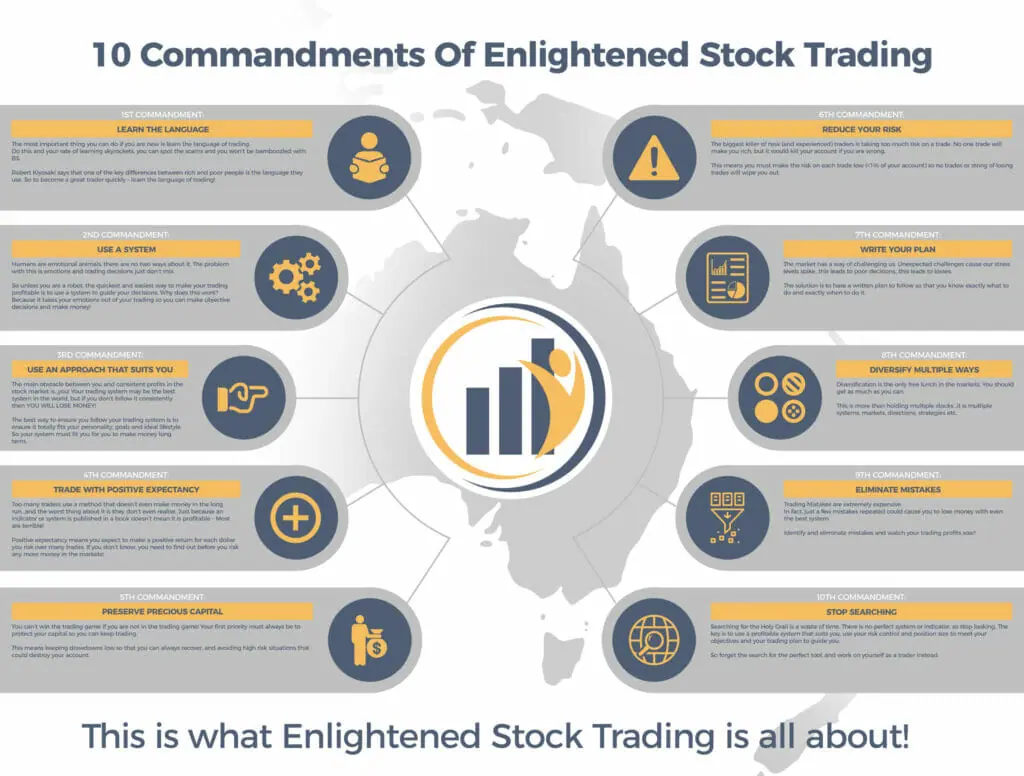
Learn The 10 Commandments For Profitable Trading
Discover the 10 most important lessons from 18 years of profitable trading & reading over 150 trading books.
Get your FREE Report & 10 Training Videos NOW!