Is Taking Partial Profits in Trend Following a Rational Idea?
TLDR
Taking partial profits in trend trades feels sensible. When a position grows large and starts swinging your portfolio around, locking in gains can seem prudent.
But when we objectively test profit targets and scaling out of positions inside a systematic trend following strategy, the data tells a different story.
As you’ll see below, taking partial profits reduces total returns and weakens risk-adjusted performance. In most cases, it is an emotional response rather than a rational, data-driven decision.
Why Traders Want to Take Partial Profits in Trend Trades
One of the most common behaviours I see among traders is the desire to take profits off the table during a strong trend.
This happens most often in long-term Trend Trading systems. A stock breaks out, trends strongly, and suddenly the open profit is significant. The position becomes large relative to the portfolio.
And then the doubt creeps in.
You start thinking:
- “Should I scale out of part of this position?”
- “Should I lock in profits before they disappear?”
- “Is it smart to use a profit target here?”
It feels rational. After all, the larger the open profit, the more painful the potential give-back if the trend reverses and hits the trailing stop.
The problem is this: trend following is built on the principle of letting profits run. The big winners pay for all the small losses. When you take partial profits or scale out early, you reduce exposure to the very trades that drive long-term performance.
So the real question becomes:
Is partial profit taking improving your trading system – or just making you feel better?
The Trend Following Strategy Used in This Analysis
To answer that question properly, we need objective data. That means Backtesting the idea rather than relying on opinion.
For this test, I used a simple long-term trend following system on Australian stocks:
- Entry: New 200-day highest close.
- Universe: Liquid ASX stocks with a maximum volatility threshold.
- Exit: 25% trailing stop below the highest price since entry.
- If the stop is touched intraday, exit next bar on open.
This is a classic breakout-based trend following approach. Nothing fancy. No discretionary overrides. Just rules.
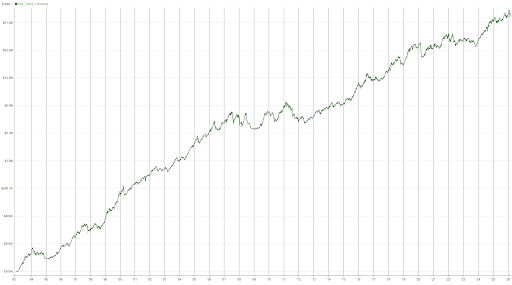
Here are the performance statistics for the base system:
Performance statistics:
- Rate of Return: 21.6%
- Max Drawdown: 41.7%
- MAR: 0.52
- Trades: 1432
This gives us a clean benchmark before introducing profit targets or scaling out of positions.
Modelling Partial Profit Taking in RealTest
To test profit taking, we added an additional exit rule to simulate a profit target.
Here is the code added to the Library Section:
ProfitExit1: FillPrice*(1+ProfitTarget)
We then optimised two variables:
- The width of the profit target.
- The percentage of the position closed when the target is hit.
Here are the parameters:
ProfitTarget: From 0.25 TO 1.50 Step 0.25 Def 0.50
ProfitTargetPositionReduction: From 0 To 1 Step 0.25 Def 0
This allowed us to test scaling out of positions from 0% to 100%, across different profit target distances.
Next, we added this to the strategy section:
ExitLimit: ProfitExit1
ExitLimitQty: IF(ExitNum=1,Shares*ProfitTargetPositionReduction,0)
ExitLimitTime: Intraday
This ensures the profit target only triggers once per trade. Without the IF(ExitNum=1,…) condition, RealTest would repeatedly scale out each time price crossed the level. That would not reflect real-world trading behaviour.
In practical terms, this models a limit order that sells a portion of the position the first time the profit target is hit.
Optimisation Results: Do Profit Targets Improve Trend Following?
We then optimised across:
- The width of the profit target
- The percentage of the position reduced
1. Rate of Return
Across all combinations tested, every instance of partial profit taking reduced the overall rate of return compared to the base trend following system.
Every single one.
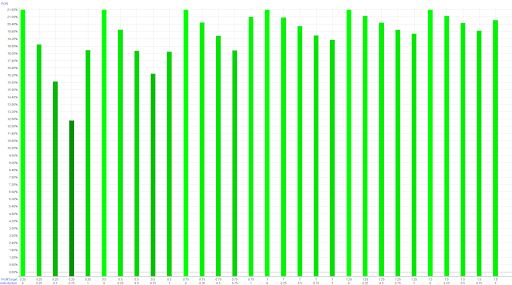
When you scale out of strong trends, you reduce exposure to the largest winners. That is where the compounding power comes from in trend following.
2. Maximum Drawdown
Interestingly, every combination of profit target and position reduction reduced maximum drawdown.
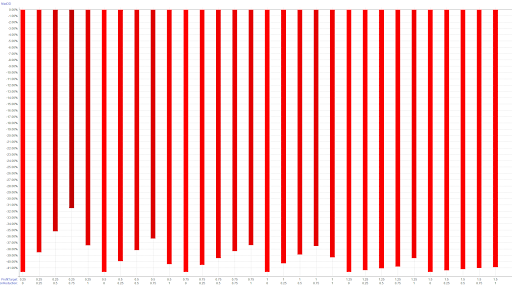
That sounds positive.
But drawdown alone is meaningless without context. What matters is the balance between return and risk.
For that, we look at the MAR ratio.
3. MAR Ratio (Return / Drawdown)
The MAR ratio tells the real story.
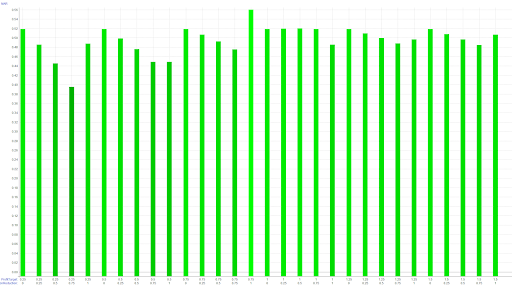
The base case MAR was 0.52.
Apart from one isolated outlier at a 75% profit target with 100% position reduction, every other combination produced an equal or worse MAR ratio.
For a hypothesis to be valid in Trading System Optimization, it should hold across a broad range of parameters. A single marginal outlier is not enough.
The conclusion is clear:
Taking partial profits in this trend following system degrades both total return and risk-adjusted performance.
Why Scaling Out of Positions Feels Right – But Isn’t
This is where Trading Psychology enters the picture.
Scaling out reduces emotional discomfort.
It reduces volatility in your equity curve. It makes open profits feel “real”. It reduces the pain of give-back at the end of a bull market.
But trading is not about what feels comfortable.
As Richard Weissman said:
“The market rewards those who train themselves to do that which is unnatural and uncomfortable and punishes those desiring certainty, safety, and security.”
Trend following works because it captures rare, large, extended moves. The moment you cap those moves with profit targets, you blunt the edge.
Conclusion: Should You Take Partial Profits in Trend Following?
If you are trading a systematic trend following strategy, the data suggests:
- Profit targets reduce long-term returns.
- Scaling out reduces exposure to large winners.
- Risk-adjusted returns do not improve in a meaningful, stable way.
- The decision to take partial profits is usually emotional.
You make more money long term by:
- Letting profits run.
- Using a trailing stop.
- Accepting temporary give-back.
- Trusting your backtested edge.
Of course, test it yourself. Other markets and strategies may differ. But for classic breakout trend following systems, partial profit taking is typically a drag on performance.
This is the difference between discretionary comfort and systematic discipline.
What This Really Means for Your Trading
If this article made you slightly uncomfortable… good.
Because this is the exact fork in the road that separates discretionary traders from systematic traders.
Most traders:
- Take partial profits because it feels safer.
- Override their rules because a position looks “too big”.
- Change systems during drawdown.
- Optimise for comfort instead of long-term edge.
Systematic traders do something different.
They:
- Backtest ideas before acting on them.
- Accept drawdown as part of the edge.
- Let profits run when the data says that is optimal.
- Design portfolios of systems so no single strategy controls their emotional state.
The difference is not intelligence.
It is structure.
If You’re Serious About Trading Like a Professional
The reality is this:
You cannot trade a diversified portfolio of long-term trend following, short systems, and mean reversion strategies confidently unless you:
- Know your edge is statistically valid.
- Understand your drawdown profile.
- Have tested alternative exit methods.
- Can quantify the impact of every rule.
- Have multiple systems working together.
That is exactly what we teach inside The Trader Success System.
This is not about tips.
It is not about hype.
It is not about “feel”.
It is about building a portfolio of proven trading systems that you trust enough to follow – even when it feels uncomfortable.
Because that is where the money is made.
Imagine This Instead…
Instead of wondering:
- “Should I scale out?”
- “Should I take profits now?”
- “Is this too big?”
- “What if it gives it all back?”
You simply check your system.
You look at your backtest.
You understand the probabilities.
You know the expected give-back.
You know the historical worst drawdown.
You know the MAR.
You know the expectancy.
And you execute.
Calmly.
Confidently.
In 20-30 minutes a day.
That is what consistent traders do.
This Is The Shift From Emotional to Systematic
Inside The Trader Success System, you will learn how to:
- Build and test complete trading systems.
- Optimise exits without curve fitting.
- Combine trend following and mean reversion.
- Diversify across markets.
- Allocate capital intelligently between systems.
- Reduce emotional friction through statistical confidence.
- Automate parts of your workflow.
- Trade alongside a community of analytical traders who think like you.
This is the trading program for logical thinkers.
If you have an engineer’s brain.
If you value data over opinion.
If you want confidence instead of second-guessing.
You will feel at home here.
The Real Question
The real question is not:
“Should I take partial profits?”
The real question is:
Do you want to keep reacting emotionally to trades…
Or do you want to build a portfolio of systems that removes the need to react at all?
If you are ready to trade based on proven systems instead of emotions, click below and learn how The Trader Success System works.
Learn The 10 Commandments For Profitable Trading
Discover the 10 most important lessons from 18 years of profitable trading & reading over 150 trading books.

Get your FREE Report & 10 Training Videos NOW!