SMSF Trading Strategies: Systematic vs Discretionary
If you’re managing your retirement wealth through an SMSF and actively trading stocks, one question matters more than most: Should you trade using a rules-based system or rely on instinct? The answer can make or break your consistency, compliance, and long-term performance.
Discretionary trading gives you flexibility, but it also exposes your fund to emotional decisions, compliance challenges, and inconsistent results. Systematic trading, on the other hand, follows predefined rules – making it easier to stay disciplined, scale your strategy, and meet ATO requirements.
This article breaks down the key differences between discretionary and systematic trading in an SMSF – from auditability and time demands to psychological discipline and portfolio diversification. If you’re aiming to trade smarter, not harder, this will help you decide which approach suits your mindset, strategy, and retirement goals – and for me, the choice is clear!
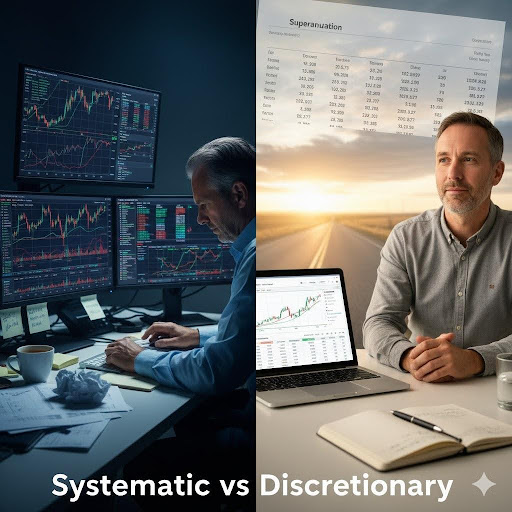
Understanding Trading Styles in an SMSF
Discretionary: Intuition, Flexibility, Risk
Discretionary trading is based on your judgment. You analyze the market, news, charts, and patterns in real-time and make decisions based on what feels right. It gives you flexibility, but that freedom can be a double-edged sword.
Discretionary trading is heavily influenced by emotions, and poor trading psychology can lead to impulsive decisions that create unnecessary risk inside an SMSF where capital preservation and compliance are critical. Because an SMSF is designed for long-term retirement wealth, relying on subjective judgement rather than rules-based systems exposes the fund to inconsistent outcomes driven by fear, greed, and flawed psychology under pressure.
Systematic: rules-based, testable, scalable
Systematic trading follows a defined set of rules. Entries, exits, position sizing, and risk limits are pre-determined and followed exactly. It’s about making decisions based on logic and data, not emotions or market noise.
In an SMSF, this structured approach helps you stay compliant and consistent. You can backtest your rules, prove they work historically, and document them clearly for your investment strategy. That means less second-guessing, more confidence.
It’s also scalable. As your SMSF grows, a systematic model makes it easy to trade across more stocks or markets without increasing mental load or admin. I have been able to effortlessly scale and diversify my portfolio as it has grown, with monitored automation of my trading systems making this even easier.
Performance and consistency comparison
Discretionary trading might work in short bursts, but it’s rarely consistent. One good year can be followed by a disastrous one, often due to emotional decisions or market conditions changing faster than you can adapt.
Systematic traders, on the other hand, tend to achieve steadier performance because they stick to rules, adapt only when data supports it, and avoid major mistakes caused by fear or FOMO. Even if returns aren’t always higher, the reduced variability makes planning much easier in an SMSF.
Over the long term, consistency matters more than the occasional big win – especially when you’re trading your retirement savings.
Pros and Cons for SMSF Investors
Auditability and documentation
Every decision made within an SMSF must be auditable. You need a paper trail (or digital one) that shows how your trading aligns with your written investment strategy. This is where systematic trading shines.
Rules-based trading strategies can be documented once and then followed consistently. You can export logs, print system logic, and show proof of testing. If the ATO asks why you bought or sold a stock, your system answers for you.
Discretionary trades require detailed notes for every single decision – which is rarely done consistently. That’s a major compliance risk, and it makes your fund harder to manage over time.
Time investment and decision fatigue
Discretionary trading can be mentally exhausting. Every trade demands attention, analysis, and judgment. The more decisions you make, the more prone you are to fatigue, mistakes, and hesitation.
Systematic trading removes most of that burden. Once your systems are built and tested, daily or weekly execution takes minutes. Many Enlightened Stock Trading students manage entire portfolios in under 30 minutes a day.
In the context of an SMSF, this efficiency frees you up to focus on strategy rather than micro-decisions – which is crucial if you’re balancing trading with work, life, and compliance tasks.
Psychological discipline
The hardest part of trading isn’t technical – it’s emotional. Discretionary traders often struggle with fear, greed, and self-doubt. A few losses can lead to hesitation or chasing trades. Wins can create overconfidence and risk-taking.
Systematic trading builds discipline by removing emotion from the equation. You’re not reacting to noise, you’re following a plan. That reduces stress, builds confidence, and makes it easier to handle drawdowns and market volatility.
This is especially important in an SMSF, where emotional decisions can have long-term retirement consequences.
Blended Approaches and Automation
When to apply each style
There are cases where discretionary inputs make sense – like adjusting exposure after major market news or choosing between two equally valid trades. But these should be exceptions, not the foundation of your SMSF strategy.
Use discretionary thinking in your system development phase – to test ideas, refine logic, or adapt to new markets. But once the rules are set, execution should be systematic. That’s the best way to stay consistent and compliant.
In short: use your brain to build the system, not to override it.
Tools to support hybrid models
If you’re not ready to go fully systematic, you can start with a hybrid model. Use rules for entries and exits, but allow discretionary inputs for filters or timing. For example, you might only take signals when volatility is within a specific range or during certain market regimes.
There are also platforms like Amibroker that allow for semi-automated trading. You can run scans, generate signals, and manually review trades before execution.
Hybrid models can ease the transition for discretionary traders moving toward full systemisation. You may find that once you logically describe the discretionary filters you may be considering, you can quantify them and backtest how they would have actually performed historically.
Scaling and diversification benefits
As your SMSF grows, managing a larger portfolio manually becomes harder. Discretionary trading doesn’t scale well – you’ll hit time and attention limits quickly, and your decision quality may suffer.
Systematic strategies scale easily. You can run multiple systems across different markets and timeframes, diversifying your risk while maintaining consistency. You’re not doing more work – you’re letting the systems do the heavy lifting.
This scalability is crucial for building a truly diversified, robust SMSF portfolio that can perform in all market conditions.
Summary: Systematic vs Discretionary SMSF Trading – Which Fits Your Strategy?
Discretionary trading relies on human judgment. Systematic trading runs on rules. Inside an SMSF, that difference isn’t just about style, it’s about structure, risk, and long-term efficiency. A systematic approach gives you better audit trails, less decision fatigue, and more consistent execution – all crucial when trading retirement capital.
While discretionary trading offers flexibility, it also demands more time, emotional discipline, and meticulous documentation. Most traders find they perform better (and sleep easier) when their SMSF follows a portfolio of tested systems, not gut feel.
If you want to build wealth reliably through your SMSF, this comparison can help you align your trading approach with your goals. Systematic trading isn’t just about automation – it’s about making smarter decisions, with less stress and more control. At the start of this article, I stated that the choice was clear, by joining the Trader Success System you can learn how to build and manage a portfolio of systems in under 30 minutes a day.
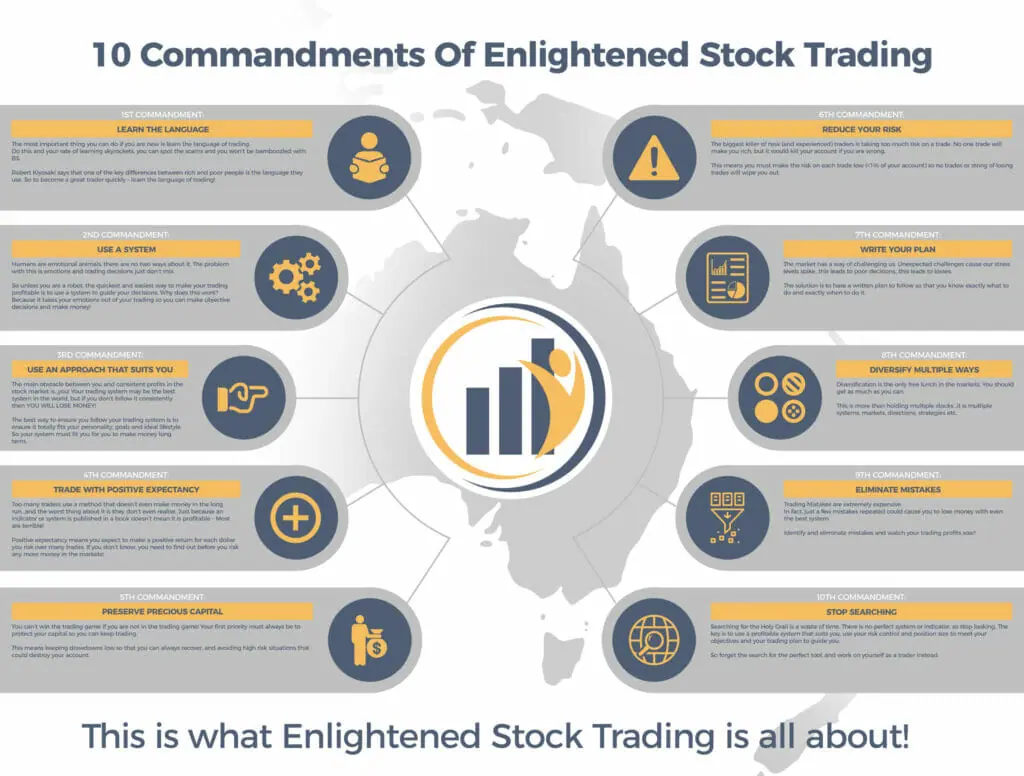
Learn The 10 Commandments For Profitable Trading
Discover the 10 most important lessons from 18 years of profitable trading & reading over 150 trading books.
Get your FREE Report & 10 Training Videos NOW!