The short stock profit calculator is a powerful tool that helps traders evaluate the profitability of short trades. By entering key trade data such as entry price, exit price, commissions, number of shares, days held, and the stock borrow rate, the calculator determines your net profit or loss, taking into account all associated costs.
The Short Stock Profit Calculator
Step-by-Step Explanation of The Short Stock Profit Calculator
Entry Price and Exit Price: The calculator starts by calculating the gross profit or loss from the trade. Since this is a short position, profit is generated when the stock price drops between the entry and exit.
Gross Profit/Loss Formula:
This initial calculation shows how much was earned or lost based on the price change of the stock while the short position was held.
Commissions on Entry and Exit: The calculator deducts entry and exit commissions, which are fees charged by the broker to execute the trades. These are entered as percentages of the stock prices during both the entry and exit of the trade.
Total Commission Formula:
Stock Borrow Rate: For short selling, there is an additional cost – the borrow rate – which is charged as an annual percentage for borrowing shares. The calculator factors in the stock borrow rate for the number of days the short position was held.
Borrow Cost Formula:
Net Profit/Loss: Finally, the short stock profit calculator subtracts the total commissions and the borrow cost from the gross profit to give the net profit or loss.
Net Profit/Loss Formula:
Example of How The Short Stock Profit Calculator Works
Let’s say you shorted 100 shares of a stock at $50 per share, exited the trade at $45, held the position for 10 days, paid 0.5% commission on both entry and exit, and had a borrow rate of 2%. The short stock profit calculator would compute the gross profit first, subtract the commission fees, and factor in the borrow cost to give you the net profit or loss.
Importance of the Short Stock Profit Calculator
Using a short stock profit calculator is essential for short sellers to understand their true profits after accounting for commissions and borrowing costs. This ensures that traders don’t overlook hidden costs that can significantly affect profitability. Additionally, by incorporating the number of days held and the borrow rate, the calculator provides a more realistic view of the total cost of a short trade.
To become a more successful trader and fully optimize your trading strategy, consider learning more through The Trader Success System, where you can build the skills and systems needed to consistently generate profits while minimizing risk and costs.
Conclusion
The short stock profit calculator simplifies the process of calculating potential profits or losses from short trades. By entering trade-specific data like entry/exit prices, commissions, stock borrow rate, and days held, traders can easily determine their net profits or losses, helping them make better-informed trading decisions.
Frequently Asked Questions about Short Stock Profit Calculator
How to calculate profit from shorting a stock?
Calculating profit from shorting a stock is pretty straightforward. Here’s how it works:
- Initial Sale Price: When you short a stock, you sell it at the current market price. Let’s say you short 100 shares of a stock at $50 each. Your initial sale proceeds are 100 shares x $50 = $5,000.
- Repurchase Price: Later, you buy back the shares at a lower price. Suppose the stock price drops to $30, and you repurchase the 100 shares at this price. Your repurchase cost is 100 shares x $30 = $3,000.
- Profit Calculation: The profit from the short sale is the difference between the initial sale proceeds and the repurchase cost. In this example, it’s $5,000 – $3,000 = $2,000.
Remember, there are costs involved in shorting, such as brokerage fees, stock borrow fees, and potentially dividends if the stock pays them while you’re short . These costs can affect your net profit, so it’s essential to factor them in when calculating your overall gain from a short sale.
How do you profit from shorting a stock?
Shorting a stock allows you to profit from a decline in its price. Here’s how it works:
- Borrow and Sell: You start by borrowing shares of a stock from your broker and selling them at the current market price. Let’s say you borrow 100 shares of XYZ stock and sell them at $50 each. You receive $5,000 from this sale.
- Repurchase at Lower Price: If the stock price falls, you can buy back the shares at the lower price. Suppose the price drops to $30 per share. You buy back the 100 shares for $3,000.
- Profit Calculation: Your profit is the difference between the selling price and the repurchase price. In this example, it’s $5,000 (initial sale) – $3,000 (repurchase) = $2,000 profit.
Remember, there are costs involved in shorting, such as brokerage fees, stock borrow fees, and potentially paying dividends if the stock issues them while you’re short . These costs can impact your net profit, so it’s crucial to factor them in when calculating your overall gain from a short sale.
What is the maximum profit on short selling?
The maximum profit you can achieve from short selling is 100% of the initial sale amount. This happens when the stock price goes to zero. For instance, if you short a stock at $10 per share and the company goes bankrupt, causing the stock to become worthless, you keep the entire $10 per share as profit. However, this is the absolute best-case scenario, and it doesn’t happen often .
The risk, on the other hand, is theoretically unlimited because if the stock price rises, you could face significant losses. This asymmetry between potential gains and losses makes short selling riskier than buying stocks on the long side. It’s crucial to have a solid risk management plan in place to protect yourself from these potential losses .
How to calculate profit when shorting a stock?
Calculating profit from shorting a stock is pretty straightforward. Here’s how it works:
- Initial Sale Price: When you short a stock, you sell it at the current market price. Let’s say you short 100 shares of a stock at $50 each. Your initial sale proceeds are 100 shares x $50 = $5,000.
- Repurchase Price: Later, you buy back the shares at a lower price. Suppose the stock price drops to $30, and you repurchase the 100 shares at this price. Your repurchase cost is 100 shares x $30 = $3,000.
- Profit Calculation: The profit from the short sale is the difference between the initial sale proceeds and the repurchase cost. In this example, it’s $5,000 – $3,000 = $2,000.
Remember, there are costs involved in shorting, such as brokerage fees, stock borrow fees, and potentially dividends if the stock pays them while you’re short . These costs can affect your net profit, so it’s essential to factor them in when calculating your overall gain from a short sale.
Can a regular person short a stock?
Yes, a regular person can short a stock, but there are a few things to keep in mind:
- Margin Account: You’ll need to have a margin account with your broker. This is because short selling involves borrowing shares, and a margin account is necessary to facilitate that borrowing .
- Broker Requirements: Not all brokers offer short selling, so you’ll need to choose one that does. It’s important to select a broker with a broad range of stocks available for shorting and competitive borrowing fees. Interactive Brokers is one example, but there are others .
- Costs and Risks: Short selling comes with costs like stock borrow fees and potential dividend payments to the original stock owner. Plus, the risk is theoretically unlimited if the stock price rises, so it’s crucial to have a solid risk management plan .
Short selling can be a valuable strategy, but it’s essential to understand the mechanics and risks involved before diving in.
What happens if I short a stock and it goes to $0?
If you short a stock and it goes to $0, that’s the best-case scenario for a short seller. When a stock goes to zero, it typically means the company has gone bankrupt or been delisted, and the shares are worthless. Here’s what happens:
- Initial Sale: You initially sold the borrowed shares at a certain price, let’s say $10 per share.
- Repurchase at Zero: Since the stock is now worthless, you don’t need to spend any money to buy it back. You essentially “repurchase” it for $0.
- Profit: Your profit is the entire amount you received from the initial sale. So, if you sold 100 shares at $10 each, you keep the full $1,000 as profit because you don’t have to pay anything to buy back the shares .
This scenario gives you a 100% gain on the initial sale amount, which is the maximum profit you can achieve from short selling. It’s a rare occurrence, but when it happens, it’s quite rewarding for the short seller .
How long can you short a stock?
The duration you can hold a short position isn’t fixed, it largely depends on a few factors:
- Broker’s Terms: Your broker may have specific rules or limitations on how long you can maintain a short position. Generally, as long as you meet the margin requirements and pay the associated costs, you can hold the position indefinitely .
- Costs: Holding a short position incurs costs like stock borrow fees and potential dividend payments. These costs can add up over time, so it’s crucial to factor them into your strategy. If the costs become too high, it might not be profitable to hold the position for an extended period .
- Market Conditions: If the stock becomes hard to borrow or if there’s a short squeeze, your broker might force you to cover your position, especially if the stock price rises significantly .
In essence, while there’s no strict time limit, practical considerations like costs and market dynamics often dictate how long you can or should hold a short position.
How do you profit from shorting?
Profiting from shorting a stock involves a few key steps:
- Borrow and Sell: First, you borrow shares of a stock from your broker and sell them at the current market price. For instance, if you short 100 shares at $50 each, you receive $5,000 from the sale .
- Price Decline: The goal is for the stock price to drop. Let’s say the price falls to $30 per share.
- Repurchase and Return: You then buy back the 100 shares at the lower price of $30 each, costing you $3,000. After repurchasing, you return the shares to your broker .
- Calculate Profit: Your profit is the difference between the initial sale proceeds and the repurchase cost. In this example, it’s $5,000 – $3,000 = $2,000 .
Keep in mind, there are costs involved, such as stock borrow fees and potential dividends, which can affect your net profit. It’s crucial to factor these in when planning your short selling strategy .
Can you make a lot of money shorting stocks?
Shorting stocks can indeed be profitable, but it’s important to understand the risks and dynamics involved. Here’s a breakdown:
- Profit Potential: When you short a stock, you’re betting that its price will fall. If the stock price drops significantly, you can buy it back at a lower price, pocketing the difference as profit. For example, if you short a stock at $100 and it falls to $50, you make $50 per share .
- Risks: The potential loss in short selling is theoretically unlimited because a stock’s price can rise indefinitely. If the stock price increases instead of falling, you could face substantial losses. For instance, if you short a stock at $10 and it rises to $100, your loss is $90 per share .
- Costs: There are costs associated with shorting, such as stock borrow fees and dividends. These can eat into your profits, so it’s crucial to factor them into your strategy .
- Market Conditions: Shorting is often more successful in bear markets when stock prices are generally declining. Timing and market conditions play a significant role in the profitability of short selling .
While shorting can be lucrative, it’s not for the faint-hearted. It requires careful risk management and a solid understanding of market dynamics. If you’re considering shorting, make sure you’re well-prepared and aware of the potential pitfalls .
Who loses money when a stock is shorted?
When a stock is shorted, the dynamics of who loses money can be a bit nuanced. Here’s how it generally works:
- Original Shareholders: If the stock price falls after being shorted, the original shareholders who hold onto their shares might see a decrease in the value of their holdings. However, this isn’t a direct loss from the shorting itself, it’s more about the market’s perception and the resulting price movement .
- Short Sellers: If the stock price rises instead of falling, short sellers can incur losses. They have to buy back the stock at a higher price than they sold it for, which results in a financial loss. This is the risk that short sellers take on when they bet against a stock .
- Market Dynamics: Short selling can sometimes contribute to downward pressure on a stock’s price, but it’s not the sole factor. Market sentiment, news, and other traders’ actions also play significant roles. It’s important to remember that short sellers are just one part of the market ecosystem, providing liquidity and sometimes helping to correct overvalued stocks .
In essence, while short sellers can profit from a stock’s decline, the losses are typically borne by those who hold the stock as its value decreases.
How do brokers make money on short selling?
Brokers make money on short selling through several avenues:
- Stock Borrow Fees: When you short a stock, you borrow shares from your broker. The broker charges a stock borrow fee for this service, which is a percentage of the value of the borrowed shares, charged per day. This fee is shared between the broker and the original owner of the shares, who allows their shares to be lent out .
- Commissions: Just like any other trade, brokers earn commissions on the transactions involved in short selling. This includes the initial sale of the borrowed shares and the subsequent repurchase to close the position .
- Interest on Margin: Short selling typically requires a margin account, and brokers charge interest on the borrowed funds used to maintain the short position. This interest is another source of income for brokers .
These mechanisms ensure that brokers are compensated for facilitating short selling, providing liquidity, and managing the risks associated with lending shares.
How do investors make profits on a short sale?
Investors make profits on a short sale by capitalizing on a decline in a stock’s price. Here’s how it works:
- Borrowing and Selling: The investor borrows shares from their broker and sells them at the current market price. For example, if a stock is trading at $100, they sell it at that price .
- Price Decline: The aim is for the stock price to drop. If the price falls to $50, the investor can then buy back the shares at this lower price .
- Repurchasing and Returning: The investor buys back the shares at the reduced price of $50 and returns them to the broker. The difference between the selling price and the repurchase price is the profit .
- Profit Calculation: In this scenario, the profit per share is $50 ($100 – $50). If they shorted 100 shares, the total profit would be $5,000 .
It’s important to consider costs like stock borrow fees and potential dividend payments, which can affect the net profit. Short selling can be a powerful strategy, especially in bear markets, but it requires careful risk management due to the potential for unlimited losses if the stock price rises instead .
What is the uptick rule?
The uptick rule is a regulation that affects short selling. Essentially, it requires that a short sale can only be executed at a price higher than the last different price, or on an uptick. This rule is designed to prevent short sellers from adding to the downward momentum of a stock that’s already declining.
In practice, when the uptick rule is in force, you can’t short a stock after a downtick. Instead, you have to wait for an uptick, meaning the stock price has to tick upwards before you can initiate a short sale. This is intended to slow down the selling pressure and provide a bit of stability to the market .
If you’re using a platform like Interactive Brokers, it will show you whether the uptick rule is in place for a particular stock right on your order entry ticket. However, this feature might not be available in paper trading accounts .
More Trading Calculators to Improve Your Trading Decisions
Visit our Ultimate Collection of Trading Calculators Page for all our trading calculators
- Stock Market Calculator
Project your wealth from investing in the stock market based on starting capital, returns, tax, deposits & withdrawals. The Stock Market Calculator makes it easy to set your trading goals and plan for your financial future. - Stock Profit Calculator
Calculate the profit or loss you will incur from an individual stock trade based on the entry and exit assumptions as well as your chosen position size. The Stock Profit Calculator is a great 'what if' analysis tool for your individual trades. - Average Down Stock Calculator
Calculate your average purchase price and perform scenario analysis for averaging down on stocks with our average down stock calculator. This easy calculator shows you your average price depending on the number of shares you buy at each price level. - Stock Split Calculator
Calculate the impact of a stock split on position and determine the number of shares and the share price on a split adjusted basis with our stock split calculator. - Reverse Stock Split Calculator
Calculate the impact of a reverse stock split on position and determine the number of shares and the share price on a split adjusted basis with our reverse stock split calculator. - Compound Interest Calculator
Discover our Compound Interest Calculator, designed for traders to confidently plan high level investments and project future wealth with ease including regular contributions to your account. - Stock Average Calculator
Calculate your stock average price quickly and easily for multiple purchases of the same stock with this easy to use stock average calculator. Find the average price for up to 10 purchases in the same stock. - Position Size Calculator
Maximize profits & manage risk with our Position Size Calculator! Optimize your trade sizes using 3 powerful sizing models tailored to your trading style. - Expected Return Stock Calculator
Use our Expected Return Stock Calculator to find the expected profit based on outcome scenarios for the stock. Start making confident decisions by using probabilities instead of prediction. - Trading Expectancy Calculator
Unlock the true potential of your trading strategy with the Trading Expectancy Calculator. Master profitability by predicting gains and losses over multiple trades. Elevate your trading game now! - Risk Reward Calculator
The Risk-Reward Calculator helps traders quickly assess the potential profit versus the risk of a trade by calculating the risk-reward ratio based on the entry price, stop loss, and target price. - Rule of 72 Calculator
Use the Rule of 72 Calculator to quickly estimate how long it takes to double your investment. Learn the formula, calculate exact time frame estimates to double your investments at different interest rates. - Trading For A Living Calculator
Curious how much capital you need to trade for a living? Our Trading for a Living Calculator reveals the exact amount based on returns, taxes, and drawdowns. Calculate now! - Capital Gain Stock Calculator
The Capital Gain Stock Calculator helps traders estimate their before and after-tax capital gains on stock trades, accounting for factors like purchase price, sale price, holding period, and tax rates. Use it to quickly determine how much tax you might owe based on long-term or short-term gains, and plan your trading strategy more effectively. - Drawdown Calculator
The Drawdown Calculator helps traders calculate the percentage and dollar losses from their portfolio's peak value. Simply input your peak equity and lowest value after the peak to instantly determine your drawdown and better manage your risk. - Short Stock Profit Calculator
Use our Short Stock Profit Calculator to estimate your net profit or loss on short trades. Factor in commissions, borrow rates, and holding period for accurate results.
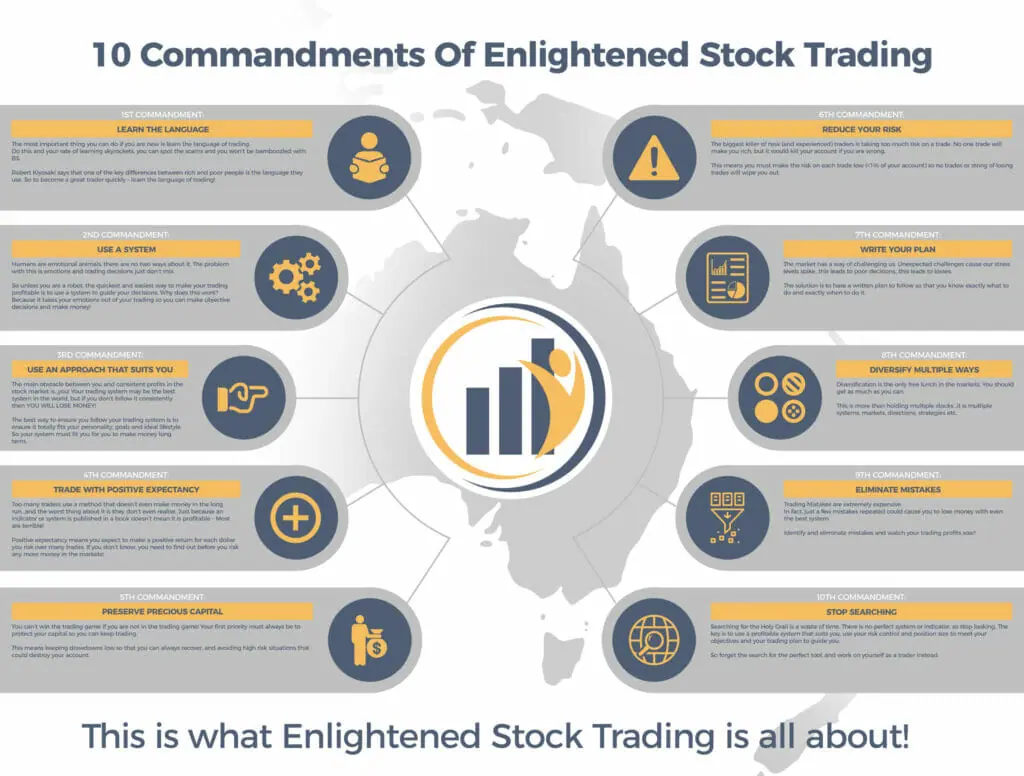
Learn The 10 Commandments For Profitable Trading
Discover the 10 most important lessons from 18 years of profitable trading & reading over 150 trading books.
Get your FREE Report & 10 Training Videos NOW!