Most traders go looking for a VIX ETF on exactly the wrong day.
The market has just dropped hard. The financial news is loud. Somebody mentions the “fear index” and it is up 40% while everything in the portfolio is red. So the search begins, and it is the same search a prospect once described to me about hyped themes in general: “By the time you hear about them, they’re on their way down.”
Here is the problem with that search. There is no such thing as a VIX ETF.
There are products with VIX in the name. There are tickers you can buy in any brokerage account. But none of them hold the VIX, none of them can hold the VIX, and most of them are built in a way that loses money slowly and steadily in a normal market. Buying one because you are worried about a crash is a bit like buying a fire extinguisher that leaks a little every day and only works if the fire starts this week.
This article covers what these products actually hold, the mechanism that drains them, the structural traps that never make it into the marketing, and what a rules-based trader does instead when they want protection from a falling market.
What Is A VIX ETF?
A VIX ETF is an exchange-traded product that aims to give you exposure to expected stock market volatility by holding VIX futures contracts, not the VIX index itself. Most of them are not technically ETFs at all. They are exchange-traded notes (ETNs) or commodity pools, which are different legal structures carrying different risks.
The common tickers people mean when they say “VIX ETF”:
| Ticker | Product | What it does |
|---|---|---|
| VIXY | ProShares VIX Short-Term Futures ETF | 1x exposure to short-term VIX futures |
| VXX | iPath Series B S&P 500 VIX Short-Term Futures ETN | Same exposure, structured as a note |
| VIXM | ProShares VIX Mid-Term Futures ETF | Mid-term VIX futures, slower moving |
| UVXY | ProShares Ultra VIX Short-Term Futures ETF | Leveraged long, reset daily |
| UVIX | 2x Long VIX Futures ETF | 2x leveraged long, reset daily |
| SVXY | ProShares Short VIX Short-Term Futures ETF | Inverse, profits when VIX futures fall |
Every one of them is a futures position in a wrapper. That single fact explains almost everything that goes wrong with them.
Can You Buy The VIX Directly?
No. The VIX is a calculation, not an asset.
The Cboe Volatility Index is derived from the prices of S&P 500 index options. It expresses, in annualised percentage terms, how much movement the options market is pricing into the next 30 days. There are no shares of it. There is no vault holding it. It is a number published from other prices, in the same way that a temperature reading is not a thing you can put in a warehouse.
That is why every product in the table above holds futures instead. VIX futures are real contracts with real prices, and they are the closest tradable thing to the index. But “closest tradable thing” is doing a lot of work in that sentence, and the gap between the futures and the index is where the money goes.
If you want to understand the index itself and how a systematic trader reads it, that is covered separately in the guide to the volatility index. This article is about the products built on top of it.
What Do VIX ETFs Actually Hold?
Short-term VIX products hold a rolling blend of the front two VIX futures contracts, rebalanced every day to maintain a roughly constant 30-day average maturity.
That daily rebalance is not an occasional housekeeping step. It is the entire operation of the fund. Every trading day, the fund sells a slice of the expiring near-month contract and buys a slice of the next-month contract, so the weighted average maturity stays near 30 days as the calendar rolls forward.
The fund is therefore a permanent seller of the nearer contract and a permanent buyer of the further-out contract. Whether that is profitable or expensive depends entirely on which of the two is more expensive. In most market conditions, the further-out contract is the expensive one.
Why Do VIX ETFs Lose Money Over Time?
Because VIX futures usually trade above the spot VIX, so the fund sells cheap and buys expensive every single day. That is called negative roll yield, and it is a structural cost rather than bad luck.
The shape of the futures curve has a name. When further-dated contracts cost more than nearer ones, the curve is in contango. When the near contract costs more, it is in backwardation.
| Curve shape | When it happens | What the daily roll does to the fund |
|---|---|---|
| Contango (upward sloping) | Calm and normal markets, the large majority of the time | Sells the cheaper near contract, buys the pricier far contract. Bleeds value. |
| Backwardation (downward sloping) | Panic, crashes, sharp selloffs | Sells the pricier near contract, buys the cheaper far contract. Gains value. |
The market spends most of its life in the top row. Traders want these products for the bottom row.
That mismatch is the whole story of VIX exchange-traded products. You pay a daily toll to hold an instrument that only pays you during the short windows when everyone else also wants it. The toll is small on any given day and enormous over a year.
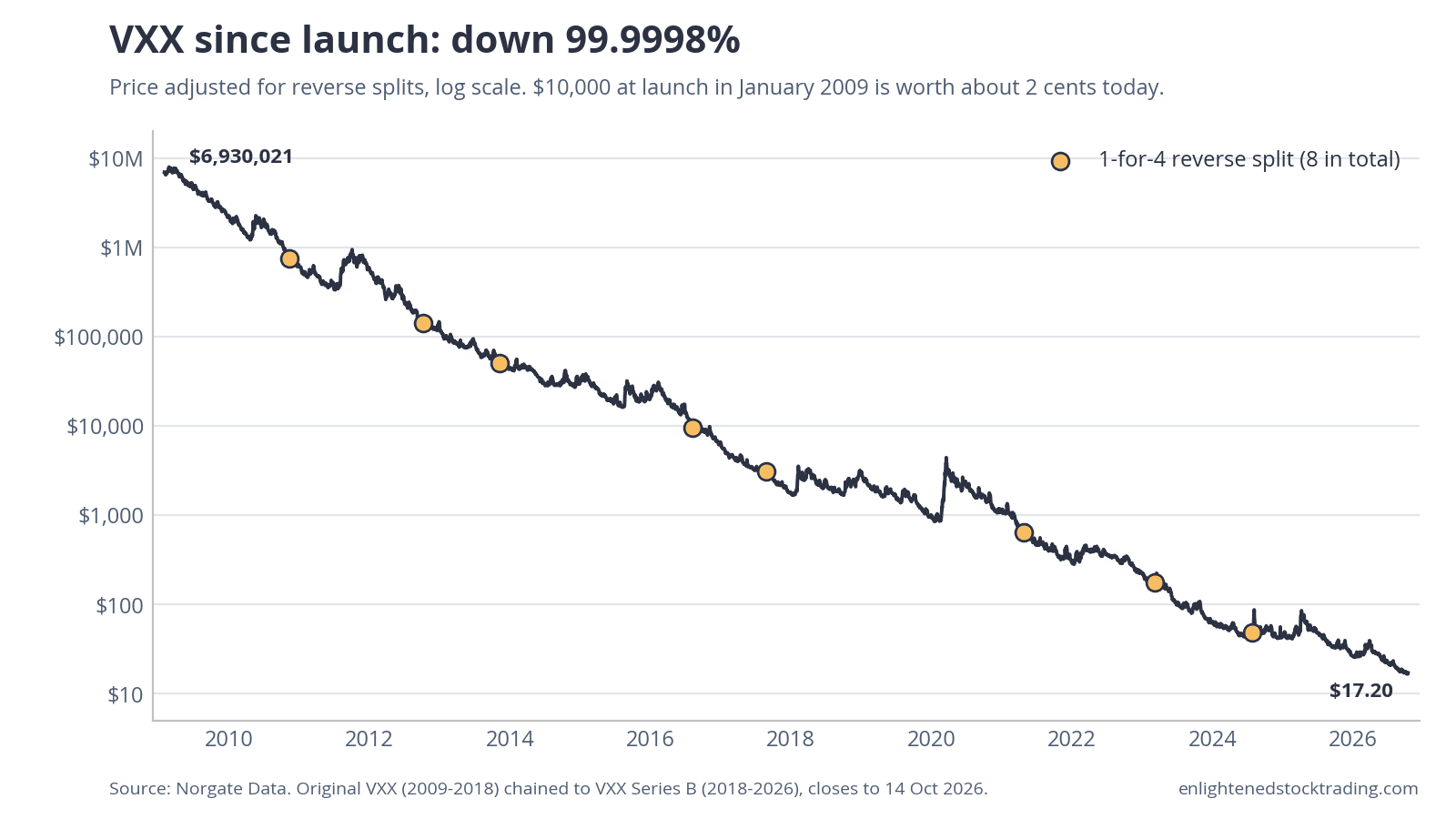
You do not need a model to see the effect. VXX has been through repeated reverse splits since it launched in 2009, and a reverse split is what an issuer does when the share price has fallen so far that the product needs cosmetic surgery to stay respectable. A product that needs constant reverse splits over and over clearly has a long-run downward drift, as you can see in the chart below.
What About Leveraged And Inverse VIX Products?
They take the same decay and multiply it, because daily-reset leverage adds a second cost on top of the roll.
Any leveraged exchange-traded product that resets its exposure daily suffers from volatility drag. If an instrument falls 10% and then rises 11.1%, it is back where it started. A 2x product that falls 20% and then rises 22.2% is not. The compounding of daily returns over a choppy path leaves you behind the multiple you were promised, and VIX futures are one of the choppiest series available anywhere. Leveraged VIX products stack that drag on top of a curve that is already draining them.
The inverse products deserve their own warning, because one of them has already destroyed an entire class of account.
On 5 February 2018 the VIX more than doubled in a single session. XIV, an inverse VIX ETN sold by Credit Suisse, lost about 96% of its value overnight. The issuer triggered the acceleration clause in its own prospectus and wound the product up. SVXY fell roughly 90% on the same day, and afterwards permanently reduced its target exposure from -1x to -0.5x.
None of that was a surprise to the people who built it. The prospectus said out loud that the note could lose substantially all of its value in a single day, and the managers selling short-volatility exposure to retail accounts should have known better than to package a position with that loss profile as something you buy through an ordinary brokerage screen. The people holding it went to bed with a position and woke up without an account. It is the same pattern that runs through the professional collapses catalogued in the hedge fund graveyard: short volatility looks like free money for years, and then it does not.
If a firm with a risk committee and a compliance department can be destroyed by one day of short volatility, a private trader holding the same exposure has no reason to expect a better outcome.
Are VIX ETFs A Good Hedge For A Stock Portfolio?
Not as a holding. The cost of carry means a permanent VIX hedge position constantly erodes in value, losing you money so that you are unlikely to still be holding it in any significant size when you really need it most.
Think about what a permanent hedge requires. You must hold enough of the product to matter, hold it through months or years of contango decay, and still hold it on the specific week the market breaks. Most traders manage the first two for a while, get tired of the bleed, cut the position, and are flat when the payoff arrives. The instrument punishes exactly the behaviour that human beings reliably display.
There is a narrower and more honest use case: a short-term tactical trade, opened and closed inside a couple of days, by someone who has backtested the rules and sized the position properly. That is a legitimate thing to do. It is also nothing like what most people are doing when they search for a VIX ETF after a bad week.
The Structural Traps Nobody Puts In The Marketing
Three things sit underneath these products that have nothing to do with volatility at all.
Credit risk on the notes. An ETN is unsecured debt issued by a bank. You are not holding a portfolio of futures with a custodian standing behind it. You are holding a promise from the issuer, and if the issuer fails, your claim joins the queue with everyone else’s. VXX is an ETN. So was XIV.
Tax paperwork on the pools. Several of these products are structured as commodity pools rather than funds, which can mean a K-1 at tax time rather than a simple statement, and a tax treatment you were not expecting. Check the structure before you buy, not at the end of the tax year.
Termination and acceleration clauses. Issuers reserve the right to wind a product up. XIV was not an accident of the market, it was a clause being exercised. Any strategy built on a specific ticker carries the risk that the ticker stops existing, and it will stop existing on the worst possible day, because that is the day the clause triggers.
What Does A Systematic Trader Do Instead?
Systematic traders looking for a hedge stop looking for a buy and hold product that protects them and instead build the protection into the rules of the system itself.
This is the part of the conversation the rest of the internet skips. Almost every result on page one for this search treats the reader as either a day trader or a hedger shopping for an instrument. There is a third answer, and it is the one that works for a private trader running end-of-day systems.
Use a market regime filter
The most reliable protection is not owning a hedge, it is not being long when conditions are hostile. A regime filter is a rule that turns a system off when the broad market is falling.
My starting point for stock systems is straightforward: is the index above or below its 200-day moving average? If the market is below it, long systems stand down. When the market is collapsing and you keep taking long signals, the account gets destroyed, and no volatility product you can buy will offset that.
There are many valid ways to define the regime, and I deliberately use different settings across different systems in a portfolio:
- Index above or below a 50, 100, 150 or 200-day moving average
- Index rate of change over N bars
- Index making new N-bar highs or lows
- The percentage of stocks trading above their own moving average
- Volatility-based filters using the VIX or the ATR of the index
Note the last one. The VIX is genuinely useful to a systematic trader as an input to a rule, and close to useless as an asset to hold. That distinction is the practical takeaway of this whole article.
Be careful how you test the filter
There is a trap here that catches good traders…If your regime filter only switches your system on and off four times across your entire data history, you have four data points supporting that decision. You may have 500 trades in the backtest, which feels like plenty, but the filter itself has only been tested across four bull and bear cycles. Optimise it until the equity curve looks beautiful and you have not built a robust system, you have fooled yourself with a very small sample.
What I do instead is check that the filter works broadly across a wide range of settings. If it only works when it is dialled in to one specific parameter, it is fragile and it will fail out of sample. Robust rules work across a range of inputs. This is standard practice in proper backtesting, and it applies to regime filters more urgently than to almost anything else, precisely because the effective sample size is so much smaller than it looks.
Size positions so no single event can end you
The traders who were wiped out by short volatility were not wrong about volatility. They were wrong about size. A position that cannot survive a two-standard-deviation day is a position that ends the account eventually, whatever it is invested in.
Correct position sizing does more for crash survival than any hedging instrument, because it works on every position, every day, without a carrying cost. Run your intended risk per trade and your worst historical drawdown through the drawdown calculator before you decide the number is acceptable.
Trade short systems, and trade more than one system
If you want to make money when the market falls, the direct route is a system designed to do that. Shorting stocks with tested rules gives you a genuine bear-market profit driver rather than a decaying proxy for one.
Better again is not relying on any single answer. A portfolio of trading systems that trades long and short, across different markets and timeframes, with different profit drivers, gives you layers of protection built into the design. When one system stands down because its regime filter says the market is hostile, another is still working. That is what smooths an equity curve, and it costs you nothing to carry. Building that portfolio properly is the core of what we teach inside the Trader Success System.
Can You Backtest A VIX ETF Strategy Properly?
It is harder than it looks, for a number of reasons.
The tradable history is short. VIX futures began trading in 2004 and the exchange-traded products arrived from 2009, so you have a limited number of genuine volatility events to test against, and most of them sit inside one long bull market.
The structures have changed underneath the tickers. SVXY is not the same product after February 2018 that it was before, because its target exposure was halved. A backtest that runs straight through that date is testing two different instruments and calling them one.
And the dead products are missing. XIV is gone. Any study of how inverse VIX products performed that only looks at the ones still listed is measuring the survivors of a process that specifically kills the losers. This is survivorship bias in its purest form, and it makes short-volatility strategies look far safer than they are.
None of this means a VIX product strategy is impossible to test. It means the honest version of the test is much less flattering than the one most people run.
The Bottom Line
The VIX is a useful number. VIX exchange-traded products are a specialised, decaying, short-horizon instrument that most traders buy for the wrong reason at the wrong time.
If you are searching for one because you want your portfolio to survive the next crash, the instrument is not the answer to that question. The answer is a set of rules: a regime filter that stands your long systems down when the market turns, position sizes that no single day can break, and more than one system so that something in your portfolio is still working when the market is falling.
That protection is built rather than bought, and it costs you nothing to carry while you wait, unlike buying and holding a VIX ETF!
If you want the structure for building it, the Trader Success System is our full systematic trading education, covering regime filters, position sizing, and how to combine systems into a portfolio that holds up in bad markets. If you would rather start free, the Trader Acceleration Bundle includes “The 9 Secrets To Becoming A Profitable Global Stock Trader”, which covers protecting capital, systemising your decisions, and diversifying properly.
Remember – you are only one trading system away.
Frequently Asked Questions
What is the best ETF for the VIX?
There is no VIX ETF that holds the VIX, so “best” depends entirely on how long you intend to hold it. VIXY and VXX give 1x exposure to short-term VIX futures, VIXM uses mid-term futures and decays more slowly, and UVXY and UVIX are leveraged and decay fastest. For any holding period beyond a few days, the honest answer is that all of them work against you.
What is the difference between VIX and VIXY?
The VIX is an index calculated from S&P 500 option prices and cannot be bought. VIXY is a tradable fund holding a rolling position in VIX futures contracts. They move in the same direction most of the time, but VIXY carries a daily roll cost that the index does not, so their long-run paths diverge substantially. VIXY will not deliver the VIX’s return over any meaningful period.
Is there a 2x VIX ETF?
Yes. UVIX seeks twice the daily return of a long VIX futures index, and UVXY is a leveraged ProShares product in the same family. Both reset exposure daily, which means volatility drag compounds against you on top of the normal roll decay. They are built for short-horizon trades, not for holding.
How can I buy a VIX ETF?
These products trade on US exchanges like any other listed security, so any broker with US market access can buy them. The mechanics are trivial, the decision is not. Before buying one, know your exit rule, know your position size, and know how much the position will cost you per month simply for existing.
Do VIX ETFs go to zero?
Long VIX products trend toward zero over time, and issuers use reverse splits to keep the quoted price presentable, so the ticker survives while the value does not. Inverse VIX products face the opposite risk: a sudden loss of nearly everything in a single session, which is what happened to XIV in February 2018.
Is there a Vanguard or iShares VIX ETF?
No. The large low-cost index issuers people associate with ETFs do not offer VIX products. These instruments come from specialist providers such as ProShares, Barclays and Volatility Shares, which is itself a signal about what kind of instrument this is.
What should I use instead of a VIX ETF to protect my portfolio?
Rules rather than instruments. A market regime filter that stands long systems down when the index is below its long-term moving average, position sizing that survives a bad day, and a portfolio containing short systems and uncorrelated strategies will protect a private trader’s capital far more reliably than a decaying volatility product, and will not charge you a carrying cost while you wait.